Apple warns iPhone users about rapidy growing FaceTime scams that could wipe you out
Scammers are increasingly using FaceTime to rip off iPhone users and drain their bank accounts.

Apple warns users about FaceTime frauds | Image by PhoneArena
I remember that just before Apple unveiled the iPhone 3G in June, 2008, a bogus AT&T brochure that looked to be very real, showed how the new iPhone would support video calls. The pictures accompanying the fake brochure showed video chats in progress on the phone. Of course, the iPhone 3G did not offer this feature and in fact, did not even have a front-facing camera.
FaceTime has evolved into a tool for scammers
What was interesting about this bogus AT&T brochure was that it insinuated that the video chats could only take place over Wi-Fi. Sure enough, when FaceTime debuted on the iPhone 4 in 2010, it could only handle video calling via Wi-Fi. It wasn't until the release of iOS 6 in 2012 that FaceTime calls could be made over a cellular connection.
With iOS 7 released in 2013, Apple introduced FaceTime Audio to deliver a high-quality VoIP alternative to phone calls. In 2018's iOS 12.1, Apple created Group FaceTime allowing as many as 32 people to be on a video call at one time. And in iOS 15, released in 2021, Android and Windows users were allowed to join FaceTime calls for the first time via a web browser link.
Apple and the FTC have issued a warning about FaceTime scammers
So why this look at the evolution of FaceTime? It's because Apple, along with the Federal Trade Commission (FTC) and law enforcement, has issued a warning telling consumers that legitimate corporations will not make unsolicited FaceTime calls to ask for passwords, immediate payments, or financial information.
What brought on these warnings from Apple and the FTC is the use of FaceTime by scammers looking to access victims' financial accounts. There is nothing wrong with the FaceTime feature itself, but by using the platform, the criminals are pretending to be bank employees, government officials, tech support, and even romantic partners.
The "Financial Scam" is quite popular
Using FaceTime to make their video calls seem official, these criminals also can create a more personal relationship with their "marks." One of the fastest-growing FaceTime scams actually starts with a text message received by the victim claiming that there is suspicious activity on a credit card or a bank account. The victim then calls a number provided in the text message, or he might receive a follow-up call.
Regardless of how he ends up on the phone with the scammer, the victim is told that more verification is needed and switches the call to FaceTime. During the video call, the victim may be told to share his screen while logging into bank accounts, typing in security codes, or while transferring money.
According to the FTC, financial institution scams are among the most successful ways criminals get consumers to move their funds into accounts run by criminals. Also moving to FaceTime are scams that deal with fake tech support calls. Once again, the victim might receive a text claiming that due to an issue with the victim's device, tech support needs to step in immediately.
During the subsequent FaceTime call, the victims are shown by the tech experts how to change their settings. This gives the scammer the opportunity to suggest usernames and passwords, or view them being typed, as once again the victim is asked to share his screen. Legitimate Apple employees will never make unsolicited calls asking customers for passwords, verification codes, or other sensitive account information.
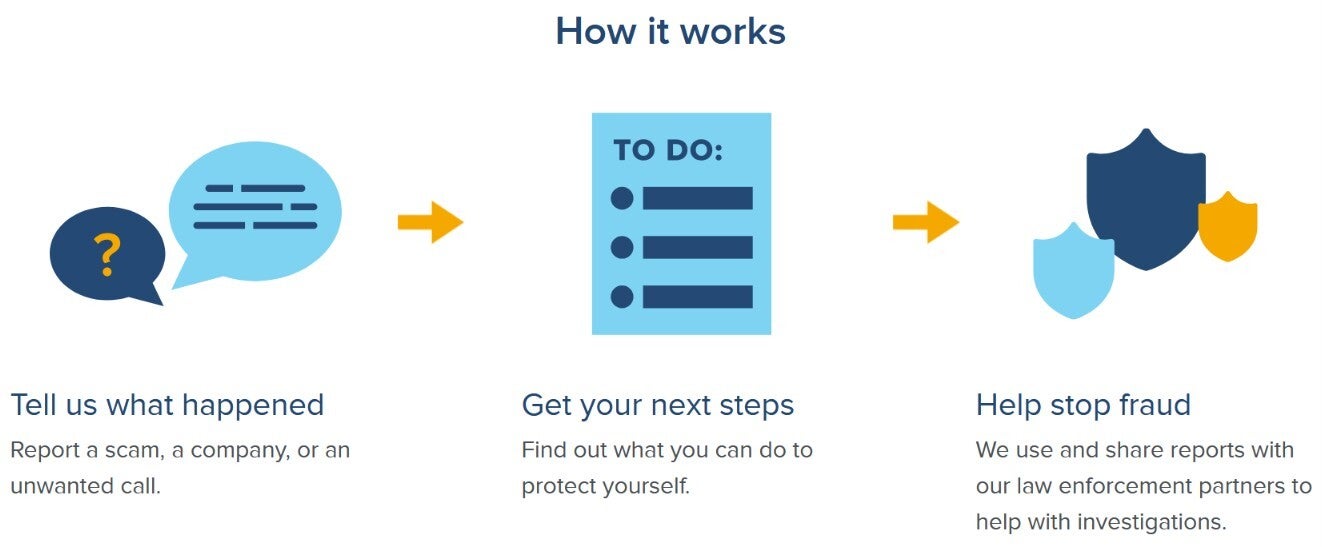
How to handle a FaceTime fraud. | Image by FTC
The same scam can be used by criminals pretending to be police, or FBI agents. When the scam escalates from text to FaceTime, the scammer will often display a fake badge or wear a uniform. A variation of the FaceTime scam can be used to start a "romance," which is all make-believe on the part of the scammer. FaceTime plays a huge role since the victim is apt to believe that he or she has a real romantic connection based on video and voice calls.
After a few weeks to months, the scammer might ask for some cash for car repairs, or for a doctor's visit for a sick relative, or for something else. The amount requested keeps climbing, and the victim may even be forced to take out a second mortgage or a loan.
There are some things you can do to protect yourself
Here are some tips that you should keep in mind:
- Never ever share your screen with an unsolicited caller.
- Do not give out your credentials, including passwords, during a FaceTime call.
- If someone pressures you to move money or take any action immediately, tries to display a sense of urgency, or claims your funds must be "protected," hang up the phone.
- Contact your bank, Apple, or the government agency by calling a phone number from its official website; never use a number provided by the scammer.
- Report suspicious FaceTime calls to Apple and all scams should be reported to the FTC at ReportFraud.FTC.gov.


Popular stories






Latest News






Things that are NOT allowed:
To help keep our community safe and free from spam, we apply temporary limits to newly created accounts: