Display battle: NOVA Display vs Super AMOLED vs Retina Display vs ClearBlack AMOLED
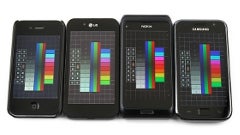
We here at PhoneArena are suckers for bright shiny screens, as we spend most of our waking hours staring at them, so naturally when we got a prototype unit of the LG Optimus Black with the newfangled NOVA Display technology, we ought to stage a fight with the current cream of the crop in the mobile display technologies.
First, a bit of tech specs background. From left to right we had the iPhone 4, with its 3.5" IPS-LCD with stunning 640x960 pixels of resolution. IPS stands for In-Plane-Switching, and is currently the best high-end value for money proposition for mobile displays, at least until Samsung's PLS (Plane-to-Line-Switching) screens flood the market.
IPS-LCD is characterized with elevated brightness (the iPhone 4 shines with more than 500 nits), better contrast, wider viewing angles, and way lower power consumption than the conventional LCD displays.
The iPhone 4's IPS-LCD display is made by LG, but the company is obviously not done improving the technology, as it saved the best for itself, and planted the brightest mobile display out there in the thin and light LG Optimus Black. The 4" IPS-LCD in the Optimus Black has 480x800 pixels, and the company claims it clocks in at 700 nits, which is an astonishing feat for a mobile display. LG calls it the NOVA Display, and claims the increased brightness is not affecting battery life, but rather the screen is actually more power-efficient than its IPS-LCD predecessors.
The screen on the LG Optimus Black is supposedly drawing 0 watts when showing black, like what the AMOLED displays do, and 0.7 watts when showing an entirely white page. The iPhone 4's Retina Display munches on 0.42 watts in both cases, but considering most websites and ebooks have white backgrounds, the battery consumption from the NOVA display should in reality be on par with the Retina Display, so no worries.
Interestinglyenough, the black areas of the test picture we used, looked as muchilluminated by an LCD backlight on the LG Optimus Black, as they didon the iPhone 4, so we don't know what to make of LG's claim that thepixels draw no power when displaying black – for that they have tobe completely turned off. Regardless, that's what a leaked comparison table showed, back when the Optimus Black was stillcodenamed the LG B.
Zero watt draw when showing black was a specialty reserved for AMOLED-based screens, like the third handset on the left we had, the Nokia E7. In their case, the pixel is completely off, that is why the screen is showing black as it's intended to be, not grayish like on the LCD technology, where the backlight is constantly on. Nokia E7's 4" display is called ClearBlack AMOLED, and has a polarizing filter sitting on top of it that blocks light, making it more visible in direct sunlight.
The final handset on the far right we had was the Samsung Galaxy S, which carries the so-called Super AMOLED technology, which is characterized with 20% more brightness, and the same amount less battery consumption than regular AMOLED, not to mention its whole package is thinner. The Super AMOLED on the Samsung Galaxy S also has a special anti-reflectance coating, that makes the phone's screen visible in direct sunlight as much as those on the IPS-LCD handsets, although it clocks in at "only" 300 nits of brightness.
All in all, it was the superior brightness of the IPS-LCD technology on the iPhone 4 and the LG Optimus Black versus the almost infinite contrast levels, wider viewing angles, saturated colors, and pitch black pixels of the AMOLED displays on the Nokia E7 and the Samsung Galaxy S.
As the pictures below clearly show, all the theoretical specs are confirmed when we place the phones side by side. The NOVA Display on the LG Optimus Black is arguably the brightest of the four, a tad brighter even than the iPhone 4's Retina Display, but with about the same performance as far as viewing angles go - the colors and brightness degraded when we passed a certain degree mark.
The ClearBlack AMOLED, and the Super AMOLED on the Nokia E7 and the Samsung Galaxy S clearly had no problem with wide viewing angles, keeping the colors punchy, and the brightness almost unchanged from 10 to 170 degrees. Bear in mind that the Nokia E7 was always on automatic display adjustment, which couldn't be turned off, so in the dark its display toned down the brightness quite a bit - it is actually as bright as the Super AMOLED, but this was only visible outside.
The outdoor pictures came to show how the anti-reflectance coating is at least as important, if not more, for better sunlight visibility than the high brightness. That is why the Samsung Galaxy S, with its superior anti-reflectance coating, and the Nokia E7, with its polarizing filter that blocks light, didn't fare much worse outside, compared to the way brighter iPhone 4 and LG Optimus Black.
As we mentioned, the Optimus Black we had was a non-final unit, and probably didn't have all the coatings like anti-reflectance and oleophobic applied yet, considering how easy it was to smudge the screen, so in its retail version the reflectance might be even lower, and then it might easily grab the outdoor visibility crown. Even in its non-final form, when looked at directly, the NOVA display appears brighter than the other technologies, although in reality it won't scorch your eyebrows with some groundbreaking difference.
For an in-depth comparison of the current mobile display technologies in terms of brightness, contrast, color saturation, viewing angles and resolution, you can read our comprehensive article here.
Which screen technology is most to your liking? Tell us in the comments below!
First, a bit of tech specs background. From left to right we had the iPhone 4, with its 3.5" IPS-LCD with stunning 640x960 pixels of resolution. IPS stands for In-Plane-Switching, and is currently the best high-end value for money proposition for mobile displays, at least until Samsung's PLS (Plane-to-Line-Switching) screens flood the market.
The iPhone 4's IPS-LCD display is made by LG, but the company is obviously not done improving the technology, as it saved the best for itself, and planted the brightest mobile display out there in the thin and light LG Optimus Black. The 4" IPS-LCD in the Optimus Black has 480x800 pixels, and the company claims it clocks in at 700 nits, which is an astonishing feat for a mobile display. LG calls it the NOVA Display, and claims the increased brightness is not affecting battery life, but rather the screen is actually more power-efficient than its IPS-LCD predecessors.
Interestinglyenough, the black areas of the test picture we used, looked as muchilluminated by an LCD backlight on the LG Optimus Black, as they didon the iPhone 4, so we don't know what to make of LG's claim that thepixels draw no power when displaying black – for that they have tobe completely turned off. Regardless, that's what a leaked comparison table showed, back when the Optimus Black was stillcodenamed the LG B.
Left to right - Apple iPhone 4, LG Optimus Black, Nokia E7, Samsung Galaxy S
Zero watt draw when showing black was a specialty reserved for AMOLED-based screens, like the third handset on the left we had, the Nokia E7. In their case, the pixel is completely off, that is why the screen is showing black as it's intended to be, not grayish like on the LCD technology, where the backlight is constantly on. Nokia E7's 4" display is called ClearBlack AMOLED, and has a polarizing filter sitting on top of it that blocks light, making it more visible in direct sunlight.
The final handset on the far right we had was the Samsung Galaxy S, which carries the so-called Super AMOLED technology, which is characterized with 20% more brightness, and the same amount less battery consumption than regular AMOLED, not to mention its whole package is thinner. The Super AMOLED on the Samsung Galaxy S also has a special anti-reflectance coating, that makes the phone's screen visible in direct sunlight as much as those on the IPS-LCD handsets, although it clocks in at "only" 300 nits of brightness.
As the pictures below clearly show, all the theoretical specs are confirmed when we place the phones side by side. The NOVA Display on the LG Optimus Black is arguably the brightest of the four, a tad brighter even than the iPhone 4's Retina Display, but with about the same performance as far as viewing angles go - the colors and brightness degraded when we passed a certain degree mark.
The ClearBlack AMOLED, and the Super AMOLED on the Nokia E7 and the Samsung Galaxy S clearly had no problem with wide viewing angles, keeping the colors punchy, and the brightness almost unchanged from 10 to 170 degrees. Bear in mind that the Nokia E7 was always on automatic display adjustment, which couldn't be turned off, so in the dark its display toned down the brightness quite a bit - it is actually as bright as the Super AMOLED, but this was only visible outside.
Left to right - Apple iPhone 4, LG Optimus Black, Nokia E7, Samsung Galaxy S
The outdoor pictures came to show how the anti-reflectance coating is at least as important, if not more, for better sunlight visibility than the high brightness. That is why the Samsung Galaxy S, with its superior anti-reflectance coating, and the Nokia E7, with its polarizing filter that blocks light, didn't fare much worse outside, compared to the way brighter iPhone 4 and LG Optimus Black.
Left to right - Apple iPhone 4, LG Optimus Black, Nokia E7, Samsung Galaxy S
As we mentioned, the Optimus Black we had was a non-final unit, and probably didn't have all the coatings like anti-reflectance and oleophobic applied yet, considering how easy it was to smudge the screen, so in its retail version the reflectance might be even lower, and then it might easily grab the outdoor visibility crown. Even in its non-final form, when looked at directly, the NOVA display appears brighter than the other technologies, although in reality it won't scorch your eyebrows with some groundbreaking difference.
Which screen technology is most to your liking? Tell us in the comments below!


Popular stories
Latest News
Things that are NOT allowed:
To help keep our community safe and free from spam, we apply temporary limits to newly created accounts: