Verizon is ready to pop the champagne, as its $20 billion Frontier deal is finally being approved by California's Public Utilities Commission.
The whole thing was a saga: Verizon faced multiple obstacles in the last year both from federal and local regulators.
The unanimous vote
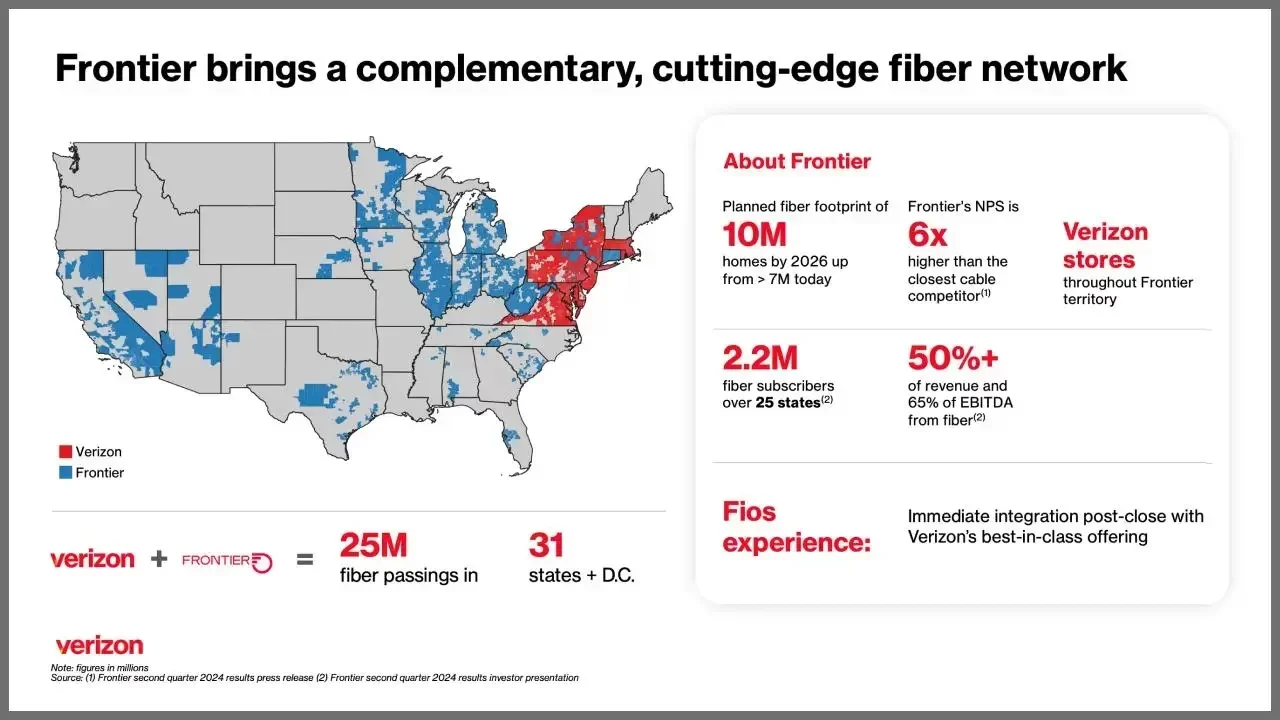
Verizon and Frontier's fiber networks. | Image by Verizon
The deal is expected to give Verizon access to new customers in areas that fit well with its existing fiber markets. After it's finalized, customers should get more home internet and mobile options, plus savings and deals they can't get elsewhere.
As Fierce Network reports, CPUC (the California Public Utilities Commission) cast a unanimous vote on January 15, allowing the Frontier acquisition to happen.
After this, Verizon said it's expected for the transaction to be closed on January 20.
The path to closing the Frontier acquisition marks a significant milestone in Verizon's evolution and is a bold step forward in Verizon's transformation to regain market leadership. Upon closing, we will be uniquely positioned to offer our customers the best combined mobility and fiber experience for mobile, home internet, and other essential services across a significantly expanded footprint. Verizon is wholly focused on serving and delighting our customers and earning their trust and loyalty.
– Verizon CEO Dan Schulman, January 15, 2026
Recommended For You
Verizon, a fiber pioneer since 2005, plans to use this acquisition to speed up its nationwide fiber expansion and will share more details during its Q4 2025 earnings call on January 30, 2026.
What analysts say
New Street Policy Analyst Blair Levin noted that California's approval was expected any day, following a filing by an Administrative Law Judge (ALJ) the previous evening.
The approval came after Verizon agreed to key conditions around diversity, equity, and inclusion. This includes setting up a recruiting pipeline for underrepresented groups and holding regular meetings with state officials and addressing earlier concerns about conflicts with California's diversity laws.
As you've may heard, Trump's administration previously insisted that Verizon should tone down its DEI activities. Then, CPUC pressured Verizonnot to abandon DEI if it wants the deal to go through.
Deployment requirements were another major focus. Verizon explained that delivering broadband speeds of 100/20 Mbps or higher to all 88 Frontier wire centers would be costly and challenging, particularly in remote, mountainous regions.
The company successfully gained exemptions for locations already served by other providers or where no customer had requested service.
However, CPUC Commissioner John Reynolds stressed that deployment obligations remain enforceable, while noting Verizon could seek state grants to offset costs in difficult areas. He also highlighted that without these investments, rural and low-income communities risk degraded service as older copper infrastructure ages.
In addition to DEI and deployment commitments, Verizon pledged $500 million in investments for California small businesses and $20-per-month broadband for low-income consumers, ensuring the deal brings tangible community benefits.
What do you think will be the biggest impact of Verizon’s Frontier acquisition?
14 Votes
Faster and more reliable fiber internet.
50%
More affordable broadband for low-income households.
28.57%
Stronger focus on DEI.
21.43%
Six-month unlimited plan is now 57% off
$90
$210
$120 off (57%)
Mint Mobile is now allowing you to get whichever plan you like for either three, six, or 12 months for just $15/mo. If you go for the six-month unlimited service, for instance, you'll now have to pay just $90 upfront instead of $210.
Sebastian is one of PhoneArena’s senior opinionators. A veteran news writer with almost 20 years of experience in media and technology, he not only covers all the hot news about Galaxies and iPhones, but often provides hot takes on industry trends. He’s fascinated with camera-focused flagships from the likes of Oppo and Vivo, as well as foldable phones.
A discussion is a place, where people can voice their opinion, no matter if it
is positive, neutral or negative. However, when posting, one must stay true to the topic, and not just share some
random thoughts, which are not directly related to the matter.
Things that are NOT allowed:
Off-topic talk - you must stick to the subject of discussion
Offensive, hate speech - if you want to say something, say it politely
Spam/Advertisements - these posts are deleted
Multiple accounts - one person can have only one account
Impersonations and offensive nicknames - these accounts get banned
To help keep our community safe and free from spam, we apply temporary limits to newly created accounts:
New accounts created within the last 24 hours may experience restrictions on how frequently they can
post or comment.
These limits are in place as a precaution and will automatically lift.
Moderation is done by humans. We try to be as objective as possible and moderate with zero bias. If you think a
post should be moderated - please, report it.
Have a question about the rules or why you have been moderated/limited/banned? Please,
contact us.













Things that are NOT allowed:
To help keep our community safe and free from spam, we apply temporary limits to newly created accounts: