US is worried that China got its hands on advanced chipmaking tool
The lone company that makes EUV Lithography machines, ASML, denies ever shipping one to China.
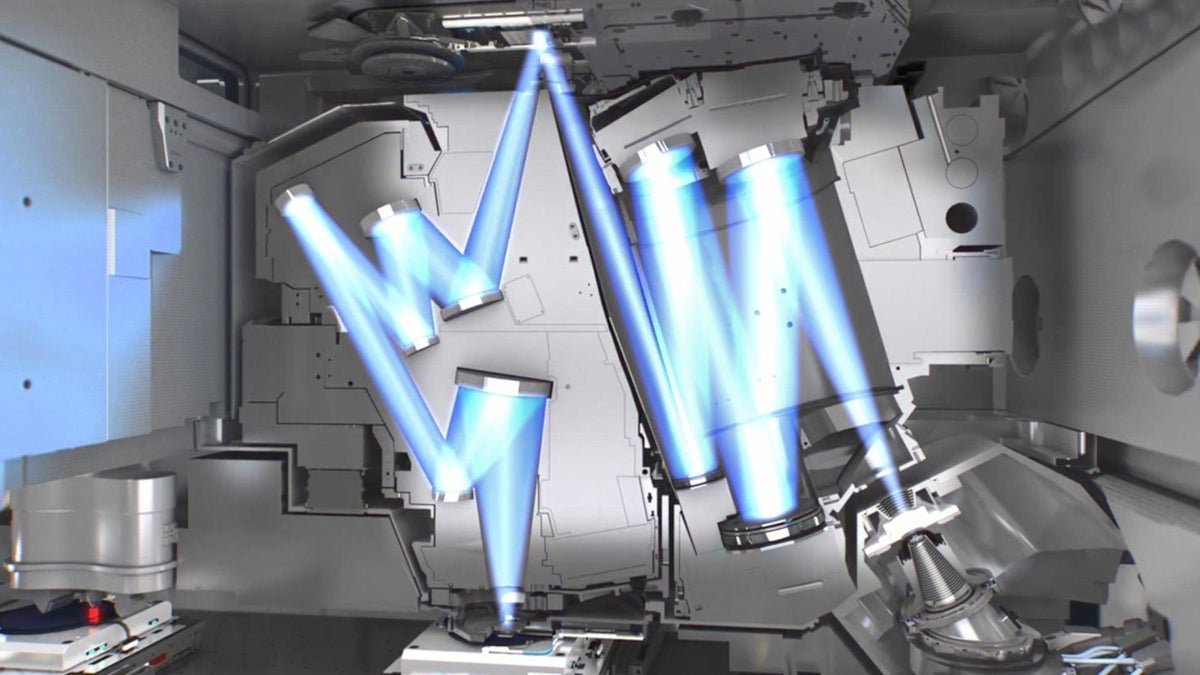
ASML denies shipping EUV Lithography machine to China. | Image by ZEISS
If you've been reading PhoneArena for a few years, you probably know that US sanctions prevent Huawei from sourcing cutting-edge chips. You also might know that the largest foundry in China, SMIC, cannot produce Integrated Circuits (IC) using a process node under 7nm. That's because the advanced lithography machines needed to manufacture such chips, produced by just one company in the whole world, are banned from being shipped to China.
Thanks to Huawei's Tau Scaling Law, shrinking transistor size might not remain the number one priority
Last month, Huawei announced its Tau Scaling Law, which replaces Moore's Law as a principle behind the production of more powerful chips. While the latter focuses on continually shrinking transistor and die size to increase transistor density, the Tau Scaling Law says that by shortening the distance signals have to travel on a chip, more powerful ICs can be built.
Using the LogicFolding architecture, which employs vertical stacking to shorten signal paths, powerful chips can be made by optimizing the speed that data travels instead of raising the transistor density of a chip by reducing transistor size. LogicFolding doesn't require the use of an Extreme Ultraviolet (EUV) Lithography machine because it can achieve higher transistor density via the 3D stacking.
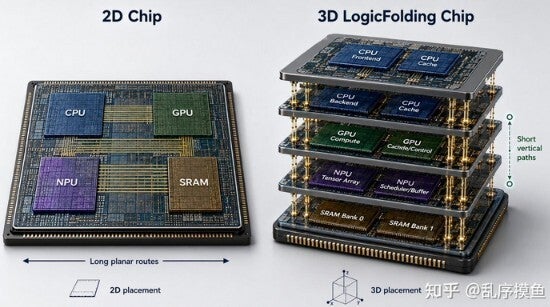
How LogicFolding works without an EUV machine. | Image by Kangxi Emperor
Using Tau Scaling Law and LogicFolding, Huawei hopes to make chips with a transistor density equivalent to a 1.4nm chip by 2031. Huawei will still be behind by then since TSMC is planning to start mass production of 1.4nm chips by the second half of 2028.
Using its LogicFolding architecture, Huawei hopes to power the Mate 90 line with a Kirin chip equivalent to 3nm
Last month, Huawei announced that its upcoming flagship Mate 90 series will be powered by a new Kirin chip that will be equivalent to an application processor produced using a 3nm process node. The company says that it will produce the new unnamed chipset using its LogicFolding architecture.
Recently, the US has expressed concerns that China has been able to get its hands on an EUV machine. Only one company in the world, Dutch firm ASML, makes and sells it. It is used to transfer extremely thin circuitry patterns to the silicon wafers that chips are made on.
Remember, as many as 30 billion transistors are expected inside Apple's first 2nm application processor (AP), the A20 Pro, which will power the iPhone 18 Pro and 18 Pro Max. The transistor density is expected to hit 310-330 million per square mm.
ASML denies shipping an EUV machine to China
ASML has issued a statement denying that it shipped an EUV machine to China. Commerce Secretary Howard Lutnick met with ASML officials to discuss the concerns of the US. ASML has said that it has "consistently adjusted its business to any development in export controls to comply to any new rules".
To be sure, an EUV machine, even when shipped in pieces for assembly at a foundry, is not something that can be slipped into a pocket and carried into a country. Each machine is about the size of a school bus and weighs 180 tons. Each standard machine can cost $180 million to $250 million, while the newest generation High-NA EUV machine can cost as much as $400 million.
China can still purchase dry DUV lithography machines
Last December, Reuters reported that Chinese scientists developed a prototype EUV machine, built by a team of former ASML engineers. Meanwhile, the Commerce Department and the White House were not available to make an immediate comment. ASML told Reuters, "ASML has never shipped an EUV machine to China nor have we shipped to China any component, module or equipment specially designed to be used in an EUV machine."
ASML is still allowed to ship its less-advanced Deep Ultraviolet (DUV) dry systems to China. This does not include more advanced Immersion DUV models that use water placed in front of the final lens and the silicon wafer. Those machines are still not allowed to be shipped to China because of water's higher refractive index (1.44) compared to air (1.0).
When the DUV light passes through water, it shortens the light's wavelength, allowing smaller, more precise circuit features to be printed on a silicon wafer. That in turn allows for the production of more advanced chips.


Popular stories


Latest News




Things that are NOT allowed:
To help keep our community safe and free from spam, we apply temporary limits to newly created accounts: