T-Mobile CEO Gopalan says SpaceX/Starlink is not a real threat to T-Mobile
Srini Gopalan says that the threat to mobile operators from satellite companies is exaggerated.
Gopalan says SpaceX threat is overexaggerated | Image by T-Mobile
Bob Dylan once sang that "you don't need a weatherman to know which way the wind blows." For the "Big 3" wireless carriers in the US, you know the guys we mean, the wind blowing in their faces recently was pretty harsh. Rumors suggested that SpaceX, the satellite communications and space transportation firm, was looking to encroach on the territory where Verizon, AT&T, and T-Mobile hang out.
SpaceX President Shotwell expects to steal customers from Verizon, AT&T, and T-Mobile
Ever since company founder Elon Musk and SpaceX President Gwynne Shotwell spoke during the company's Q2 earnings conference call, talk of SpaceX's future mobile plans have heated up. Shotwell fired a shot across the bow of the Big 3 when she said, "I anticipate us to be able to acquire quite a few of their customers, because I think our service will be better."
SpaceX discussed placing femtocells, the low powered compact cellular base station that is used to boost indoor mobile signals, on existing Starlink dishes to reduce the costs of building cell towers and acquiring spectrum. While fears about SpaceX have negatively impacted the shares of T-Mobile, Verizon, and AT&T, investors are overexaggerating the threat from SpaceX. That comment comes from someone who might be predisposed to play down the challenge from SpaceX, and that is T-Mobile's relatively new CEO, Srini Gopalan.
Gopalan begins his tenure as T-Mobile CEO with a rocky start
Gopalan, whose tenure as the carrier's top executive has begun under rocky and controversial conditions, replaced Mike Sievert on November 1 of last year. Almost immediately he got caught up in T-Mobile's shift to a digital-first carrier, forcing all reps and customers to use the T-Life app to handle almost all transactions inside the carrier's stores or even those placed by customers from their homes.
The CEO believes that satellite technology will be "complementary" to traditional wireless networks. "The threat posed to mobile operators from satellite companies such as Starlink has been exaggerated and I struggle to see which consumer problems they would solve by entering the market," Gopalan said.
How will Musk scratch his mobile itch?
Perhaps the easiest way for Elon Musk to achieve his mobile ambitions would be for SpaceX to make an unsolicited tender offer to buy T-Mobile, Verizon, or AT&T. A deal to buy T-Mobile would be difficult since Deutsche Telekom owns 53.7% of the US carrier; any deal for T-Mobile would have to go through Deutsche Telekom and the latter has its own dream about acquiring T-Mobile.
A deal that combines Deutsche Telekom and T-Mobile would be the largest tech deal in history and would also create the world's most valuable telecom company replacing China Mobile. Should SpaceX take a look at buying Verizon or AT&T, it would have to deal with the pairs' net debt of $120 billion each.
T-Mobile has about a similar amount of debt, but analysts say that the amount of debt is less of an issue for a purchase of T-Mobile by Space. That's because both AT&T and Verizon own legacy copper networks that are decaying and require constant maintenance.
The FCC and DOJ, as always, stand ready to muck up a deal
Regardless of which carrier SpaceX goes after, if any, regulatory approval will be needed from the Federal Communications Commission (FCC) and the Department of Justice (DOJ). This will be quite an accomplishment for SpaceX to attempt if it decides to go the acquisition route. Some might say that Elon Musk has some experience closing on a difficult deal after completing his $44 billion acquisition of Twitter.
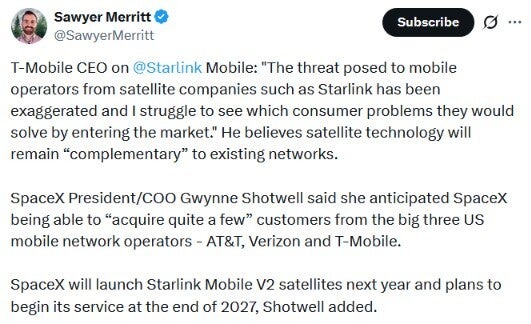
Tweet contains quotes from T-Mobile CEO and SpaceX president. | Image by X
As trying as that deal must have been at times, it will probably seem like a walk in the park. Based on current market cap and tossing in a 30% premium, it would cost SpaceX the following to purchase each Big 3 carrier:
- T-Mobile: $230 billion-$250 billion.
- Verizon: $240-$250 billion.
- AT&T: $200 billion-$215 billion.
SpaceX is planning to launch its Starlink Mobile V2 satellites next year and plans to start its service at the end of 2027.
Want to read more about SpaceX? Check out these stories:


Popular stories


Latest News

Things that are NOT allowed:
To help keep our community safe and free from spam, we apply temporary limits to newly created accounts: