SpaceX rival just put itself back on the map
AST SpaceMobile inches closer to providing space-based cellular broadband.
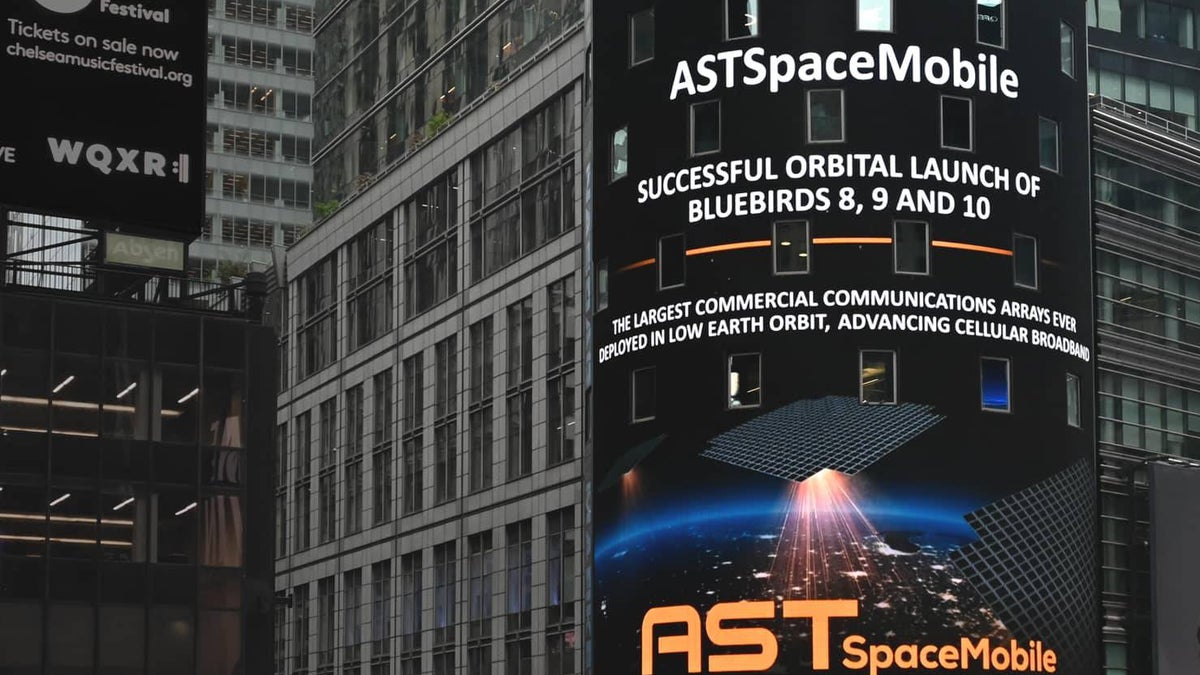
AT&T and Verizon users will still have to wait a little longer. | Image by AST SpaceMobile
SpaceX's Starlink may be accused of operating a monopoly, but the truth is rivals barely exist. While other companies are trying to get skin in the game, none has yet launched a commercial service. One competitor, AST SpaceMobile, is hurtling closer to that goal.
After a failed mission in April when the BlueBird 7 was placed into the wrong orbit by Blue Origin's New Glenn rocket, AST SpaceMobile bounced back. The company deployed three next-gen satellites — BlueBirds 8, 9, and 10 — into low Earth orbit recently.
The company's satellites are the largest commercial communications arrays ever put into orbit. It is building a constellation to provide space-based cellular broadband to unmodified smartphones.
The satellites feature arrays of roughly 2,400 square feet. The large antenna arrays translate to more targeted coverage, less interference, and greater capacity.
The next-gen BlueBird satellites can deliver double the peak data speeds of the Block 1 BlueBird satellites, which recently achieved peak download speeds of 98.9 Mbps directly to smartphones.
We are looking at peak data speeds of around 200 Mbps, enabling far richer experiences than what's possible with Starlink's narrowband service.
This was AST's first successful deployment of 2026. The company started the year with seven satellites in orbit and hopes to finish with 45.
The April stumble forced AST to dial back its satellite target from 60 to 45, pushing the launch of direct-to-device (D2D) services into next year. To get there, the company expects to maintain a launch pace of every one to two months.
Tim Farrar, satellite analyst and president at TMF Associates, doesn't expect commercial D2D from the company until the second half of 2027, more than two years after the launch of Starlink D2D beta through a partnership with T-Mobile.
That means AT&T and Verizon users will be waiting longer than the promised 2026 rollout.
While AST SpaceMobile doesn't have quite the same ambitions as Starlink, its entry into the D2D space might break the stranglehold that SpaceX has on the cellular industry right now.
SpaceX's satellites may not be as physically massive as AST's, but the company already has 650 V1 mobile satellites in orbit, supporting 7.4 million devices monthly across 30 countries. The company plans to deploy next-gen V2 satellites in 2027, which will also support broadband data and IoT connectivity on top of texting and light data.
The bigger question, of course, is whether customers actually care. T-Mobile's T-Satellite accounted for only 0.0002% of total network traffic in May, making it clear that most customers don't find themselves needing the service that often.
Successful launch
After a failed mission in April when the BlueBird 7 was placed into the wrong orbit by Blue Origin's New Glenn rocket, AST SpaceMobile bounced back. The company deployed three next-gen satellites — BlueBirds 8, 9, and 10 — into low Earth orbit recently.
BlueBirds 8, 9, and 10 represent the continued execution of a vision once considered impossible: space-based cellular broadband to everyone, everywhere.
Abel Avellan, Founder, Chairman, and CEO of AST SpaceMobile, June 2026
Coming for SpaceX
The satellites feature arrays of roughly 2,400 square feet. The large antenna arrays translate to more targeted coverage, less interference, and greater capacity.
We are looking at peak data speeds of around 200 Mbps, enabling far richer experiences than what's possible with Starlink's narrowband service.
What do you think of AST SpaceMobile?
35 Votes
AT&T and Verizon's only real hope.
74.29%
Tall promises.
11.43%
Out of touch with reality.
14.29%
First of many launches
This was AST's first successful deployment of 2026. The company started the year with seven satellites in orbit and hopes to finish with 45.
The April stumble forced AST to dial back its satellite target from 60 to 45, pushing the launch of direct-to-device (D2D) services into next year. To get there, the company expects to maintain a launch pace of every one to two months.
That means AT&T and Verizon users will be waiting longer than the promised 2026 rollout.
A player is a player
While AST SpaceMobile doesn't have quite the same ambitions as Starlink, its entry into the D2D space might break the stranglehold that SpaceX has on the cellular industry right now.
SpaceX's satellites may not be as physically massive as AST's, but the company already has 650 V1 mobile satellites in orbit, supporting 7.4 million devices monthly across 30 countries. The company plans to deploy next-gen V2 satellites in 2027, which will also support broadband data and IoT connectivity on top of texting and light data.


Popular stories




Latest News



Things that are NOT allowed:
To help keep our community safe and free from spam, we apply temporary limits to newly created accounts: