Wired internet has long ceased to be the sole way to get internet in the US, but it remains a superior option. While AT&T, Verizon, and cable giants all made inroads in the second half of 2025, satellite stalled out and failed to make any meaningful speed progress compared to H1, and T-Mobile got complacent.
Increasing competition
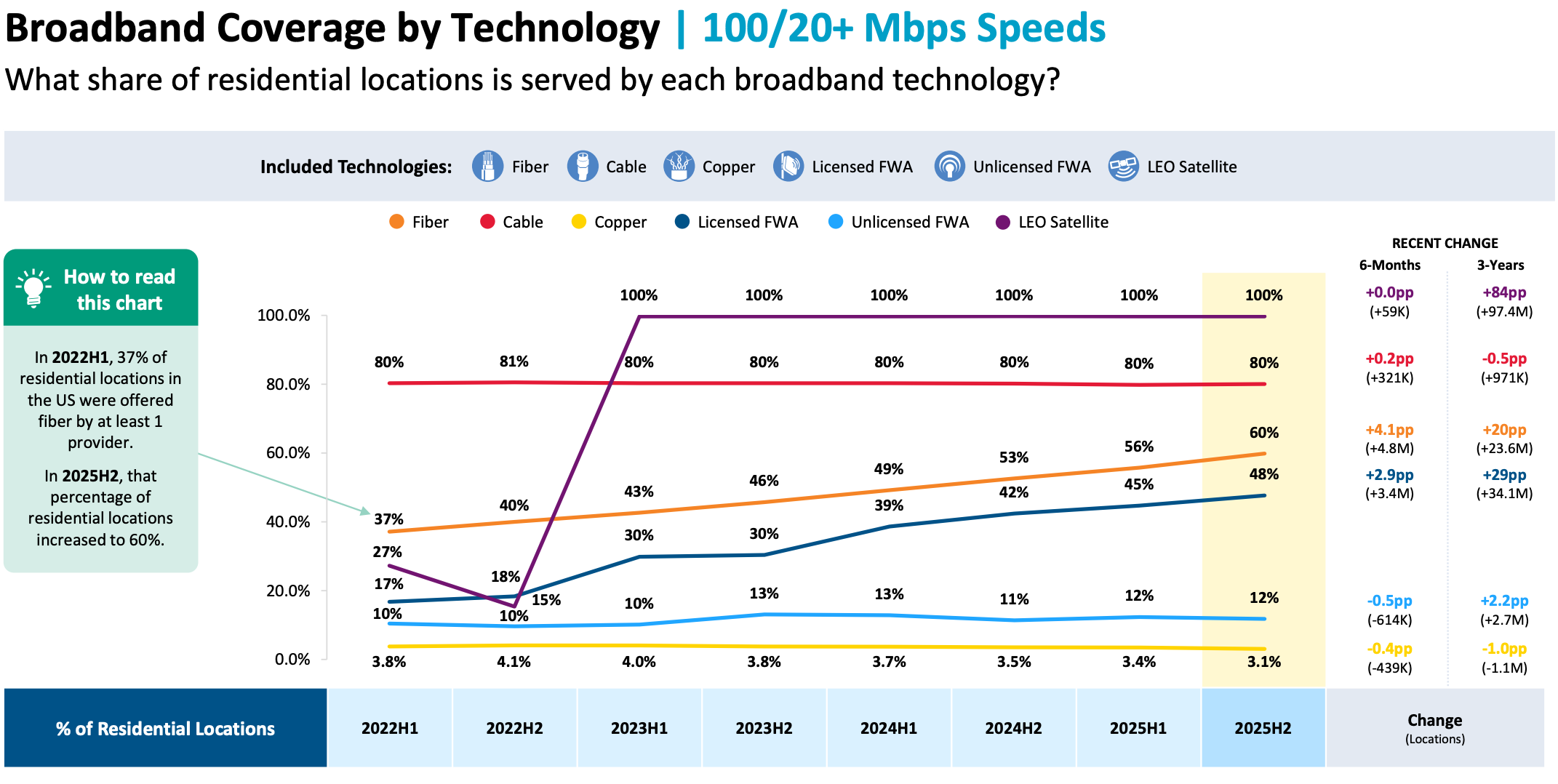
Choices are multiplying. | Image by Cartesian
A new report from consulting firm Cartesian (via Mike Dano) provides a bird's-eye view of the broadband landscape. Per the analysis, more than 50% of US households can now choose between two or more fiber or cable companies.
Availability of symmetrical 1 Gbps download and upload speeds expanded faster in late 2025 than it did in the previous three years combined, highlighting a shift toward faster internet.
On the flip side, Fixed Wireless Access (FWA) or 5G internet footprint mostly expanded in the slower 25/3 to 100/20 Mbps tiers. Still, 38% of residential locations across the US can now access at least two FWA providers.
The broadband gap continues narrowing, with the share of underserved locations declining in 48 states and Washington, D.C.
Most companies grew through deals and mergers, with Comcast being the only Internet Service Provider (ISP) not having recently completed an acquisition.
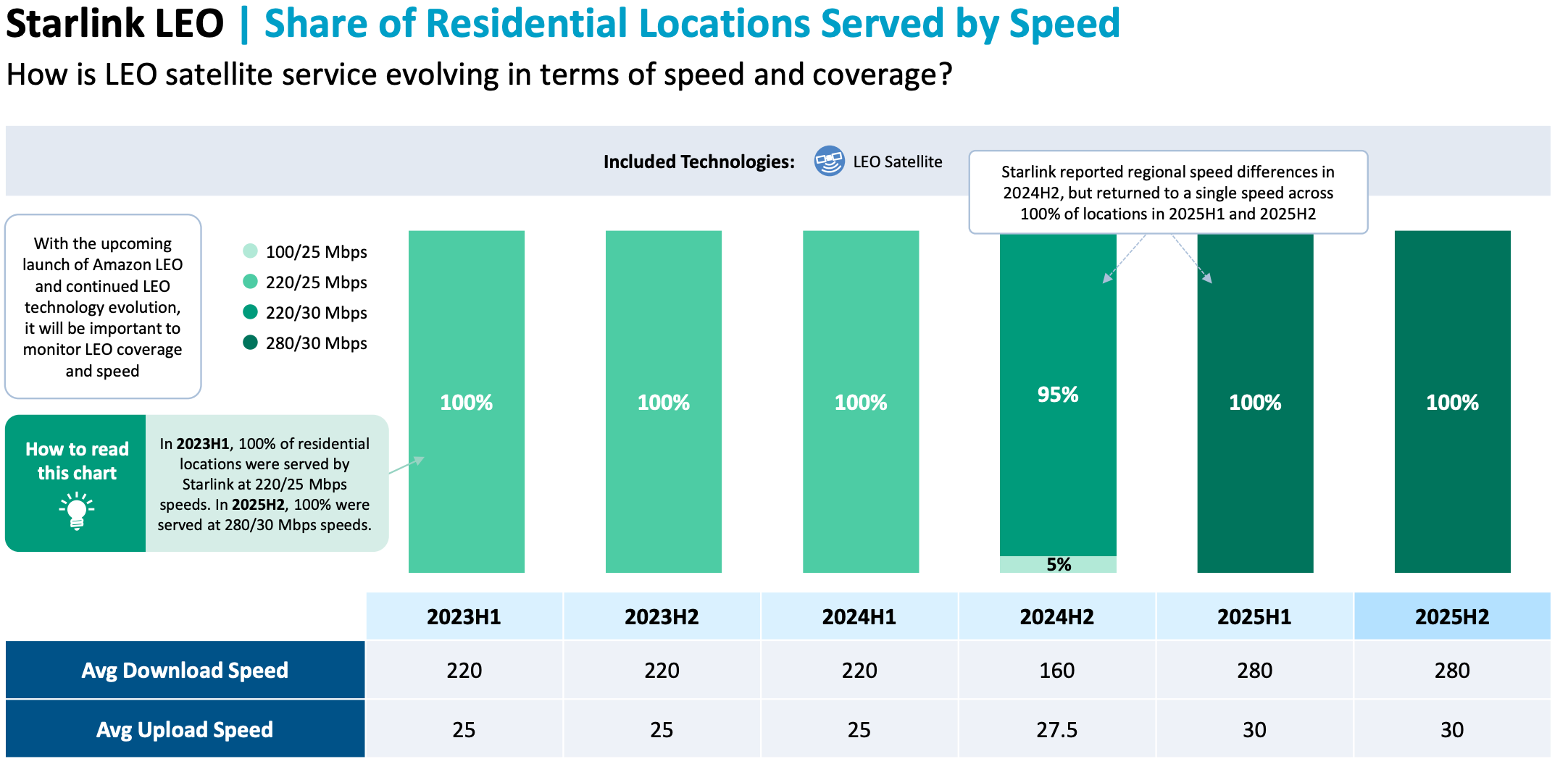
SpaceX's Starlink was the only option blanketing the whole country, though its speeds held flat at 280/30 Mbps. Cable followed in second place, reaching 80% of households.
Taking into account all wired technologies, Charter boasts the largest footprint with 43.2 million locations passed, followed by Comcast at 38.7 million, and AT&T at 37.4 million. Verizon sits at a distant fourth with 15.9 million locations, while T-Mobile trails far behind at eighth place at just 4.4 million.
Fiber buildout
AT&T remained the top fiber builder, with Charter hot on its heels. Construction activity across the board was impressive. Nearly all of the top 25 fiber builders accelerated their pace in H2 2025 relative to their three-year average. Cable companies snapped up six of those spots.
Recommended For You
Most new fiber deployments happened in areas that previously didn't have access to the technology. T-Mobile's expansion in the category occurred via acquisitions.
What's your take on the current broadband landscape?
120 Votes
Looking healthy.
33.33%
SpaceX has too much power.
27.5%
Deals are reducing the number of players.
39.17%
The FWA shakeup
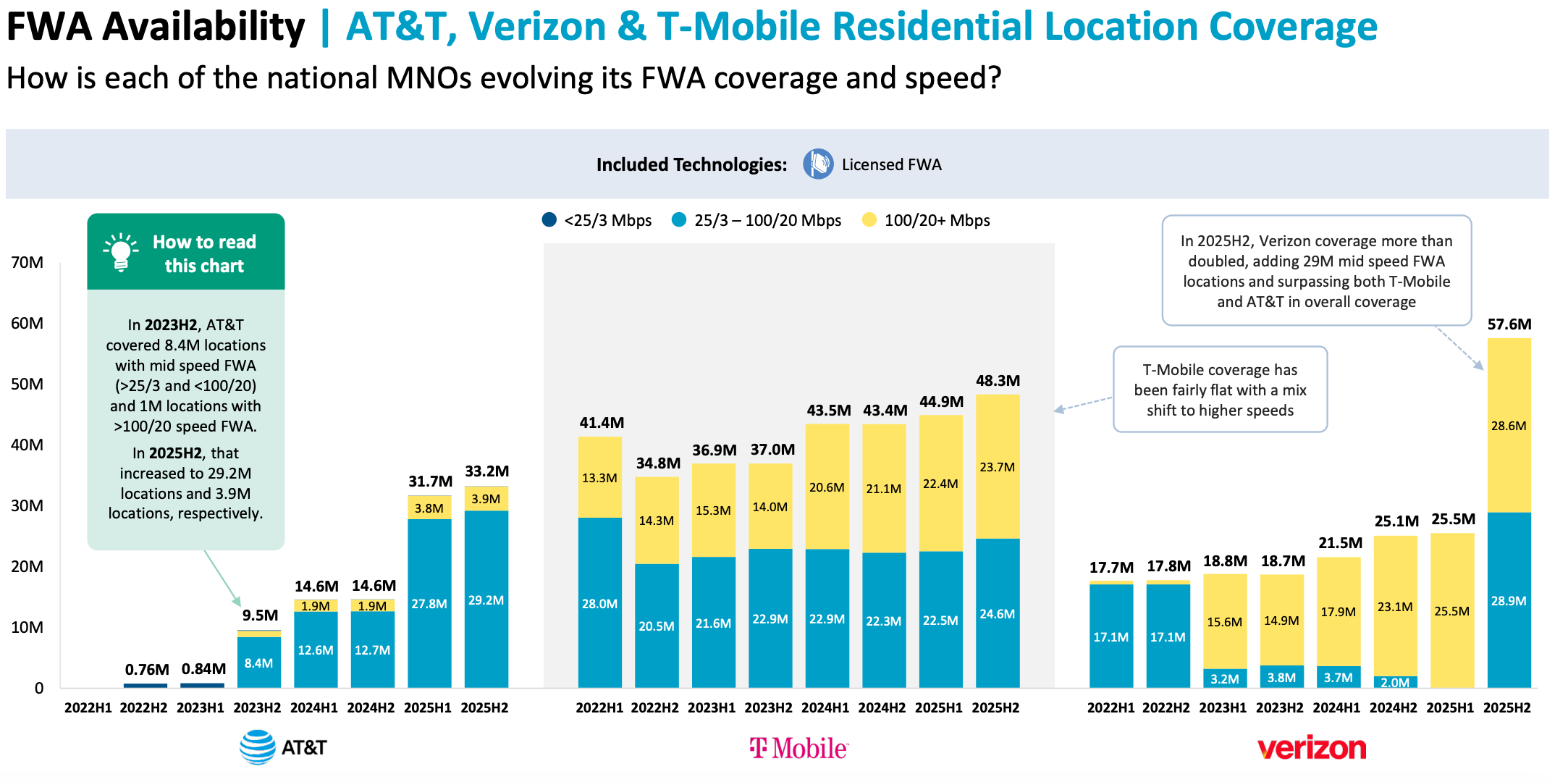
FWA has a new coverage leader. | Image by Cartesian
Verizon dominated FWA growth, doubling its coverage in H2 to surpass both AT&T and T-Mobile. Most of that growth was concentrated in mid-speed locations.
T-Mobile's coverage remained nearly flat, even if customers are seeing faster speeds. Why the company froze its rollout and lost its coverage crown remains unclear, but the growing obsession with fiber might explain the sudden slowdown.
T-Mobile doesn't have a strong showing
Starlink is the only satellite player. | Image by Cartesian
Starlink has an accidental monopoly, and it will be interesting to see how the entry of new players like Amazon LEO impacts that.
The share of unserved and underserved locations declined to 5.4%. Only a few states, particularly highly rural locations, have fewer than 4% of areas lacking adequate internet access. Consequently, only 9% of locations are now candidates for public investment, strengthening Starlink's argument of taking care of the problem.
Six-month unlimited plan is now 57% off
$90
$210
$120 off (57%)
Mint Mobile is now allowing you to get whichever plan you like for either three, six, or 12 months for just $15/mo. If you go for the six-month unlimited service, for instance, you'll now have to pay just $90 upfront instead of $210.
Anam Hamid is a computer scientist turned tech journalist who has a keen interest in the tech world, with a particular focus on smartphones and tablets. She has previously written for Android Headlines and has also been a ghostwriter for several tech and car publications. Anam is not a tech hoarder and believes in using her gadgets for as long as possible. She is concerned about smartphone addiction and its impact on future generations, but she also appreciates the convenience that phones have brought into our lives. Anam is excited about technological advancements like folding screens and under-display sensors, and she often wonders about the future of technology. She values the overall experience of a device more than its individual specs and admires companies that deliver durable, high-quality products. In her free time, Anam enjoys reading, scrolling through Reddit and Instagram, and occasionally refreshing her programming skills through tutorials.
A discussion is a place, where people can voice their opinion, no matter if it
is positive, neutral or negative. However, when posting, one must stay true to the topic, and not just share some
random thoughts, which are not directly related to the matter.
Things that are NOT allowed:
Off-topic talk - you must stick to the subject of discussion
Offensive, hate speech - if you want to say something, say it politely
Spam/Advertisements - these posts are deleted
Multiple accounts - one person can have only one account
Impersonations and offensive nicknames - these accounts get banned
To help keep our community safe and free from spam, we apply temporary limits to newly created accounts:
New accounts created within the last 24 hours may experience restrictions on how frequently they can
post or comment.
These limits are in place as a precaution and will automatically lift.
Moderation is done by humans. We try to be as objective as possible and moderate with zero bias. If you think a
post should be moderated - please, report it.
Have a question about the rules or why you have been moderated/limited/banned? Please,
contact us.







Things that are NOT allowed:
To help keep our community safe and free from spam, we apply temporary limits to newly created accounts: