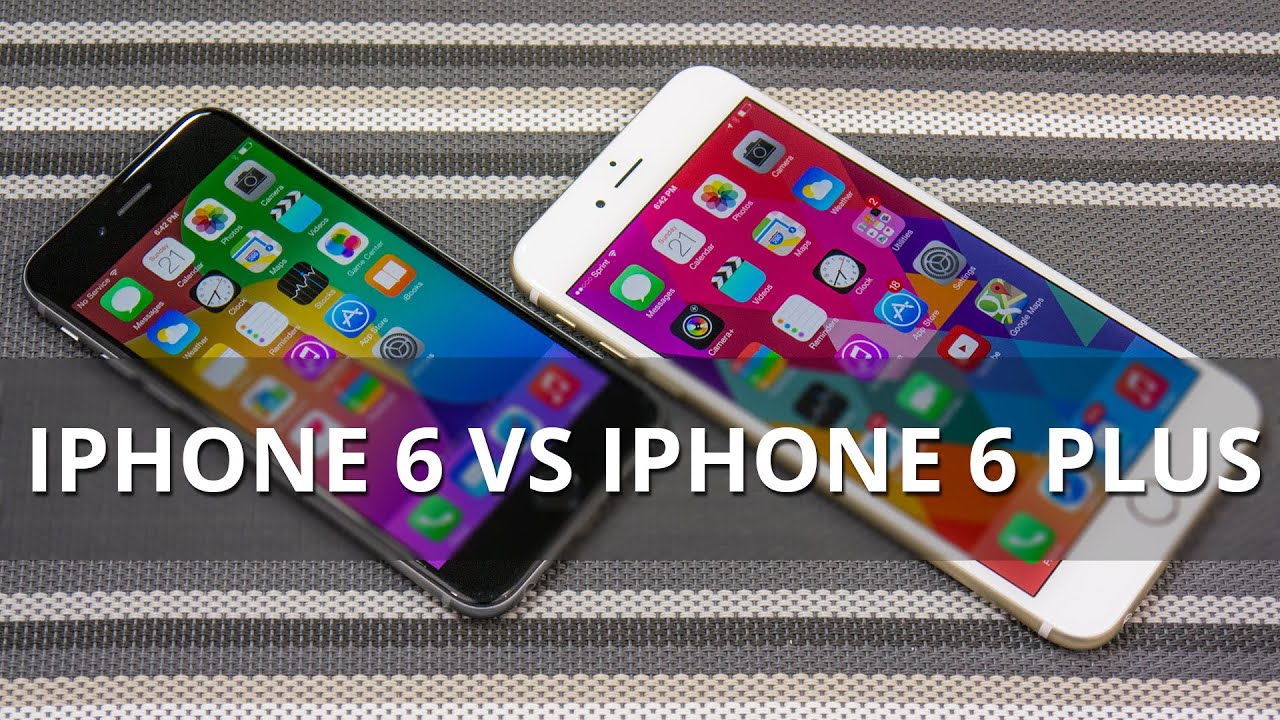
In a move that aims to make Apple competitive on the phablet market, the company has recently introduced a new iPhone with a very, very large screen – the iPhone 6 Plus. Just a year ago, no one would have believed that such a gargantuan phone may come out of Apple, but here it is in the flesh, sporting a massive 5.5” screen and the same beautiful metal body that's exhibited by its mainstream sibling – the iPhone 6. Speaking of the latter, we'd wager that most users who'll be getting Apple's new smartphone will be going for the 6. However, the 6 Plus being an entirely new thing for Apple, there's bound to be some serious interest in it as well.
In that case, how do people decide which one to get? Well, that's what this comparison is for – let's try to find the things that set these new iPhones apart and see how people should go about determining which one to buy.
Design
Equally beautiful, not so equally portable
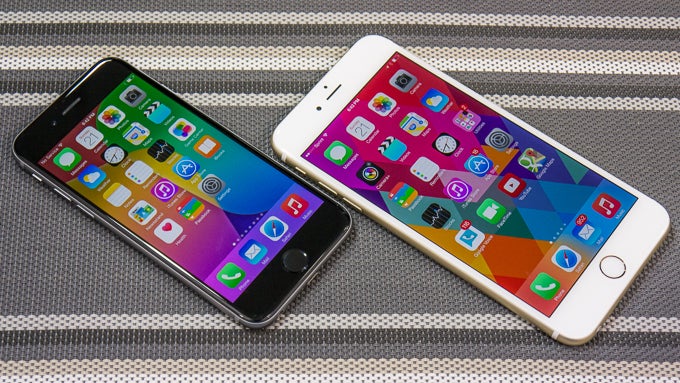
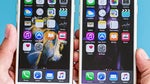
It won't be a wrong statement to say that both the iPhone 6 and iPhone 6 Plus have the same exact design language. Both handsets look extremely cool in their metal bodies, with the only difference being the 6 Plus' dimensions being (a lot) bigger, at 6.22 x 3.06 x 0.28 inches (158.1 x 77.8 x 7.1 mm), vs the much more compact 5.44 x 2.64 x 0.27 inches (138.1 x 67 x 6.9 mm) of the iPhone 6. So, that's the first major difference we'd like to point out here, and that's how big the 6 Plus is. Users who don't know much about the so called phablets should know that this thing is BIG – the 6 Plus may be remarkably thin, but it's a 100% phablet, so size is something you'll have to be ready to cope with, if that's the way you're willing to go. Meanwhile, the iPhone 6 is significantly bigger than previous generations of the iPhone, but it's still relatively easy to handle and use.
Button layout is exactly the same on both handsets, with the power key being on the right hand side, and the home and volume keys keeping their usual positions below the screen and on the left hand side, respectively. Despite the iPhone 6 Plus being bigger, the size of its physical buttons is the same as that of the iPhone 6. Thankfully, they are very easy to press on both handsets and don't cause any trouble.
Recommended For You
One thing that continues to be missing from any iPhone is water resistance. Indeed, it would have been cool if any of these new iPhones could be submerged into water, like some of the Android flagships out there, but this would have probably compromised the design, so that's one trade-off that has to be made with Apple's sexy aluminum exteriors.
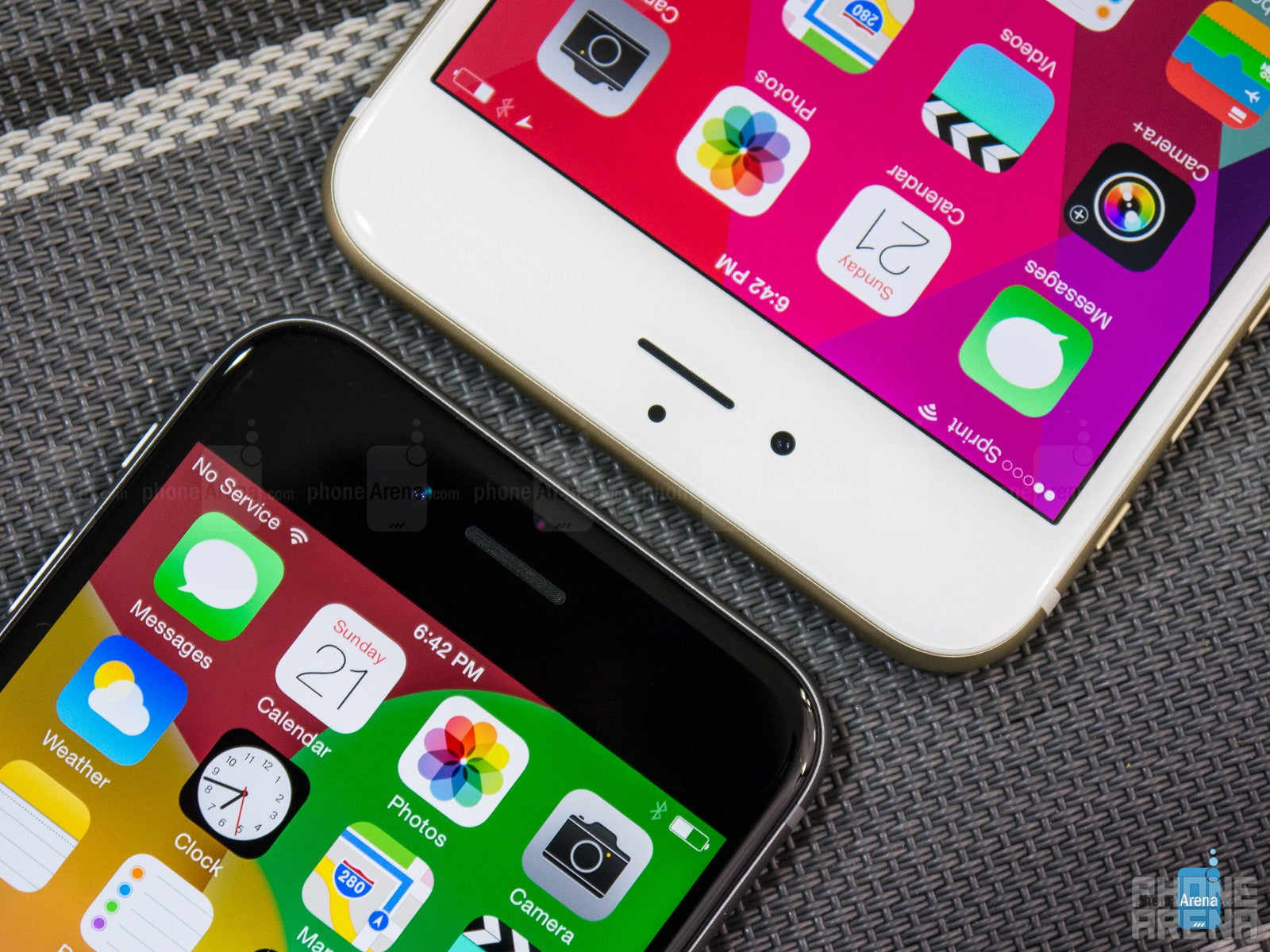
Turns out, size requires compromise – the iPhone 6's display appears slightly better calibrated than that of the massive 6 Plus
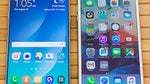
So, the first and most important difference here is that the 6 Plus' screen is much larger, at 5.5” compared to the iPhone 6's 4.7”. We still consider the display size of the iPhone 6 to be big enough in order to make the user experience with the phone a joy, but of course, for those who just can't get enough screen on their mobile device, the 6 Plus can offer even more. And of course, the 5.5” panel will make stuff like various multimedia content even more enjoyable on the 6 Plus.
With regards to resolution, the 6 Plus also has the finer display. Its resolution of 1080 x 1920 pixels makes for the superb pixel density of 401 ppi. Of course, the iPhone 6 and its 750 x 1334 pixels (326 ppi) still display things in a crisp and beautiful way, but yeah, the visuals of the 6 Plus will be a notch cleaner.
Both panels feature great brightness output, with the iPhone 6 having the upper hand with its 600 nits, versus the 6 Plus' 570 nits. Meanwhile, though, the 6 Plus can get a bit dimmer (4 nits vs 7 nits), allowing for a slightly more comfortable viewing in the dark.
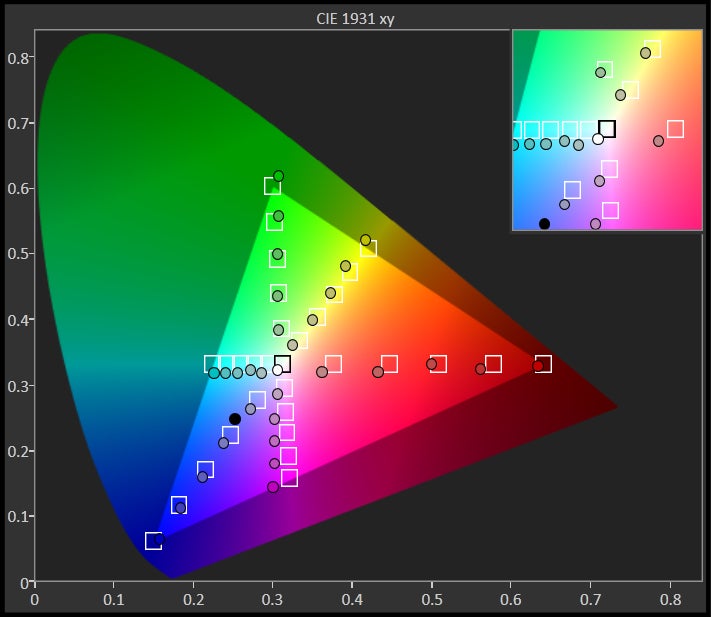
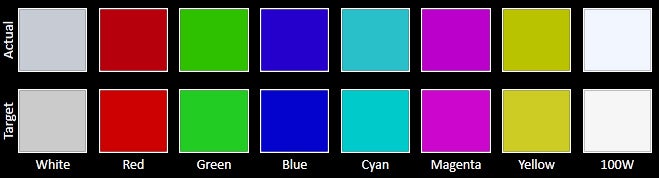
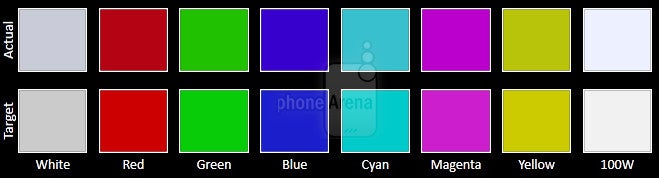
When it comes to color balance, the iPhone 6 once again has an advantage – its color temperature is about 7150 K, while the visuals of the 6 Plus are a bit colder with their 7300 K (the ideal temperature is considered to be 6500 K, with higher numbers making for colder-looking (bluish) colors). Delta E values are also higher on the 6 Plus, suggesting an overall more color-inaccurate screen. Thankfully, its numbers are still low enough for it to be considered both natural and good-looking, but it comes to show that it's not that easy to produce a super-sized touchscreen with great color characteristics.
The numbers below represent the amount of deviation in the respective property,observed when a display is viewed from a 45-degree angle as opposed to direct viewing.
The CIE 1931 xy color gamut chart represents the set(area)of colors that a display can reproduce,with the sRGB colorspace(the highlighted triangle)serving as reference.The chart also provides a visual representation of a display's color accuracy. The small squares across the boundaries of the triangle are the reference points for the various colors, while the small dots are the actual measurements. Ideally, each dot should be positioned on top of its respective square. The 'x:CIE31' and 'y:CIE31' values in the table below the chart indicate the position of each measurement on the chart. 'Y' shows the luminance (in nits) of each measured color, while 'Target Y' is the desired luminance level for that color. Finally, 'ΔE 2000' is the Delta E value of the measured color. Delta E values of below 2 are ideal.
The Color accuracy chart gives an idea of how close a display's measured colors are to their referential values. The first line holds the measured (actual) colors, while the second line holds the reference (target) colors. The closer the actual colors are to the target ones, the better.
The Grayscale accuracy chart shows whether a display has a correct white balance(balance between red,green and blue)across different levels of grey(from dark to bright).The closer the Actual colors are to the Target ones,the better.
The iPhone 6 Plus doesn't bring iPad-like functionality to the iPhone form-factor, but it's somewhere in-between
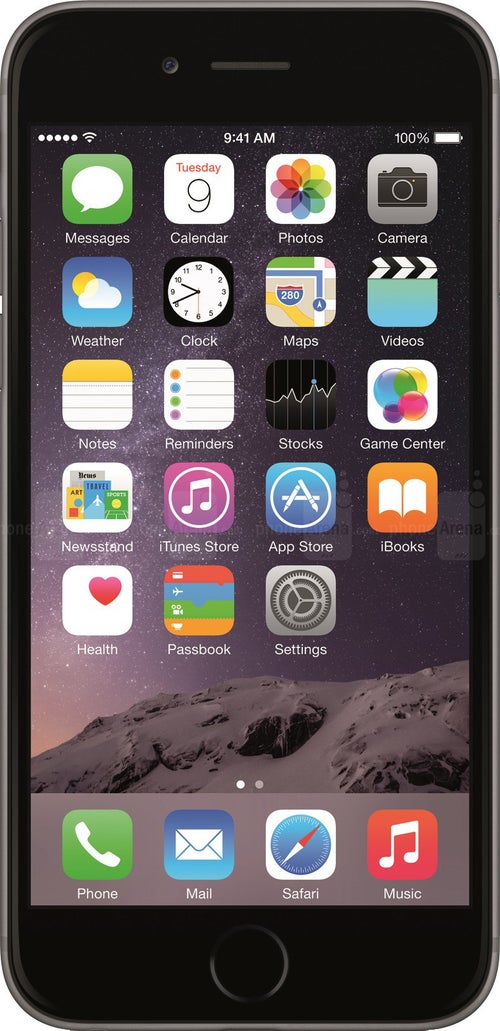
Needless to say, both the iPhone 6 and 6 Plus run the just-released iOS 8, and they both support all the latest features. However, with the build of the 6 Plus, Apple has made some interesting tweaks to the interface, allowing it to take advantage of the bigger screen in some clever ways. It's nothing groundbreaking, of course, but it's a nice addition by the manufacturer. For example, the iPhone 6 Plus can be used in landscape mode throughout the whole OS UI, while some of the core apps display some additional information when viewed on Apple's phablet – such as contact avatars in the messaging app, or an additional pane in the mail app.
Both handsets also have the new Reachability feature, which is especially useful on the iPhone 6 Plus. It's Apple's solution to making an excessively big screen usable in a bit more comfortable manner. With a double-tap on the home button, the phone brings the whole interface down, making the items located in the upper portion of the screen easily accessible for your thumb. It's a bit of a weird-looking feature at first, and it probably isn't that ideal, but it's quick and easily-accessible, so we definitely appreciate it being there.
Apple Pay, the upcoming wireless payment system from the guys and gals in Cupertino, will be supported by both new iPhones. Once you scan and import your credit card in the Passbook application, waving the phone next to a contact-less payment terminal with your finger on the Touch ID sensor will result in a quick and easy wireless payment. It's a great new system that we're definitely looking forward to.
The UI of the Apple iPhone 6 Plus
Processor and Memory
There's hardly anything that could differentiate these two speed demons in the performance department – it's A8 all the way, baby!
Well, there isn't that much to separate Apple's latest phones in the hardware field, as both are equipped with the A8 chipset that features a powerful 1.4 GHz dual-core 64-bit processor and the PowerVR GX6650 GPU. This powerful system-on-a-chip makes the whole OS run flawlessly on both new iPhones, not only when playing around with the UI, but when executing heavy 3rd-party apps/games as well. Well, in theory, the iPhone 6 should exhibit slightly better performance than its larger sibling, because of its lower resolution, but we don't really think that the difference will be noticeable. The benchmark results shown below confirm that the new iPhones treat us to spectacular performance.
Having “just” 1 GB of RAM may seem somewhat weak to many Android users out there, but the iPhone 6 and 6 Plus seem to have more than sufficient resources in order to run perfectly well, so it appears the latest iOS is very well optimized – as the case has always been with iOS. When it comes to storage space, both handsets come with the following options: 16, 64, and 128 GB, so absolutely no differences in this department – just the good news that we can now get a 64 GB iPhone at the price of yesteryear's 32 GB ones.
Safari runs equally well on both iPhones, but looks better on the bigger screen
Both new iPhones include enhanced LTE Cat. 4 radios that should theoretically allow them to achieve downlink speeds of up to 150 Mbit/s, and uplink speeds of up to 50 Mbit/s. That's slightly better than the last generation of the iPhone, but still, it has to be noted that the carrier's network will play a crucial role in this aspect. If no LTE is available, HSPA+ connectivity is, naturally, present on both the iPhone 6 and iPhone 6 Plus, so data speeds should still be pretty adequate.
Safari is the default browser on all Apple phones, and it works lovely on the 6 series. Thanks to their blazing-fast processors and great data connectivity, Safari simply flies on both phones. However, it's safe to say that viewing the web will be a bit more comfortable and enjoyable on the iPhone 6 Plus, once again thanks to its larger-than-life display and great resolution. Still, the web experience of the iPhone 6 is also superb.
As far as additional connectivity features go, the iPhone 6 and 6 Plus share the same arsenal, including 802.11 a, b, g, n, n 5GHz, ac, tethering, UMA (Wi-Fi calling), GPS, and Glonass.
The Safari browser of the iPhone 6 Plus
Camera
The iPhone 6 Plus has a slight edge in low-light photos thanks to optical image stabilization
Equipped with an 8 MP camera, there shouldn't be a noticeable difference in the quality of images taken with both handsets. Aperture is also the same – F2.2, and both can record 1080p video. However, there's a feature that's exclusive to the 6 Plus, and that's optical image stabilization. It helps the 6 Plus' camera compensate for your hand movements better than if it was digital, making for photos with potentially better focus and exposure.
We also like the way Apple has improved its camera applications. While still on the simplistic side, there is now a manual exposure setting, allowing you to tweak the exposure once you've focused on an area. It's a very clever little trick that lets you quickly and easily enhance your shots.
We like the way Apple has improved its camera applications
Interestingly, the new iPhones don't seem to produce images that are significantly better than those of the previous generation in most areas, save for a slightly more natural color reproduction. All in all, the iPhone 6 and 6 Plus take some fancy-looking photos that are among the best in the industry. They aren't the best of the best in the details department, seeing that there are many options out there taking higher megapixel photos, but they are still pretty good. Comparing the pictures taken with both handsets, there really isn't any difference when looking at outdoor shots taken during the day. However, the iPhone 6 Plus' optical image stabilization allows it to produce slightly sharper-looking indoor and night images.
As we already mentioned, both devices record video at a resolution of 1920 x 1080 pixels. Their footage is equally good – with a relatively high-detail image and smooth frame-rate, but somewhat muffled audio recording. However, we're especially fond of the new Cinematic Video Stabilization feature which make video footage appear decidedly stable and fluid – eliminating almost all of the unpleasant hand movements.
It's a 0.8” difference between these two displays, and in case YouTube is right there among your most used apps, then that difference is more than welcome
The iPhone 6 Plus' 5.5” screen is a win for heavy multimedia consumers who really watch a lot of video, and play a lot of games on their phones. It does make things more convenient to view, even compared to the iPhone 6's still-sizable 4.7” screen. That's not to say that the iPhone 6 doesn't deliver a satisfying viewing experience, but more is better in this particular department, even though the color balance of the larger iPhone isn't as great.
The music player remains unchanged from last year’s offering with iOS 7, so the visuals and functions are the same as before. Even though it continues to be integrated with iTunes Radio, we’re still required to go into the phone’s settings menu to adjust its equalizer setting. Now, it would be more useful and logical, to have it accessible directly from within the music player – as opposed to exiting out from it and then proceeding to go into the settings menu.
iPhone 6
The music player and gallery of the iPhone 6 Plus
You’d think that the iPhone 6 Plus would emit stronger tones than the iPhone 6 with its speaker, since it’s a larger sized phone and all, but that’s not necessarily the case here. Rather, its internal speaker cranks out a maximum volume output of 71.6 dB, which is less than the iPhone 6’s mark of 74.5 dB. Despite that, we can attest that both speakers sound very good – plus, they don’t crackle at the loudest volume levels. If only there were front-facing stereo speakers mounted on these new iPhones...
We guess you wouldn't be surprised if we tell you that call quality is equally good on both phones – and yes, that's exactly the case here. With a strong output through their earpieces and relatively natural-sounding tones, the iPhone 6 and 6 Plus are two fine handsets when it comes to telephony. What's more, they both support Wi-Fi calling for carriers which support the service, or in other words – just T-Mobile in the US, for the time being.
In terms of speakerphone performance – we aren't blown away by what Apple's putting to the table here, but these loudspeakers will easily get the job done.
Battery life
Bigger is better when it comes to battery life
Ever since phones started getting bigger, battery life hasn't been among the strongest sides of iPhones. With their ultra-slim and compact bodies, they couldn't house batteries big enough to help them stay powered for a longer time. Well, the iPhone 6 and 6 Plus have grown significantly, compared to their predecessor, but they have become even slimmer. So, how are their batteries doing?
Well, our custom battery life test shows that there's a small improvement, but it's not a great difference from before. The new iPhones are expected to still deliver worse battery life than most Android flagships out there, with the 6 Plus being the better one of the two, thanks to the fact that it integrates a bigger battery. To be more specific, the iPhone 6 managed to run our battery test continuously for 5h 22 min, while the iPhone 6 Plus it for 6h 32 min. In comparison, the Galaxy S5 managed the significantly better 7h 38 min, while the Xperia Z2 did even better, with 8h 10 min. By the looks of it, Apple's iPhones will continue to lag behind their Android counterparts in the battery life deparment, but oh well, we guess that's the price one has to pay for having a super-slim phone.
When it comes to official statistics, the iPhone 6 Plus is also rated to be better than the 6, with expected 3G talk time at 24 hours, and stand-by of 16 days. The iPhone 6's 3G talk time is rated at 14 hours, while stand-by is 10.4 days. Obviously, the iPhone 6 Plus will be the longer-lasting handset of the two, although not by such a great margin.
We measure battery life by running a custom web-script,designed to replicate the power consumption of typical real-life usage.All devices that go through the test have their displays set at 200-nit brightness.
The iPhone 6 Plus isn't that different from the iPhone 6. Still, it isn't simply a supersized iPhone 6, as well. It's more like a heavy-duty iPhone 6, designed to cater to the needs of users who want to get some more productivity out of their mobile handset. With its bigger screen, the slight iOS 8 enhancements, and better battery life, the iPhone 6 Plus is the bigger and better variant of the iPhone 6. You call yourself a hardcore mobile user who's into the Apple ecosystem? It looks like the iPhone 6 Plus has been made for you.
The iPhone 6, on the other hand, is Apple's mainstream flagship phone, and it's the one most users will probably get, seeing that it's significantly easier to handle, plus its screen is still big enough. Sure, it doesn't get the slight optimizations that are present in the 6 Plus' iOS 8 build, as well as the optical image stabilization, but those aren't anything game-changing anyway. Users won't really miss much functionality should they side with the iPhone 6. The screen is the main differentiator here, so that's where most of the decision-making efforts will have to be focused on. Do you really need a 5.5” display on your phone, or the 4.7” panel will get the job done just fine for you? There's a significant difference in the overall dimensions of both handsets, and we'd say that if you aren't really spending multiple hours a day staring at your phone's screen, going for the 4.7-inch iPhone 6 will probably be the more practical decision.
Why you can trust PhoneArena
25+Years of Experience
4202Product Reviews
Every product we review or recommend is thoroughly tested by our in-house experts in real-world conditions, following our
review methodology
and
ethics statement
to ensure honest, independent, and data-driven results.
Rad Slavov is the Editor-in-Chief at PhoneArena. He joined the media in 2008, right on the cusp of the modern smartphone revolution. Through time and perseverance, he amassed a great deal of knowledge and industry know-how, allowing him to guide and organize the company's growing line-up of talented content creators and ever-expanding content portfolio.
A discussion is a place, where people can voice their opinion, no matter if it
is positive, neutral or negative. However, when posting, one must stay true to the topic, and not just share some
random thoughts, which are not directly related to the matter.
Things that are NOT allowed:
Off-topic talk - you must stick to the subject of discussion
Offensive, hate speech - if you want to say something, say it politely
Spam/Advertisements - these posts are deleted
Multiple accounts - one person can have only one account
Impersonations and offensive nicknames - these accounts get banned
To help keep our community safe and free from spam, we apply temporary limits to newly created accounts:
New accounts created within the last 24 hours may experience restrictions on how frequently they can
post or comment.
These limits are in place as a precaution and will automatically lift.
Moderation is done by humans. We try to be as objective as possible and moderate with zero bias. If you think a
post should be moderated - please, report it.
Have a question about the rules or why you have been moderated/limited/banned? Please,
contact us.














Things that are NOT allowed:
To help keep our community safe and free from spam, we apply temporary limits to newly created accounts: