T-Mobile is teasing another network first
T-Mobile is teasing a major breakthrough before the end of the year.

T-Mobile continues to use AI to unlock the full potential of its network. | Image by MGAC
T-Mobile is forging ahead with efforts to integrate AI into the Radio Access Network (RAN) — the part of a telecommunications system that connects user devices to the core network. The company has just teased a major development.
As reported by Light Reading, T-Mobile Chief Network Officer Ankur Kapoor told viewers during Mobile World Live's Unwrapped virtual event to look forward to a new AI-RAN breakthrough before the end of the year.
Coming soon
As reported by Light Reading, T-Mobile Chief Network Officer Ankur Kapoor told viewers during Mobile World Live's Unwrapped virtual event to look forward to a new AI-RAN breakthrough before the end of the year.
In October, T-Mobile completed the world's first AI-RAN call at a commercial cell site in collaboration with Nokia and NVIDIA. Now, the company is gearing up to unveil another first for graphics processing units (GPUs) in the RAN.
This mysterious AI-RAN test will be "a world's first" and achieve "a lot more than what normal radio workloads are."
There are three things that for any technology to scale has to be true: The performance has to be there; the efficiencies have to be there; and economics have to work out.
Ankur Kapoor, T-Mobile Chief Network Officer, November 2026
Kapoor revealed that while T-Mobile has made strides with AI-RAN, more testing is needed to address lingering questions about the GPU-based technology. The company is still evaluating the infrastructure's performance, efficiencies, and economics. He zeroed in on costs, noting that the company hasn't yet determined whether using GPUs in the RAN is financially viable, though he expects to work through those challenges.
Poll
1 Votes
Why is this exciting for you?
Treading carefully
It looks like GPU-powered RAN will only be deployed at a fraction of the company's 85,000 cell sites nationwide to handle AI inferencing alongside radio network traffic.
There are going to be locations in this country that would require that processing in real time, and there are parts of this country that actually do not require that, which gives us lots of options for how do we really scale this across the entire network,
Ankur Kapoor, T-Mobile Chief Network Officer, November 2026
Kapoor points out that there's more than one way to go about AI-RAN. Aside from testing Nokia and Nvidia's model of using GPU-powered gear to combine conventional workloads with AI processing, the company is also pursuing Ericsson's approach of running AI capabilities on traditional RAN equipment and custom silicon.
Ultimately, Kapoor isn't letting short-term economics dictate the decision, focusing instead on what these new technologies unlock for the future.
I'm not worried about the economics. I'm more focused on what does that actually enable for where the future is headed. What does this connectivity look like in 2030? Because it would not look like just making voice calls. It would be a lot more.
Ankur Kapoor, T-Mobile Chief Network Officer, November 2026
Preparing for 6G
Kapoor envisions AI-RAN and 5G standalone as "the training wheels for 6G." AI is being considered a foundational part of 6G rather than something that gets bolted on afterward. T-Mobile is exploring two ways of incorporating AI into its network. One is placing computing capabilities closer to the user, and the other is using AI to make the network more autonomous.
T-Mobile hopes to be the first to roll out 6G in the US. It's also actively working on integrated sensing and communication (ISAC).
Branching out
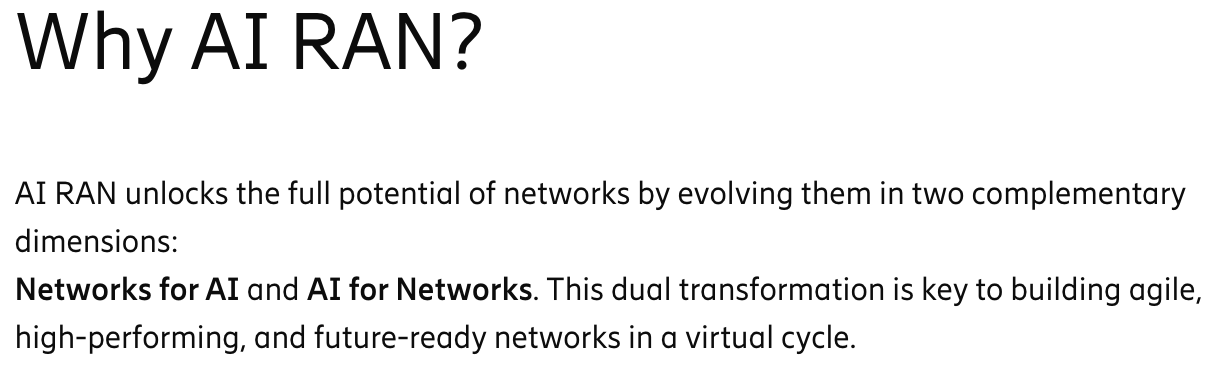
Here's why AI RAN matters. | Image by Ericsson
While T-Mobile's next announcement is anyone's guess, it could involve using GPUs to handle more than conventional operations, demonstrating how the network can provide computing resources to autonomous systems, or simply unveiling new AI-for-RAN algorithms on NVIDIA's hardware.
Whatever the milestone ends up being, one thing is clear: T-Mobile is evolving into something much bigger than a consumer wireless carrier. Sure, it does offer enterprise-specific products even right now, but it clearly wants to supercharge that business as it moves toward 6G and AI-native networks.
For everyday customers, these developments potentially mean a more reliable network capable of self-correcting during disruptions or sudden traffic spikes. Maybe it could spell the end of slowdowns or even outages.

Popular stories
Latest News

Things that are NOT allowed:
To help keep our community safe and free from spam, we apply temporary limits to newly created accounts: