FCC agrees with AT&T that it's time to get rid of copper networks and landlines in California
Copper phone networks keep some users away from employing the latest and greatest in wireless connectivity

AT&T not ready yet to eliminate copper | Image by AT&T
/The FCC announced on Friday that it is taking AT&T's side as the carrier seeks to override California regulatons. What the FCC order does is preempt certain California regulations that prevent consumers in the state from transitioning off the slow, unreliable copper networks that are used to drive what is known as POTS for Plain Old Telephone Service.
FCC is allowed to eliminate outdated regulations that keep consumers on copper networks
In a statement, FCC Chairman Brendon Carr pointed out that the regulatory agency is allowed to eliminate outdated or unnecessary regulatory requirements if such requirements prevent consumers from moving off of aging copper networks. Carr, originally appointed to the FCC by President Donald Trump in 2017, was chosen by the President to take over the position of FCC Chairman in 2025 replacing Jessica Rosenworcel, the sister of Guster drummer Brian Rosenworcel.
The FCC is working to ensure that every American benefits from modern, next-gen networks. That includes eliminating outdated or unnecessary regulatory requirements that prevent consumers from transitioning off of aging copper line networks. This FCC decision ensures that consumers in California have access to modern and reliable networks and benefit from consumers protection requirements, including improved robocall protections and modern public safety tools.
FCC Chairman Brendan Carr
The California regulations that AT&T and the FCC are trying to bypass is called "Carrier of the Last Resort" (COLR). The latter prevents AT&T from removing the old copper wire networks even though they serve only 3% of California homes. That 3% figure continues to shrink.
Friday's FCC order stops short from "wholly" preempting California's Carrier of the Last Resort rules. The FCC issued the 74- page order even though many locals in California are strongly against AT&T's desire to rip down its copper network and want to keep their landlines. One AT&T subscriber who wants to keep the option of using a copper network and analog landlines available wrote during the public comment period, "Please do not allow AT&T to eliminate the last reliable communication tool for rural residents. The VOIP and cellular infrastructure is not robust enough to provide...equal access for their communication needs."
California's PUC says nothing in COLR prevents AT&T from turning off its copper-powered service in the state
The California Public Utilities Commission (CPUC) weighed in by telling the FCC that nothing in the COLR regulations prevent AT&T from shutting its copper network. The CPUC's main concern is that AT&T's replacement for its copper wire network called AT&T Phone - Advanced, will not work as well indoors and would cost customers more money.
Meanwhile, AT&T Executive Vice President Rhonda Johnson had nothing but good things to say about the FCC chairman.
California deserves fast, reliable, future-ready technology – and with the right policies in place, we’re delivering it and transitioning away from copper," she said. "No customer will be left without access to voice or 911 service, and we’re committed to working with our customers every step of the way during this transition.
Rhonda Johnson, AT&T EVP
The CPUC called the FCC's decision "deeply concerning" for customers, especially those in rural areas, high-fire-threat areas, and areas where reliable communications are needed for public safety. The California Public Utility Commission left a comment that read, "California will continue to ensure that confidence is borne out in practice, and will continue to defend its responsibility to protect consumers, preserve essential communications services, and promote public safety. We will carefully evaluate the FCC’s order and all available legal and regulatory options."
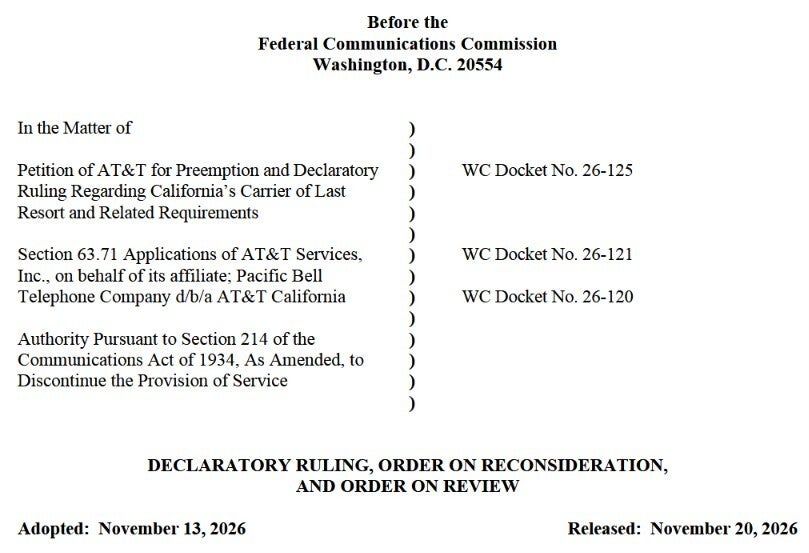
FCC order preempts COLR regulations in California. | Image by FCC
According to the CPUC, AT&T has proposed discontinuing its POTS legacy telephone service on or after June 1, 2027. The move will affect 184,000 residential customers and 15,000 business customers. The news appears to have led to a small rally on Wall Street. On Friday, despite a 950 point decline for the Dow Industrials (-1.93%), AT&T rose 47 cents or 2.15% to close at $22.31 on Friday.
Back in September, Verizon also was forced to deal with the FCC in relation to the same matter. However, unlike AT&T, which has the FCC on its side, Verizon's plan to remove its copper networks was delayed by the regulatory agency, which decided that it needed more time to study Verizon's proposal before making a final decision.
I believe that Verizon will eventually get the green light to end its plain old telephone service in the states where it has asked for permission to do so which include:
- Arizona
- Delaware
- New Jersey
- New Mexico
- Ohio
- Rhode Island
- South Carolina
- Utah
- Virginia
Exercise your mind by reading one of these articles:

Popular stories






Latest News





Things that are NOT allowed:
To help keep our community safe and free from spam, we apply temporary limits to newly created accounts: