The US wireless market gives you no shortage of options. Beyond the big three – T-Mobile, Verizon, and AT&T – prepaid carriers are quickly becoming the go-to choice for many people.
Among them, Mint Mobile and Google Fi stand out as two of the most popular MVNOs in the country. If you are not familiar with the term, MVNOs are carriers that don’t own their networks and instead operate on infrastructure provided by larger carriers.
In this matchup, both Mint Mobile and Google Fi tap into T-Mobile’s nationwide 5G network, so coverage is largely the same. Where they start to separate is pricing, plan flexibility, extra features, and overall value.
If you are trying to figure out which one makes more sense for you, you are in the right spot. Below, we’ll walk through how they compare in the areas that actually matter – coverage, speeds, device support, and plans.
As a start, let’s keep things simple and get straight to the point. Both carriers have their strong sides, but they also come with trade-offs that are worth knowing upfront. Here is a quick breakdown of where Google Fi and Mint Mobile shine – and where they fall short.
Recommended For You
Google Fi pros
Access to multiple networks
Pricing that adapts to how much data you use
Solid international roaming support
More bundled perks overall
Mobile hotspot included
Google Fi cons
Plans cost more compared to most prepaid options
Customer support can be hit or miss
No physical stores, fully online support
Limited compatibility with some devices
Mint Mobile pros
Very affordable pricing
No unexpected charges on your bill
Big savings when you commit to longer plans
Strong performance in cities and metro areas
Mint Mobile cons
Best deals require paying upfront
The Unlimited plan has data limits
Support is also digital-only
Pricing and plans comparison
Price and plan flexibility play a gigantic role when choosing a carrier, and this is one area where Google Fi and Mint Mobile take very different approaches.
Mint Mobile is known for being one of the cheapest options out there, while Google Fi clearly sits on the pricier end of the prepaid spectrum. That said, Google Fi does run promotions from time to time, sometimes cutting prices by up to 50%. To keep things fair and simple, the best comparison here is Mint Mobile’s Unlimited plan versus Google Fi’s Unlimited Standard plan.
Plan
Price for 1 line
What's in the plan?
Perks
Hotspot
Video streaming
Mint Mobile Unlimited
$30 per month paid annually
Unlimited text and calls Free calling to Mexico, Canada and the UK. 50 GB of high-speed data, then it slows down.
Chat with a human 7 days a week
20 GB
Standard Definition (SD) quality
Google Fi Unlimited Standard
$50 per month
Unlimited data, calls, and texts in the US. Unlimited data, with slower data at 256 kbps after 50 GB. Data included in Canada and Mexico. Free texts from the US to over 200 destinations. Affordable calls from the US to over 200 destinations.
Full connectivity for select smartwatches. Advanced spam call blocking. VPN by Google for online privacy. Google Account security built-in. 24/7 customer support.
25 GB
Standard Definition (SD).
Mint Mobile’s Unlimited plan is priced at $30 per month with a 12-month plan. The plan includes unlimited premium data, though speeds may slow after 50 GB in a month, along with 20 GB of mobile hotspot data.
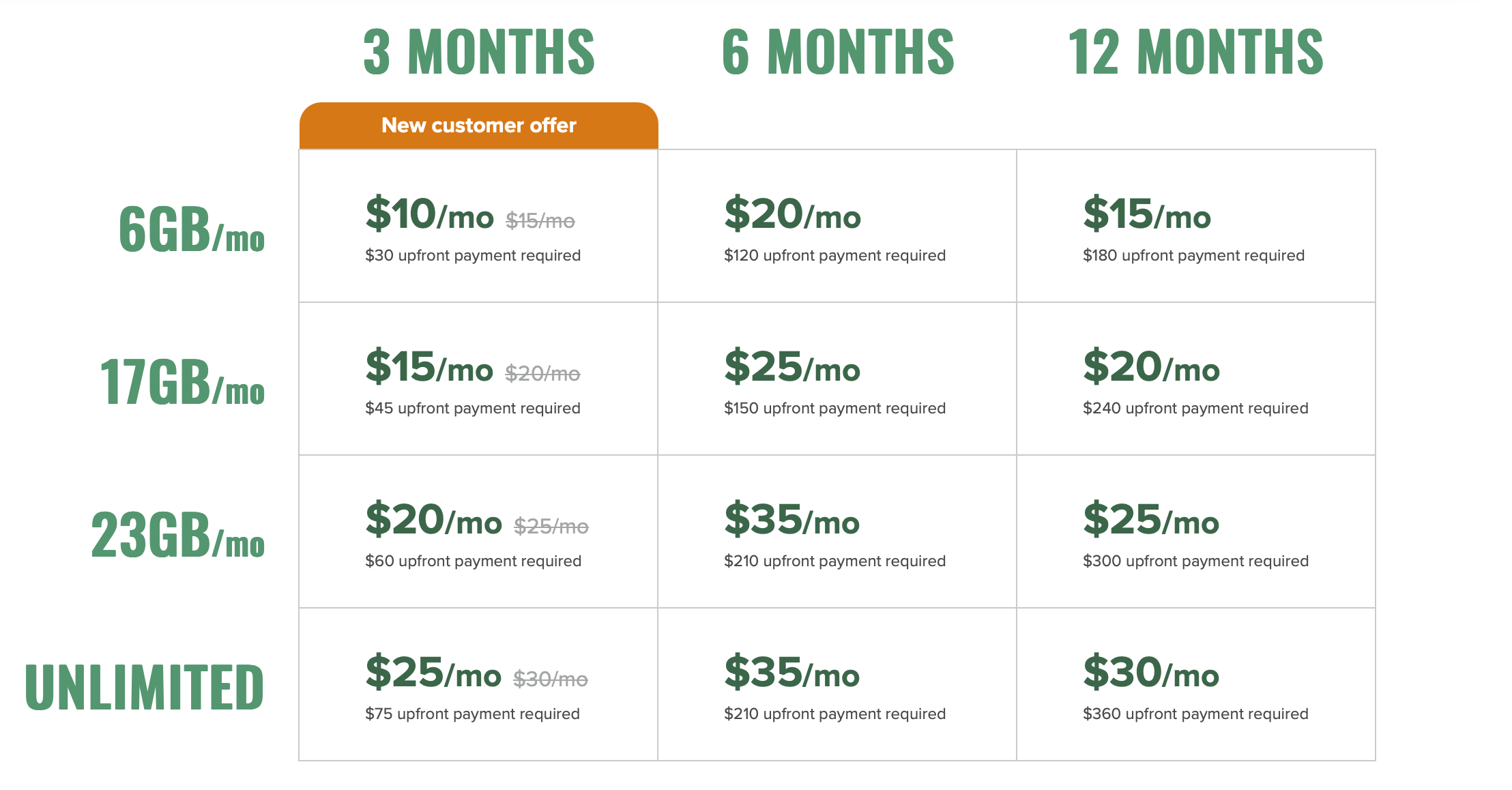
Since June 10, 2026, Mint Mobile has updated its core plans with increased data allotments at no extra cost for people for whom Unlimited is more than they would need:
New Mint Mobile core plans. | Image by Mint Mobile
The 5 GB, 15 GB, and 20 GB plans are now 6 GB, 17 GB, and 23 GB, but you pay the same price as before for those.
Google Fi’s Unlimited Standard plan is similar on paper but offers a bit more breathing room. It comes with 50 GB of premium data, a larger 25 GB hotspot allowance, and a monthly price of $50. What helps justify the higher cost are the added perks, including six months of YouTube Premium (for the Unlimited Premium plan), cloud storage, and international data support, such as included usage in Canada and Mexico – benefits Mint Mobile simply doesn’t offer.
Over time, Mint Mobile is clearly the cheaper option. If you are a single-line user and don’t burn through tons of data, Mint makes more financial sense. However, frequent travelers may find Mint limiting, since international features aren’t really its strength. In that case, Google Fi becomes the better fit.
Google Fi also pulls ahead for multi-line users. Its family plan discounts are much more aggressive and can help balance out the higher starting price. Mint does allow multiple lines under one account, but it doesn’t offer per-line discounts. Instead, it just lets users pay in three-month chunks while keeping the yearly rate.
And if perks matter to you – even if it means paying more – Google Fi easily comes out ahead.
Coverage comparison
Coverage is one of the most important things to look at when choosing a new carrier. In this case, Mint Mobile and Google Fi both run on T-Mobile’s network. However, that doesn’t mean their coverage looks exactly the same. Actually, Google Fi shows stronger reach across more areas. Yep, you can check their coverage maps below to see the differences for yourself.
Google Fi coverage (first image) vs Mint Mobile coverage (second image).
Google Fi also handles connectivity differently depending on your device. To minimize extra costs from T-Mobile, it often routes calls over Wi-Fi when supported. This setup can help boost data speeds in busy spots like airports or crowded city areas.
Reliability
Google Fi usually comes out ahead when it comes to reliability, thanks to the way it manages connections. Most Google Fi plans include Premium Data, which gives you the same priority on the network as T-Mobile’s own customers. That means even in crowded spots like airports, concerts or any big event, your data is more likely to stay fast and responsive.
Meanwhile, Mint Mobile users might notice slower speeds in congested areas. Without the premium priority, data can get throttled until the network clears up, so Fi has an edge in high-traffic situations. However, this rarely happens, so I think most users will never notice any slow downs in day-to-day use.
Features and perks
When it comes to perks, Google Fi leads. | Image by Google
Ah, perks, something which only the post paid carriers have nailed down. MVNOs are typically a different story. Mint Mobile, for example, sticks to the basics. Its plans generally include a hotspot allowance, talk and text to Canada and Mexico, and Wi-Fi calling – nothing extra, but it covers what most people need.
Google Fi takes a different approach, offering perks that rival larger carriers. With its most expensive plan, along with hotspot and Wi-Fi calling, Google Fi bundles in things like a YouTube Premium subscription (although only for 6 months), 100 GB of cloud storage, and international data access in over 200 countries.
Phone selection
When it comes to picking a phone, neither carrier gives you a huge range, but there are some key differences. Mint Mobile offers devices from Apple, Google, and Samsung, while Google Fi sticks to Google, Samsung, and Motorola – so, yeah, no iPhones through Fi (still, you can bring your own iPhone and still use Google Fi).
With both carriers, you can choose from the latest Android flagships. | Images by PhoneArena
Still, Google Fi tends to be more generous with deals. You’ll find trade-in offers, discounts, and flexible payment plans regularly, whereas Mint Mobile’s promotions are smaller and less frequent.
And if you are rocking a Pixel or consider yourself an Android power user, Google Fi might feel like the better fit. The carrier often offers better pricing and deals for new Pixel devices, keeping its own ecosystem users well taken care of.
Customer service
Since neither Mint Mobile nor Google Fi has physical stores, any issues have to be handled online. Mint Mobile has a solid app for support, and Google Fi has recently improved its digital help options, too.
That said, customer service is limited to phone lines, chatbots, and website support. Overall, based on user reviews and forum feedback, it looks like Mint Mobile currently edges out Fi slightly in overall customer satisfaction.
If you are the type who likes walking into a store to get hands-on help with a broken phone or billing questions, these online-only carriers probably aren’t for you. In that case, sticking with a postpaid carrier like T-Mobile, Verizon, or AT&T is the safer bet.
This is always the tricky part. Honestly, it mostly comes down to your budget, how many lines you need, and how much value you place on extras. Your location and personal usage also matter, of course.
If you often travel, want strong family plan discounts, or care about perks like YouTube Premium and international data, Google Fi is probably the better fit.
On the other hand, if keeping costs as low as possible is your top priority – even if that means paying upfront – or if you want an iPhone through your carrier and just need a single line, Mint Mobile is the smarter choice.
FAQ
Which is better, Google Fi or Mint Mobile?
If you want the absolute cheapest option for domestic use and don’t mind paying upfront, Mint Mobile is your best bet. But if you travel often, need family or multi-line discounts, or want faster data in busy areas, Google Fi is the smarter choice.
What carrier does Google Fi use?
As of 2026, Google Fi primarily runs on T-Mobile’s network.
Who is the #1 cell phone carrier?
It depends on the report, but T-Mobile generally leads when it comes to 5G coverage, reliability, and speed.
Why switch away from Google Fi?
If you feel like you are paying for perks and international data you don’t use, moving to Mint Mobile could save you money.
Does Google Fi have a good signal?
Yes – in 2026, Google Fi offers solid signal and coverage.
Is Google Fi losing UScellular?
Yes, Google Fi has dropped UScellular as a dedicated partner. However, because T-Mobile now owns UScellular’s assets, you still get that coverage through the main T-Mobile network.
Six-month unlimited plan is now 57% off
$90
$210
$120 off (57%)
Mint Mobile is now allowing you to get whichever plan you like for either three, six, or 12 months for just $15/mo. If you go for the six-month unlimited service, for instance, you'll now have to pay just $90 upfront instead of $210.
Tsveta, a passionate technology enthusiast and accomplished playwright, combines her love for mobile technologies and writing to explore and reveal the transformative power of tech. From being an early follower of PhoneArena to relying exclusively on her smartphone for photography, she embraces the immense capabilities of compact devices in our daily lives. With a Journalism degree and an explorative spirit, Tsveta not only provides expert insights into the world of gadgets and smartphones but also shares a unique perspective shaped by her diverse interests in travel, culture, and visual storytelling.
A discussion is a place, where people can voice their opinion, no matter if it
is positive, neutral or negative. However, when posting, one must stay true to the topic, and not just share some
random thoughts, which are not directly related to the matter.
Things that are NOT allowed:
Off-topic talk - you must stick to the subject of discussion
Offensive, hate speech - if you want to say something, say it politely
Spam/Advertisements - these posts are deleted
Multiple accounts - one person can have only one account
Impersonations and offensive nicknames - these accounts get banned
To help keep our community safe and free from spam, we apply temporary limits to newly created accounts:
New accounts created within the last 24 hours may experience restrictions on how frequently they can
post or comment.
These limits are in place as a precaution and will automatically lift.
Moderation is done by humans. We try to be as objective as possible and moderate with zero bias. If you think a
post should be moderated - please, report it.
Have a question about the rules or why you have been moderated/limited/banned? Please,
contact us.












Things that are NOT allowed:
To help keep our community safe and free from spam, we apply temporary limits to newly created accounts: