SMS of Death, a newly disclosed Android vulnerability, can crash your phone. The SMS stays hidden, never shows up in your inbox, and can completely disable your Android phone.
What is SMS of Death
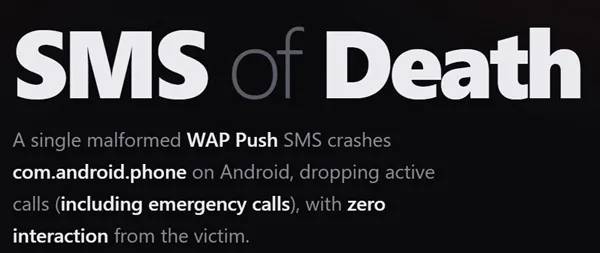
The SMS of Death could trap your phone in a bootloop, rendering it useless. | Image by GitHub
Security researcher Mark Blaszczyk first discovered this strange vulnerability. The SMS of Death, as it's now popularly called, uses a specially engineered text message that the Android system struggles to process.
The result? The system that handles calls crashes and disconnects any ongoing calls, including calls to emergency services such as 911.
Blaszczyk also warns that about 20 of these malicious messages can render an Android phone completely useless, trapping it in a bootloop, as the Android OS keeps on trying to process the SMS.
No traces in your inbox
The SMS of Death is practically undetectable. | Image by PhoneArena
The scariest part is that this SMS of Death is practically undetectable. The message never makes it to your inbox - it crashes the system immediately, so you get no notification whatsoever.
Another quite unfortunate piece of news is that even a factory reset won't solve the issue. If a malicious party has sent a bunch of these SMSes to your inbox, the carrier will keep trying to deliver them to your device, crashing it every time you power it on.
You might be able to see the messages and remove them if you hook up your phone to a computer, but that might be too much hassle for many users.
Recommended For You
Good news, Google issued a fix
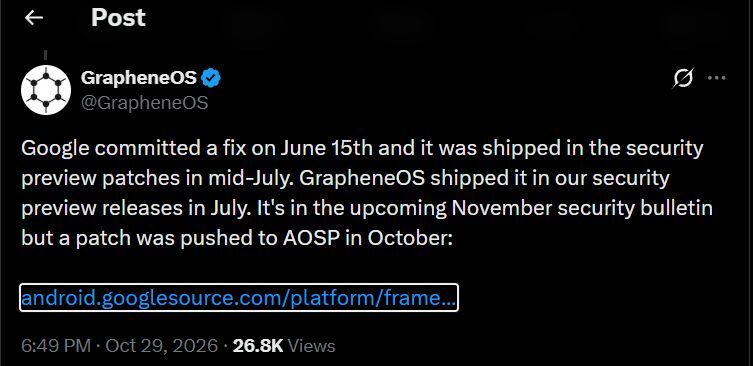
GrapheneOS posted about the vulnerability. | Image by X
Mark successfully recreated the code of the message and uploaded it both to GitHub and to the dedicated SMSofDeath website. The researcher says he was able to crash Google Pixel and Samsung Galaxy devices running Android 12 to 16.
Blaszczyk first alerted Google on May 5, but says Google repeatedly dismissed his report as a non-security issue. Here comes the interesting part.
After publicly disclosing the vulnerability and uploading a working version of the SMSofDeath on October 29, Mark found out that Google had been working on a fix for some time, probably since he contacted the company.
The actual fix was developed on June 15, according to Android’s own code records, and removes the message without processing it. GrapheneOS later clarified on X that Google distributed the fix through security previews in July, months before the researcher’s public disclosure.
Google also assigned a Critical severity rating to the vulnerability (marked as CVE-2026-58882), and included it in the upcoming November Android Security Bulletin.
Have you noticed any dropped calls on your Android phone recently?
3 Votes
What happens next? Is your phone at risk?
This whole mess looks like a miscommunication between Google's engineers and the team that handles security vulnerability reports.
The cause-and-effect chain is still unclear, and we don't know whether the initial report prompted Google to develop a fix, or if the company's engineers were aware of the issue all along.
The good news is that the fix has been included in October’s Android security updates for versions 14 through 17.
So, if your Android phone has already received the latest security patch, you should be fine. Smartphones with no software support, or running older Android versions (13 or earlier), might still be vulnerable.
The rule of thumb is to install all security patches your phone receives immediately. That's one of the main reasons to upgrade an old Android phone that has run out of software updates as well. Have you noticed any dropped calls on your Android phone recently?
Read more news about smartphone vulnerabilities and security issues here:
Get a free Galaxy A17 with Straight Talk. To claim this deal, you need to pair the phone with activation on a Silver Unlimited Plan or higher. This tier costs $45 per month. Offer valid through 01/10/27 while supplies last online.
Mariyan, a tech enthusiast with a background in Nuclear Physics and Journalism, brings a unique perspective to PhoneArena. His childhood curiosity for gadgets evolved into a professional passion for technology, leading him to the role of Editor-in-Chief at PCWorld Bulgaria before joining PhoneArena. Mariyan's interests range from mainstream Android and iPhone debates to fringe technologies like graphene batteries and nanotechnology. Off-duty, he enjoys playing his electric guitar, practicing Japanese, and revisiting his love for video games and Haruki Murakami's works.
A discussion is a place, where people can voice their opinion, no matter if it
is positive, neutral or negative. However, when posting, one must stay true to the topic, and not just share some
random thoughts, which are not directly related to the matter.
Things that are NOT allowed:
Off-topic talk - you must stick to the subject of discussion
Offensive, hate speech - if you want to say something, say it politely
Spam/Advertisements - these posts are deleted
Multiple accounts - one person can have only one account
Impersonations and offensive nicknames - these accounts get banned
To help keep our community safe and free from spam, we apply temporary limits to newly created accounts:
New accounts created within the last 24 hours may experience restrictions on how frequently they can
post or comment.
These limits are in place as a precaution and will automatically lift.
Moderation is done by humans. We try to be as objective as possible and moderate with zero bias. If you think a
post should be moderated - please, report it.
Have a question about the rules or why you have been moderated/limited/banned? Please,
contact us.











Things that are NOT allowed:
To help keep our community safe and free from spam, we apply temporary limits to newly created accounts: