
Niantic Spatial denies rumor about the U.S. military using Pokemon Go data to train drones
A report from a Dutch blog said that 30 billion scans from Pokémon Go helped the U.S. military train AI navigation for drones.
Pokemon Go is not being used by the U.S. military despite rumors | Image by PhoneArena
Despite rumors to the contrary, mobile video game Pokémon Go is not being used by the U.S. military to train drones. Last week, a report from Dutch blog Trouw said that 30 billion scans from hundreds of millions of game players reportedly helped the U.S. military train an AI system that will be used to navigate drones.
Since 2021, Pokémon Go players have scanned thousands of PokéStops while playing Pokémon Go. Players who scanned these PokéStops received Ultra Balls, Rare Candies, Stardust, Max Potions, and Max Revives.
The rumor stated that 30 billion scans from Niantic games are being used by the military to train drones
The 30 billion scans came, not surprisingly, from various Niantic games and count the individual frames from each uploaded video. The location scans used in Pokémon Go were an optional side activity that only a small percentage of players used. The feature has since been removed from the game.
The scans reportedly are now owned by Niantic Spatial, a firm that was spun out of Niantic. The latter is the company that helped develop the game, which it launched in July 2016. Pokémon Go was sold to Monopoly Go! owner Scopely in March 2025. Niantic Spatial, the spun-off company, is the one that created highly detailed 3D models of the real world to be used by mobile devices while playing Pokémon Go.
Niantic, Vantor team up to develop tech that reveals an exact location even without GPS
Trouw's report said that Niantic Spatial has teamed up with an intelligence company called Vantor that has connections to the defense industry. The pair is working on technology that would allow people and vehicles to know their exact location in areas where GPS signals are blocked or jammed, or reliable GPS signals simply do not exist.
Now as part of Scopely, Pokémon Go data is not shared with Niantic Spatial," a spokesperson said. "AR Scans collected through Pokémon Go were submitted voluntarily by players who opted into the feature and were subject to the applicable Terms of Service and Privacy Policy at the time. The discontinuation of AR scanning and the end of data sharing with Niantic Spatial were part of the transition planning associated with Pokémon Go's move to Scopely
Scopely spokesman
This new technology could be used with ground-based machines such as bomb disposal robots to help them be remotely navigated to the right location to remove a threat to the military. It also would work with aerial systems such as drones. The Trouw article added that the Pokémon Go players responsible for taking the 30 billion videos were knowingly recording location data for the game; they also were helping to contribute to military technology.
Niantic says that the rumor is not true and that it is not working with the military
As interesting as this story is, it is not true according to Niantic Spatial. The company does have a deal with Vantor that was announced last December, but it is in its early stages and does not include any provision for sharing data. A Niantic spokesman says that what they are working on with Vantor is a "system capable of allowing a sensor to determine its position in the real world." This will allow people or machines to share their locations in real-time, even without a GPS signal."
Niantic is working on ground-based navigation without GPS, Vantor is working on airborne navigation
Niantic recently announced a deal with a delivery robot company. Because this firm operates its robots in dense, crowded cities, GPS signals often do not penetrate the nearby skyscrapers making Niantic Spatial's navigation technology necessary for the robots to deliver to the right location. Vantor's website hints that Niantic's portion of this system deals only with ground-based tracking, leaving airborne usage to Vantor's work on the system.
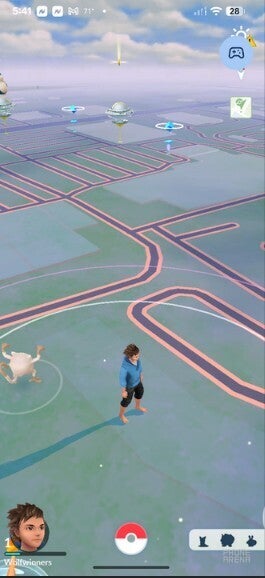
Screenshot from Pokémon Go for Android. | Image by PhoneArena
Ground-scans were used to help train Niantic Spatial's real-world foundation models, which are AI systems that learn to recognize physical spaces. "The models are the product of that training, not a copy of or a means of accessing the underlying scans, which were of public points of interest such as statues and fountains," a Niantic spokesman stated.
Pokémon Go lost its beta tag in the App Store and Google Play Store in July 2016. This means that people have been walking around with their phones in their hands searching for Pokémon for close to a decade.
The app is available for iOS users from the App Store; simply tap on this link. Android users can install the app from the Google Play Store by clicking on this link.
So if you ever played Pokémon Go, or still play it, you can relax. Based on the latest word from Niantic, your data from the game is not being used in the Iran War.


Popular stories


Latest News


Things that are NOT allowed:
To help keep our community safe and free from spam, we apply temporary limits to newly created accounts: