Is the iPhone a new high-tech form of birth control?
Reports cited by the New York Times, and somewhat confirmed by CIRP data, blame a drop in U.S. births on the iPhone.
Studies cite decline in U.S. brthrate since iPhone release in 2007 | Image by PhoneArena
The New York Times recently published an article asking whether the decline in the U.S. birthrate that started in 2007 is the fault of the iPhone. The touchscreen smartphone was unveiled and launched in January 2007 and June 2007, respectively. Is that a coincidence?
Two studies blamed declining fertility rates on the iPhone
The Times story cited two reports comparing fertility reports in U.S. counties where AT&T had close to universal coverage compared to counties with very little AT&T coverage, or no coverage at all. Remember, up until 2011, AT&T was the exclusive carrier in the U.S. for the iPhone.
One paper, published by the National Bureau of Economic Research, said that about 50% of the fertility decline between 2007 and 2011 was caused by the iPhone. The demographics showed that the age group affected the most were those 15 to 24 years of age.
One theory says the easier accessibility of porn on the iPhone made the device a substitute for sex
The reason why the iPhone is to blame is actually pretty clear to those who owned a feature phone, or even a typical pre-iPhone smartphone. There are still kids out there who weren't around and missed out on the unveiling of the iPhone, but it was clear at the time that the world was never going to be the same.
The study was published by Middlebury College economist Caitlin Myers, and her student Ezekiel Hooper. What they theorized was that with the additional capabilities of the iPhone, more people socialized on their phones instead of in person and these people were less likely to have sex, making them less likely to conceive a child. Professor Myers also wondered whether the iPhone gave male users easier access to pornography, and used it as a substitute for sex.
The study concludes that "Overall, the diffusion of the iPhone explains 33–52% of the decline in the general fertility rate among women aged 15–44."
The second study, also written by an economics professor (Hernan Moscoso Boedo of the University of Cincinnati), and a student (Nathan Hudson), analyzed data from the World Bank. Their research was conducted with statistics from 128 countries and their work found that in markets like Iran, Costa Rica, Guatemala, Chile, Mexico and Turkey, teenage fertility declines picked up once the smartphone era took off in these places.
They also tested their theory in the U.S. using 4G LTE and wired broadband. What they found was that in counties with greater accessibility to high-speed data, the fertility rates for teenagers declined the fastest.
Over 95% of CIRP respondents age 18 to 44 in 2014 and 2026 use non-social iPhone features daily
Consumer Intelligence Research Partners (CIRP) has posted the results of a survey (via subscription), that while not explicitly proving that the iPhone acts like birth control, does show why the theories of the Myers-Hooper study make sense. Looking at the chart, you can see that of the four possible uses for the iPhone measured by CIRP (phone call, texting, email, and internet), the two less-social features, texting and internet, both are used every day by over 95% of the 18 to 44-year-olds surveyed. More social features, such as making phone calls and sending emails, are used daily by only 85% and 78% of the 18 to 44-year-olds surveyed, respectively.
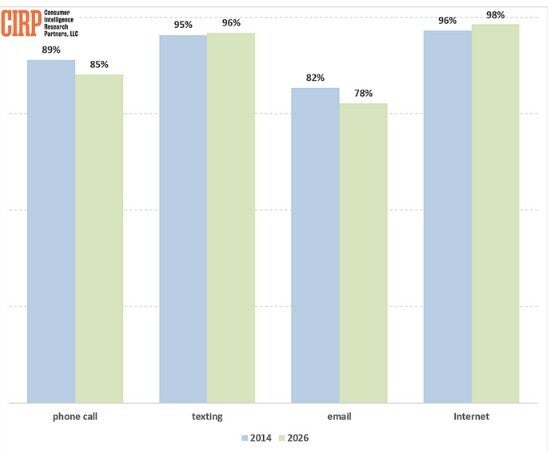
Share of iPhone Owners 18-44 Using device daily for specified features.| Image by CIRP
It should also be pointed out that the non-social features have both risen in daily usage from 2014 to 2026, while the more social features have declined. The increases are small, to be sure, as daily texting use for those 18 to 44 years of age has increased from 95% in 2014 to 96% this year. Daily internet use for the same demographic has risen from 96% in 2014 to 98% today.
Fewer 18 to 44 year-olds are using their iPhone every day for making and taking phone calls in 2026 compared to 2014
Daily usage of the social features has declined from 2014-2026. Those aged 18 to 44 making or taking a call daily on their iPhone has declined from 89% to 85%. Those in the same age group have seen daily email usage drop from 82% in 2014 to 78% today.
Even if you feel that the CIRP surveys don't absolutely guarantee that the iPhone can be called birth control, they surely do not prove that the device is not responsible for the decline in the U.S. fertility rate.


Popular stories



Latest News


Things that are NOT allowed:
To help keep our community safe and free from spam, we apply temporary limits to newly created accounts: