44% say they can spot AI fakes. Can you?
Thanks to OpenAI's Sora and Gemini's Nano Banana, it has become harder to know when a video or picture is real or AI.
AI is so good now that on social media you can't tell the difference between a video that is real and one that was created by AI. Surely you've seen one of the zillion figure skating videos that show a couple performing at some arena with Air Supply's "Making Love out of Nothing At All" playing in the background. Some of these are AI and you can tell because they show reaction shots from "America's Got Talent" judges taken out of context.
Did Reggie Jackson really hit three homers in one World Series game?
Ironically, I had to ask AI whether all of these videos are fake and was surprised to find out that some are real. But the technology has come to the point that we all feared a few years ago. It is very hard to determine with any degree of certainty if a video is real or fake. Did Reggie Jackson actually hit three homers in one World Series game? Yes! That is real, and I know because I was at Yankee Stadium that October night in 1977.
On the other hand, those videos showing two airplanes just missing a major collision, or the clips showing a major car accident with one vehicle rolling over multiple times while the other car explodes into a huge ball of fire are not real. According to CNET, 94% of U.S. adults say that they have run across AI generated images on social media. However, only 44% say that they can tell real photos and videos apart from the ones created by AI.
One solution is to label AI videos as such. Better labels for online AI is what 51% of the respondents recommend. 21% believe in the nuclear option, which would be a total ban on AI-generated videos and pictures on social media platforms. And to make matters worse, only 11% found AI videos to be informative, useful, and entertaining. Other poll results revealed that 72% of adults in the U.S. take some sort of action to help them discover if a video is real or AI. However, some do not do anything to help them make this determination, especially Boomers (36%) and Gen Xers (29%).
AI image models are so good these days that you can't tell what is real and what is fake.
Image models like Google's Nano Banana and OpenAI's Sora can create videos that are so realistic that you would swear on your life that they are real. Toss in the realistic texts that accompany these videos, and you have a public ripe to get fooled while believing that they know what is real and what is fake.
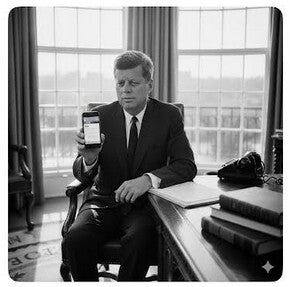
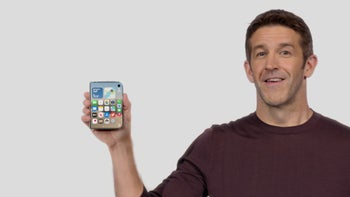
Did you know that President Kennedy, who died in 1963, tested an iPhone? Only with AI. | Image by PhoneArena
While 44% of American adults are confident in their ability to spot AI on social media on a net basis, 25% are not. What does this mean? It means that too many are going to believe that something they just saw with their own two eyes, a horrific accident involving two jets colliding in midair, really happened. 60% of U.S. adults try to determine the legitimacy of a video by looking really hard at it, something that doesn't always work out.
Red flags are no longer the sure sign of a deepfake AI
As AI image models improve, signs that you could rely on in the past as proof that a video or photo is AI can no longer be trusted. In the past, you might find a photo showing only four fingers or six fingers on the subject's hand pretty much telling you that a photo is not real. These days AI is so good that if you find a photo of someone with four fingers on one of his hands, that is no longer a red flag telling you that the image is not real. By the way, the AI image of JFK holding sn iPhone was created using Gemini's Nano Banana.
While 60% look hard at a video trying to determine its legitimacy, 25% use reverse search images in an attempt to find the truth about a questionable video or picture. 5% rely on a deepfake tool or website and 3% take the easy way out: they simply assume that an image or video is fake. Sounds like a plan to me.

Popular stories

Latest News
Things that are NOT allowed:
To help keep our community safe and free from spam, we apply temporary limits to newly created accounts: