SpaceX just tightened its grip on the 2 GHz airwaves that make satellite-to-phone service work, and our breakdown of the spectrum fight shows AT&T, Verizon and T-Mobile answering from the back foot. Carry a Galaxy S26 Ultra or an iPhone 17 Pro Max? The carrier that keeps you connected in a dead zone may end up being decided in orbit, not on the ground.
SpaceX is buying the airwaves while the carriers argue
The fight is over the 2 GHz Mobile Satellite Services band, the slice of spectrum that makes Direct-to-Device service viable. It is currently split between EchoStar and Viasat, and a 2012 Federal Communications Commission (FCC) rule says one operator has to hold both the terrestrial and satellite rights in that band, so whoever consolidates wins by default.
SpaceX is doing exactly that. It already paid $17 billion to pull EchoStar's AWS-4 and H-block licenses, then circled back for even more spectrum, and it is now pushing the FCC to fly next-gen Starlink satellites on those frequencies while leaning on existing rules and Globalstar's interference complaints to keep newcomers out.
With exclusive spectrum, SpaceX will develop next-generation Starlink Direct to Cell satellites, which will have a step change in performance and enable us to enhance coverage for customers wherever they are in the world.
SpaceX, from its statement on the $17 billion EchoStar spectrum deal, September 2025
Recommended For You
That definitely sounds like a company writing the rules of a market it intends to own.
Where do you stand on satellite coverage for your phone?
241 Votes
I already use it and it's saved me in a dead zone
15.35%
I want it but only if it's free with my plan
50.62%
Emergency texts are enough, I don't need more
17.84%
Towers are fine, satellite is a gimmick to me
16.18%
What it changes for the phone in your pocket
Right now, Direct-to-Device mostly means an emergency text or a basic message, not LTE. Both Starlink's T-Satellite and the AST SpaceMobile network that AT&T and Verizon are backing top out around messaging as of early 2026, and the "20 times the throughput" promise rides on next-gen satellites that are roughly two years out. So the obvious gripe, who wants something slower than 5G, misses the point: this is about coverage where towers do not reach, not raw speed.
The interesting part, though, is that there is no tidy three-way carrier alliance. AT&T and Verizon are betting on AST SpaceMobile, which is still pre-commercial and targeting just 45 to 60 satellites by the end of 2026. T-Mobile rides Starlink directly, and its exclusivity window is closing right as SpaceX buys the spectrum that means it no longer needs T-Mobile's airwaves.
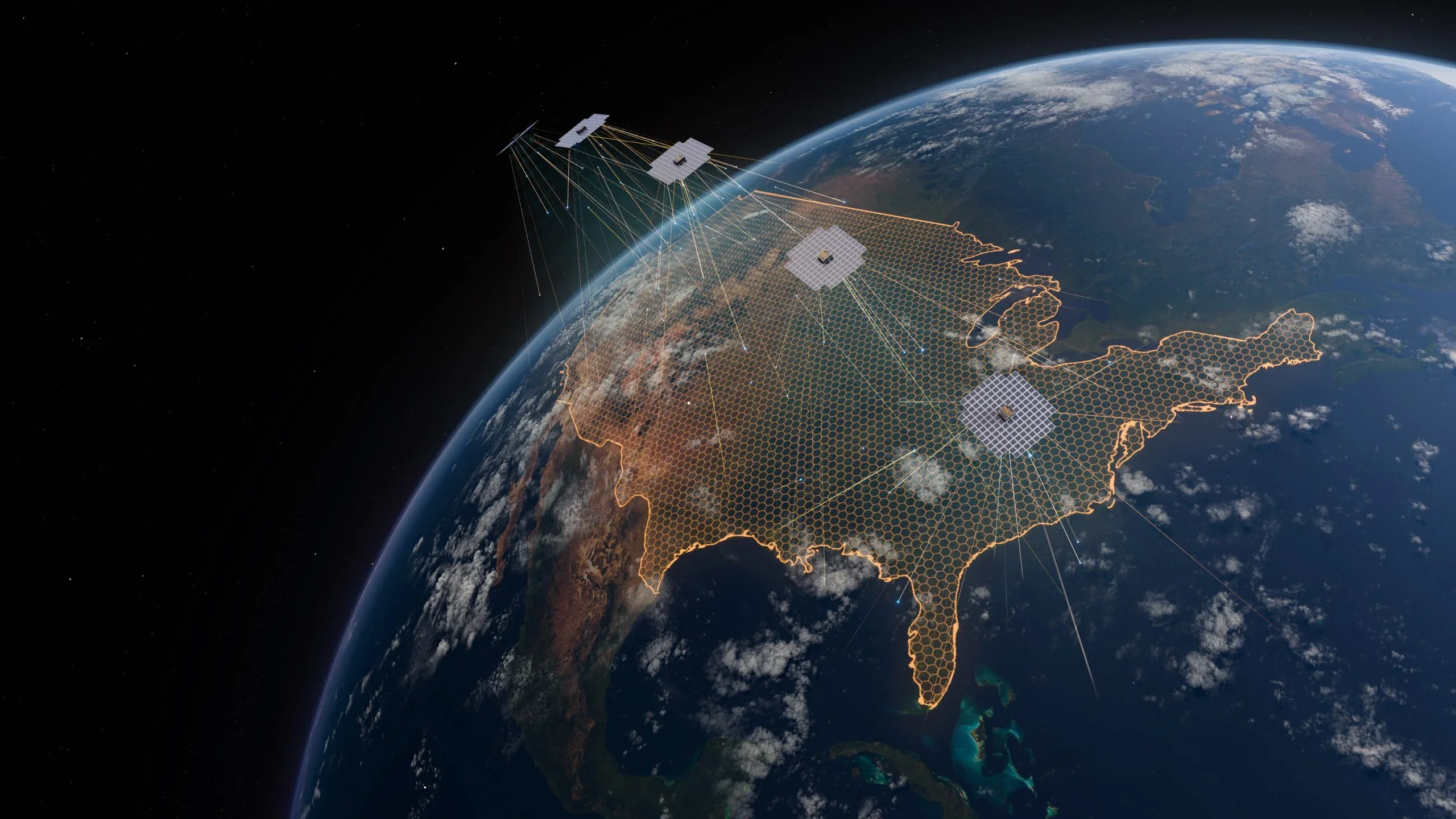
AST SpaceMobile's BlueBird satellites, the bet AT&T and Verizon are making against Starlink. | Image by AST SpaceMobile
If you are on T-Mobile, T-Satellite works today and you lose nothing tomorrow, but your carrier holds the weakest hand here. If you are on AT&T or Verizon, your satellite future is tied to a partner that has not gone fully commercial yet. Either way, the company holding the spectrum sets your terms.
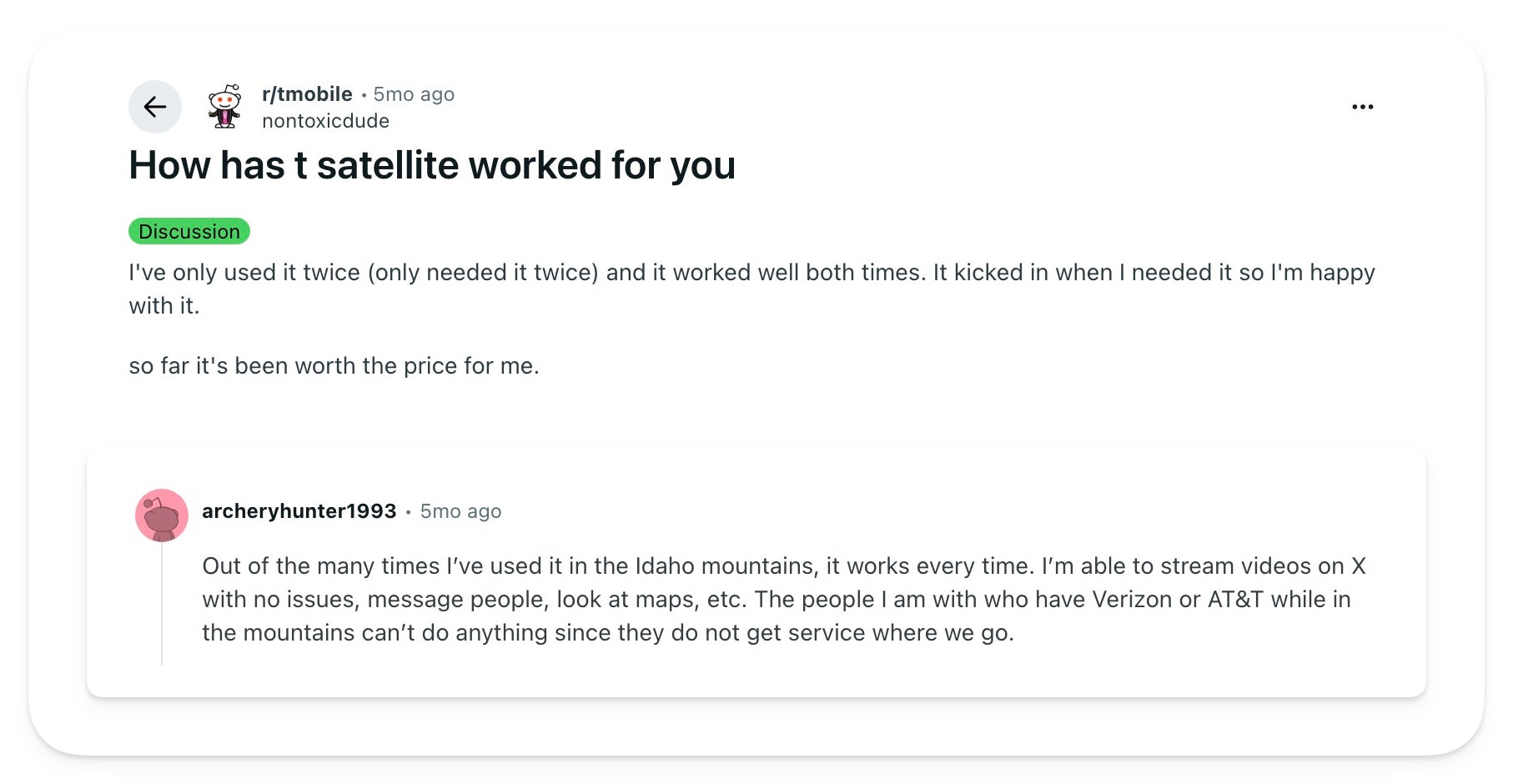
Out in the wild, T-Mobile subscribers already sound won over. On T-Mobile's subreddit, one user said T-Satellite kicked in exactly when needed and was worth the price, while another streams video from deep in the Idaho mountains where his Verizon and AT&T companions get nothing. It is anecdotal, but it is the loyalty SpaceX is banking on.
T-Mobile users say T-Satellite kicks in right when they need it, even deep in the mountains where Verizon and AT&T phones go dark. | Image by nontoxicdude via Reddit
The deck is stacked, and the hardware already knows it
This is not only about who spends the most. The FCC's framework rewards whoever already controls the band, and would-be entrants keep getting turned away. Operators like Sateliot have tried to slip through newer small-satellite rules and been blocked, with SpaceX and Globalstar lined up against them. A bottleneck like that favors the deepest pockets, and in 2026 that increasingly means one company.
The clearest tell is in the silicon. Qualcomm's X105 5G Modem-RF is expected to start showing up in phones soon, tuned to tap the very frequencies SpaceX pulled from EchoStar. When chipmakers start building for your spectrum, the industry has already picked a side.
Who actually pays for all this
Strip away the FCC filings and the stakes are simple. Today, satellite connectivity means an emergency text from a dead zone. In a couple of years, it could mean LTE-class service almost anywhere you stand.
The open question is who you will be paying for that, and on whose terms. If one company owns the spectrum, the satellites and increasingly the link to your phone maker, your carrier becomes the middleman, not the gatekeeper.
The carriers are fighting the last war
Here is where I land: the Big Three still treat satellite like a coverage checkbox, a feature to bolt onto a plan, while SpaceX treats it as the whole board. One side is buying airwaves, satellites and silicon support outright. The other is renting access or waiting on a partner to launch.
That does not mean T-Mobile, AT&T and Verizon are doomed tomorrow. They own huge terrestrial networks and deep spectrum, and AST could still deliver. But on the narrow question of who controls Direct-to-Device, the carriers look like they are reacting to a game SpaceX already set up. With next-gen Starlink and that Qualcomm modem on the horizon, the next two years will show whether the Big Three were playing defense or just standing still.
Get iPhone 18 Pro with Visible, get $480 off!
$719
/mo
$1199
$480 off (40%)
On the Visible+ Pro plan, you get access to 5G Ultra Wideband data on Verizon's fastest network. Along with unlimited roaming across Mexico and Canada, 2 days of Global Pass per month, 3x hotspot speeds, 4K streaming, and Smartwatch service.
Johanna Romero is a Senior News Writer at PhoneArena, covering mobile technology news across Android, iOS, wearables, and the Google ecosystem she knows best. Drawing on 15 years in IT and tech support from 2007 to 2022, she brings a user-friendly eye for the practical features and lesser-known tricks readers care about. Google named her an official #TeamPixel member in 2022, and she also reviews the latest devices on her YouTube channel, JoJo the Techie.
A discussion is a place, where people can voice their opinion, no matter if it
is positive, neutral or negative. However, when posting, one must stay true to the topic, and not just share some
random thoughts, which are not directly related to the matter.
Things that are NOT allowed:
Off-topic talk - you must stick to the subject of discussion
Offensive, hate speech - if you want to say something, say it politely
Spam/Advertisements - these posts are deleted
Multiple accounts - one person can have only one account
Impersonations and offensive nicknames - these accounts get banned
To help keep our community safe and free from spam, we apply temporary limits to newly created accounts:
New accounts created within the last 24 hours may experience restrictions on how frequently they can
post or comment.
These limits are in place as a precaution and will automatically lift.
Moderation is done by humans. We try to be as objective as possible and moderate with zero bias. If you think a
post should be moderated - please, report it.
Have a question about the rules or why you have been moderated/limited/banned? Please,
contact us.






![Another batch of Galaxy S26 series users in the US are getting a nice surprise today [UPDATED]](https://m-cdn.phonearena.com/images/article/183643-wide-two_350/Another-batch-of-Galaxy-S26-series-users-in-the-US-are-getting-a-nice-surprise-today-UPDATED.webp)
Things that are NOT allowed:
To help keep our community safe and free from spam, we apply temporary limits to newly created accounts: