2025 is officially behind us, which makes this a good moment to look back at what the year actually brought. One clear takeaway comes from a recent report that highlights just how intense cyber activity across Europe became toward the end of 2025.
Europe’s cybersecurity landscape is getting tougher
Overall, things haven’t really gotten any better compared to a report we shared last year. If anything, cybersecurity across Europe remains a constant challenge, pushing governments and companies to step up their cyber hygiene, build stronger resilience, and rely more on international cooperation.
Throughout 2025, Europe dealt with aggressive cyber espionage, financially driven ransomware, cryptomining attacks, and infostealers. Governments, aerospace firms, industrial companies, and critical infrastructure were all hit. The UK stood out in particular, seeing a sharp rise in nationally significant cyberattacks, with ransomware showing up again and again as a major threat.
By late 2025, this wave of cyber activity had caused billions in economic damage and forced many organizations to rethink how they protect their digital systems. A year-end threat report from LastPass, the well-known password manager company, described Europe as operating in a “continuously challenging environment,” driven by a spike in advanced identity attacks and serious supply chain disruptions.
Recommended For You
Yep, identity threats, in particular, are no longer just about basic phishing emails or stolen passwords. Security experts say we are moving into what they call “Identity 2.0.” As companies roll out stronger protections, attackers are shifting their focus in several key ways:
Session token theft: Instead of stealing passwords, attackers grab active login sessions, allowing them to bypass multi-factor authentication entirely.
Non-human identity attacks: Hackers increasingly target application identities, API keys, and service accounts. These often have powerful permissions but far less monitoring than human users.
AI-powered social engineering: Generative AI is now being used to create highly convincing messages that can slip past traditional email filters.
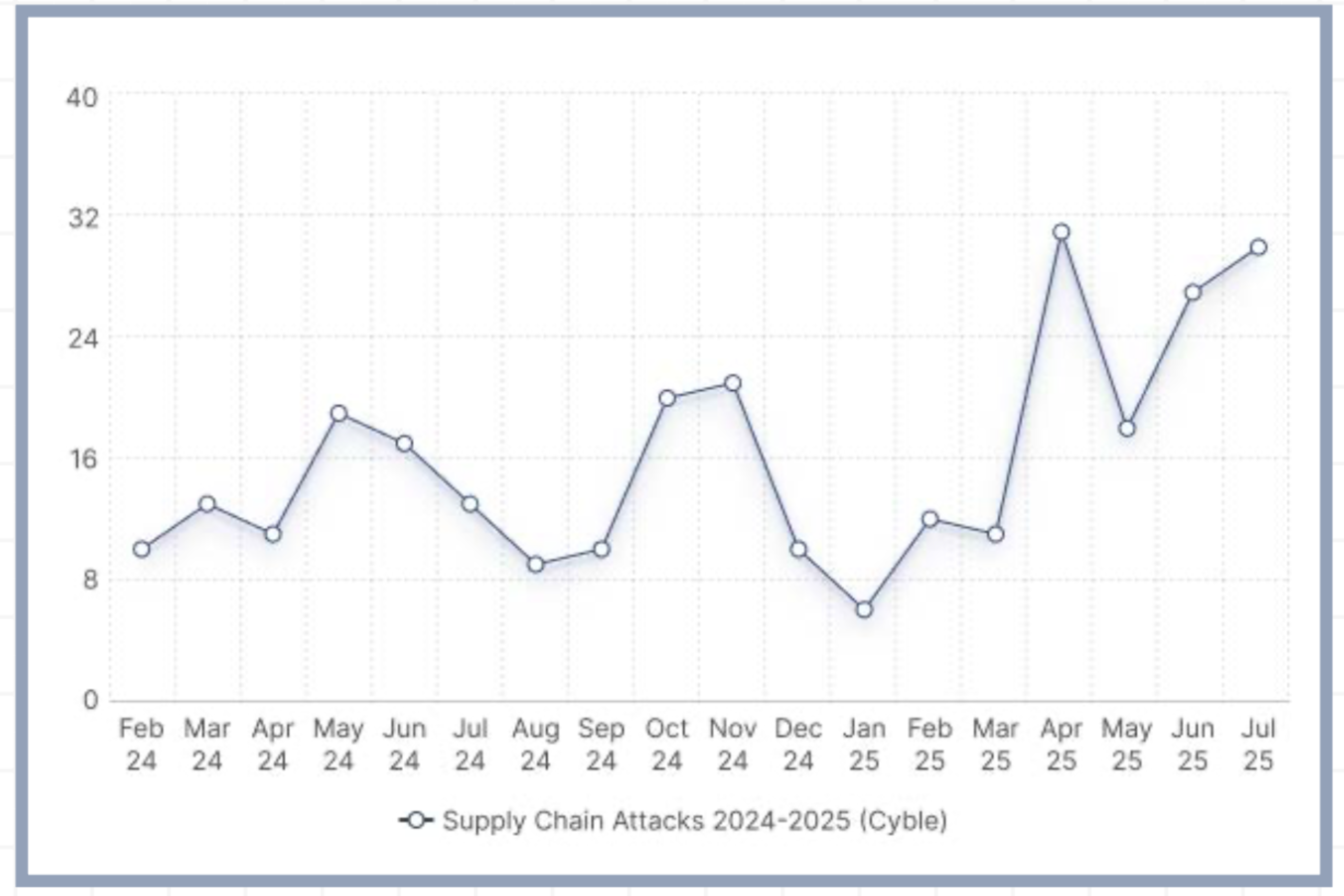
Supply chain attacks also continued to rise across Europe, following a broader global trend. While many sectors faced large numbers of data breaches, manufacturing was consistently the most targeted industry for both supply chain attacks and ransomware during 2025. This had ripple effects on related sectors, especially automotive, due to how tightly connected these industries are.
Supply chain attacks are on the rise across Europe.
The scale of the problem became impossible to ignore after an August attack on Jaguar Land Rover. The breach, linked to a group known as “Scattered Lapsus$ Hunters,” is estimated to have caused around £1.9 billion (around $2.55 billion when directly converted) in damage to the UK economy.
What’s especially notable is that Jaguar Land Rover itself wasn’t directly attacked. Instead, threat actors used social engineering to compromise a third-party IT helpdesk. The fallout shut down global manufacturing operations for more than a month and impacted around 5,000 small UK businesses that depend on the automaker. To date, it’s considered the most economically damaging cyber event in UK history.
Transportation systems also showed how vulnerable they can be. In September, a ransomware attack on Collins Aerospace, a provider of critical boarding and check-in software, disrupted major airports including London Heathrow, Brussels, and Berlin. With digital systems unavailable, airlines had to fall back on manual, paper-based processes, affecting travel for thousands of passengers.
Geopolitical tensions continued to play out online as well. The ongoing Russia-Ukraine conflict spilled further into cyberspace, with the pro-Russian group NoName057(16) increasing DDoS attacks against German banks and municipal government websites in response to European support for Ukraine.
Why cyber threats aren’t slowing down
All of this makes one thing clear: cyberattacks aren’t easing up. If anything, they are accelerating. Analysts point out that attackers are increasingly exploiting trust-based relationships between partners and suppliers.
To push back, the report recommends moving toward a Zero Trust model. This approach assumes no user or device is automatically safe and limits how far malware can spread by containing it within isolated parts of a network.
AI is now helping hackers craft more convincing scams. Are you ready for that?
5 Votes
Absolutely, I’m careful online.
60%
Kind of, but I could get tricked.
0%
Not really, it seems scary.
20%
No, I don’t even think about it.
20%
What this means for you
Now, while most of these incidents don’t directly target individuals, that doesn’t mean you can ignore them. You still need to be careful about what you click and where you share your information. As I mentioned earlier, cybercriminals, especially with the help of AI, are getting far more creative when it comes to stealing identities, money, and entire digital lives.
So, it is wise to always pause before clicking links in emails or messages. Ask yourself who’s sending it and whether you actually know them. Many AI-driven scams work by creating a sense of urgency. If a message pressures you to act or pay immediately, stop and reach out to the person or company using a trusted method, like a saved phone number or official website, instead of clicking the link.
It’s also time to move past basic passwords and adopt a more layered security approach. Passkeys are a solid starting point. Still, more than anything, critical thinking matters. In my opinion, staying alert and questioning what you see online is one of the simplest and most effective defenses you can use right now.
Mint Mobile's 6-month plans now cost $10/mo
$10
/mo
$35
$25 off (71%)
Mint Mobile is celebrating its 10-year anniversary with a special offer on its six-month subscription plans. For a limited time, you can get your preferred tier (6GB, 17GB, 23GB or unlimited) for just $10/mo. That saves you between 50% and 71% on the carrier's mobile plans, making it way easier to recommend.
Tsveta, a passionate technology enthusiast and accomplished playwright, combines her love for mobile technologies and writing to explore and reveal the transformative power of tech. From being an early follower of PhoneArena to relying exclusively on her smartphone for photography, she embraces the immense capabilities of compact devices in our daily lives. With a Journalism degree and an explorative spirit, Tsveta not only provides expert insights into the world of gadgets and smartphones but also shares a unique perspective shaped by her diverse interests in travel, culture, and visual storytelling.
A discussion is a place, where people can voice their opinion, no matter if it
is positive, neutral or negative. However, when posting, one must stay true to the topic, and not just share some
random thoughts, which are not directly related to the matter.
Things that are NOT allowed:
Off-topic talk - you must stick to the subject of discussion
Offensive, hate speech - if you want to say something, say it politely
Spam/Advertisements - these posts are deleted
Multiple accounts - one person can have only one account
Impersonations and offensive nicknames - these accounts get banned
To help keep our community safe and free from spam, we apply temporary limits to newly created accounts:
New accounts created within the last 24 hours may experience restrictions on how frequently they can
post or comment.
These limits are in place as a precaution and will automatically lift.
Moderation is done by humans. We try to be as objective as possible and moderate with zero bias. If you think a
post should be moderated - please, report it.
Have a question about the rules or why you have been moderated/limited/banned? Please,
contact us.















Things that are NOT allowed:
To help keep our community safe and free from spam, we apply temporary limits to newly created accounts: