RIM BlackBerry 4G PlayBook
- Bookmark
- Posted: 14 Jan 2011 Announced: 06 Jan 2011
- Market Status: Not yet released
- Release date: Q2 2011 (Official)
-
Do you ...?
- Links: RIM BlackBerry 4G PlayBook Official Page RIM BlackBerry PlayBook Review
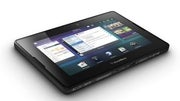
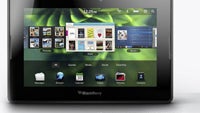
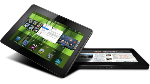
RIM BlackBerry 4G PlayBook is the WiMAX enabled version of the BlackBerry PlayBook which is introduced as the first "professional tablet" keeping with the BlackBerry's heavy usage in the business world. The specs are hot enough to interest both consumers and business users. The PlayBook features a 7 inch capacitive LCD display with resolution of 1024 x 600 pixels. Instead of the new BlackBerry 6 OS, a new tablet version of the BlackBerry software devised by the recently acquired QNX is running the show. The tablet will have some power under the hood with a 1GHz dual-core processor and 1GB of RAM on board. There are two cameras. The front facing shooter is 3MP with a 5MP on back. The WebKit browser will allow for HTML-5 and Adobe Flash Player 10.1.
Rating
RIM BlackBerry 4G PlayBook specifications
Pros
- Dual core processor
- Fast mobile data support (4G)
- Fast processor (1000 MHz)
- Lots of RAM (1024 MB RAM)
- HDMI connector for TV-out (Micro HDMI (Type D))
Cons
- Low pixel densitiy screen, below 180ppi (170 ppi)
- The camera lacks autofocus
- Lacks microSD slot for storage expansion
- Lacks a standard (3.5mm) headphones jack
Design
- Device type:
- Tablet
- OS:
- BlackBerry Tablet OS
- Form factor:
Form factor - Refers to the form factor of a phone. The main handset designs are bar, clamshell, slide, swivel
- Candybar
- Dimensions:
- 7.64 x 5.12 x 0.39 (194 x 130 x 10 mm)
- Weight:
- 14.11 oz (400 g)
the average is 17.3 oz (494 g)
- 14.11 oz (400 g)
Display
- Physical size:
- 7.00 inches
- Resolution:
- 1024 x 600 pixels
- Pixel density:
Pixel density - The pixel density of a display represents the number of pixels over an area of one inch. It’s measured in “pixels per inch”, or ppi. The higher the number, the more detailed and good-looking the display is.
- 170 ppi
- Touchscreen:
- Capacitive, Multi-touch
- Features:
- Light sensor
Hardware
- Processor:
Processor - The processor is the main computing component of a phone and is a major factor when it comes to the overall speed of the device. Some more powerful smartphones use dual-core and quad-core processors designed to deliver greater performance.
- Dual core, 1000 MHz
- Graphics processor:
- Yes
- System memory:
System memory - System memory, or RAM memory is the type of memory that the device uses to temporarily store data from the OS or currently-running apps. The more RAM available to the device, the better the performance will be when multiple or heavier programs are running.
- 1024 MB RAM
Camera
- Camera:
- 5 megapixels
- Camcorder:
- 1920x1080 (1080p HD) (30 fps)
- Features:
- Video calling
- Front-facing camera:
- Yes
Multimedia
- YouTube player:
- Yes
Internet browsing
- Browser:
- Yes
- Supports:
- HTML, HTML5, Flash, JavaScript
Technology
- Data:
Data - Shows the particular phone's type of data. the major mobile phone data types are GPRS, CDMA2000 1xRTT, EDGE, CDMA2000 1xEV-DO, UMTS, etc.
- WiMAX
- Positioning:
Positioning - This field shows the positioning systems supported by the device. There are three main types: GPS, A-GPS and GLONASS. GPS - This is one of the most widespread global positioning technologies, developed and maintained by the U.S. government. It uses satellites in order to detect your location. Works best in clear weather. A-GPS - A-GPS stands for Assisted GPS and is the industry standard for positioning and navigation. “Assisted” means that it can use local wireless networks, in addition to satellites, for quicker and more precise localization. GLONASS - GLONASS is a global positioning system, developed by the Russian Federation. It’s very similar to GPS, but isn’t so popular in cell phones.
- GPS
- Navigation:
- Yes
Phone features
- Messaging:
- Predictive text input
- E-mail:
- Yes
Connectivity
- Bluetooth:
- 2.1, EDR
- Wi-Fi:
Wi-Fi - Wireless Local Area Network (WLAN) - used radio waves (RF) or infrared signals to send and receive data over the air. Most popular WLAN solutions today is Wi-Fi (802.11b and 802.11g) standards. 801.11b provides data speeds of around 11mbps while 802.11g can go up to 54 mbps.
- 802.11 b, g, n, a
- USB:
- Yes
- Connector:
- microUSB
- HDMI:
- Micro HDMI (Type D)
- Computer sync, OTA sync
Other features
- Notifications:
- Speakerphone
- Sensors:
- Accelerometer, Gyroscope, Compass
- Voice recording
Availability
- Officially announced:
- 06 Jan 2011
- Scheduled release:
Scheduled release - Shows when is the particular phone scheduled to be made available to the public in North America
- Q2 2011 (Official)
To see the full specifications with in-depth details click here.
Despite our efforts to provide full and correct RIM BlackBerry 4G PlayBook specifications, there is always a possibility of admitting a mistake. If you see any wrong or incomplete data, please LET US KNOW.
If you are interested in using our specs commercially, check out our Phone specs database licensing page.