Two powerful earthquakes struck Venezuela on June 24, and across the country Android phones buzzed with a warning seconds before the shaking, while nearby iPhones stayed silent. That heads-up came from Google's crowdsourced alert system, the safety net baked into the Pixel 10 Pro and the best Android phones, and one the iPhone still can't match.
Android phones sounded the alarm before the ground moved
On June 24, two back-to-back earthquakes hit northern Venezuela, a magnitude 7.2 quake followed about 40 seconds later by an even stronger 7.5. It was the deadliest quake to hit the country in over a century, and rescue crews are still searching the rubble.
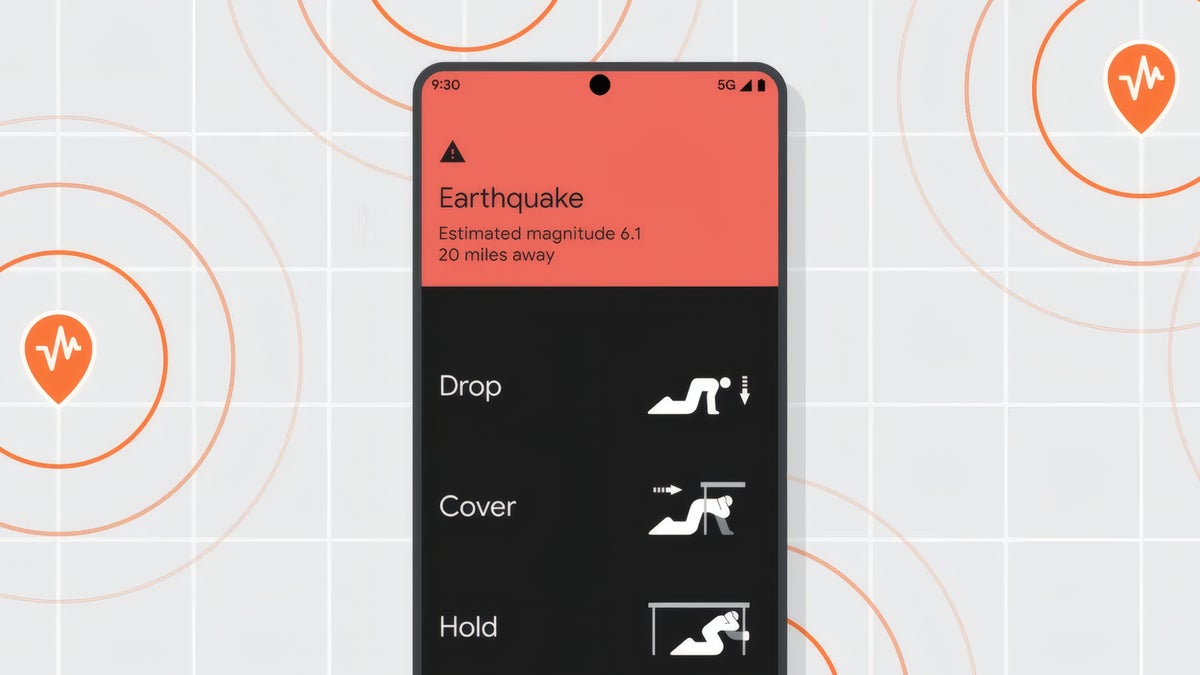
In the moments before the worst shaking, millions of Android phones lit up with an alert showing the quake's estimated magnitude and distance, enough warning for many to get clear of a window or under a table.
Security-camera footage of the alert reaching phones moments before the shaking. | Video by Dellis251984 via r/Earthquakes
Footage shared all over social media caught the moment, phones chiming in unison just before everything moved. However, it should be noted that Google is careful to say the system doesn't predict earthquakes. It detects them as they start and races the warning out ahead of the damage.
Recommended For You
Your safety is our priority, and we are continuously working to provide you with the tools and information you need to stay prepared during emergencies.
— Boone Spooner, Group Product Manager, Android and Pixel Safety, Google
How your phone becomes an earthquake sensor
The trick is the accelerometer, the same sensor that flips your screen when you turn the phone sideways. Sitting still, it can also feel the ground shake.
Earthquakes travel in waves, and the fast but weak P-waves arrive ahead of the slower, more destructive S-waves. When a phone catches that early tremor, it sends a signal and a rough location to Google's servers.
A single phone could be a dropped device or passing truck. But thousands reporting the same shake at once let the system confirm a real quake and warn people ahead of the destructive waves, what Google's research team has called the world's largest earthquake detection network.
Google research animation of the April 2025 magnitude 6.2 Turkey earthquake. | Video by Google
The animation above is a magnitude 6.2 Turkey quake from last year, not Venezuela, but the mechanism is the same.
How prepared is your phone for an earthquake alert?
109 Votes
I've checked, alerts are on and ready
24.77%
I had no idea my phone could do this
28.44%
I'm on iPhone, so I'm not fully covered
23.85%
I live where quakes aren't a worry
22.94%
A global safety net that started small
Android Earthquake Alerts began quietly in 2021 in New Zealand and Greece, and have grown considerably since. Google's own numbers tell the story:
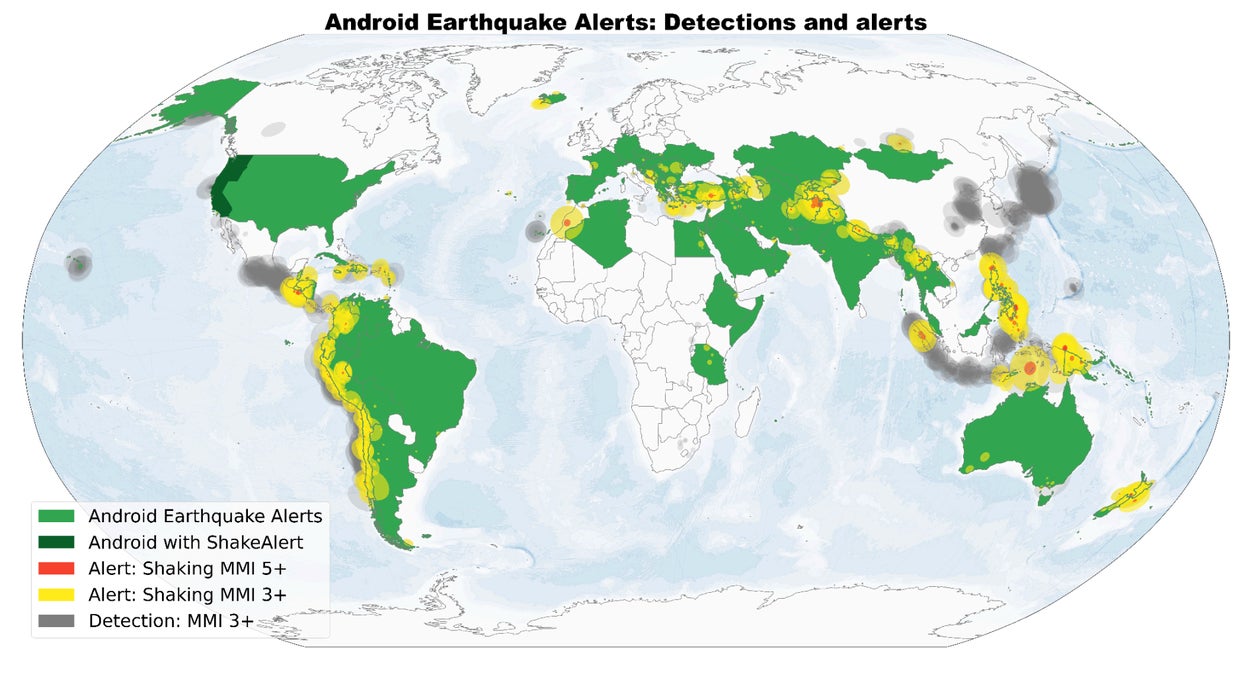
Nearly 100 countries are now covered
More than 790 million alerts have been sent to phones
Early-warning access is up from 250 million people in 2019 to about 2.5 billion today
In the US, it leans on the official ShakeAlert network in California, Oregon and Washington, which we covered when alerts reached all 50 states. Everywhere else, the phones do the detecting.
Green areas show where Android Earthquake Alerts are active, with detections and alerts mapped worldwide. | Image by Google
However, in countries like Venezuela, there is no government early-warning network. Because of this, the crowdsourced layer became what this system was dependent on, instead of just a backup.
Where this leaves your iPhone
Here's the part Apple fans won't love. iPhones aren't fully in the dark, since Apple added Enhanced Safety Alerts that pass along warnings and relay them between nearby devices.
However, going by Apple's own support pages, those alerts need an official source to already exist. Apple has no phone-sensor detection network of its own, so where no government system feeds it, like in Venezuela, an iPhone has nothing to pass along.
An iPhone in a quake-prone area with a government system is likely fine. Without one, that's the gap Google built its network to fill.
What should you do when an earthquake alert appears?
The hard lesson out of Venezuela was about awareness, not the tech. Many people there had never seen the alert and weren't sure what it meant, so the warning landed but the response often didn't.
If a Take Action alert takes over your screen, the advice is the one rescue experts repeat: drop, cover and hold on. A Be Aware alert is gentler, just a heads-up that lighter shaking may be coming.
Here's how to turn on Android Earthquake Alerts
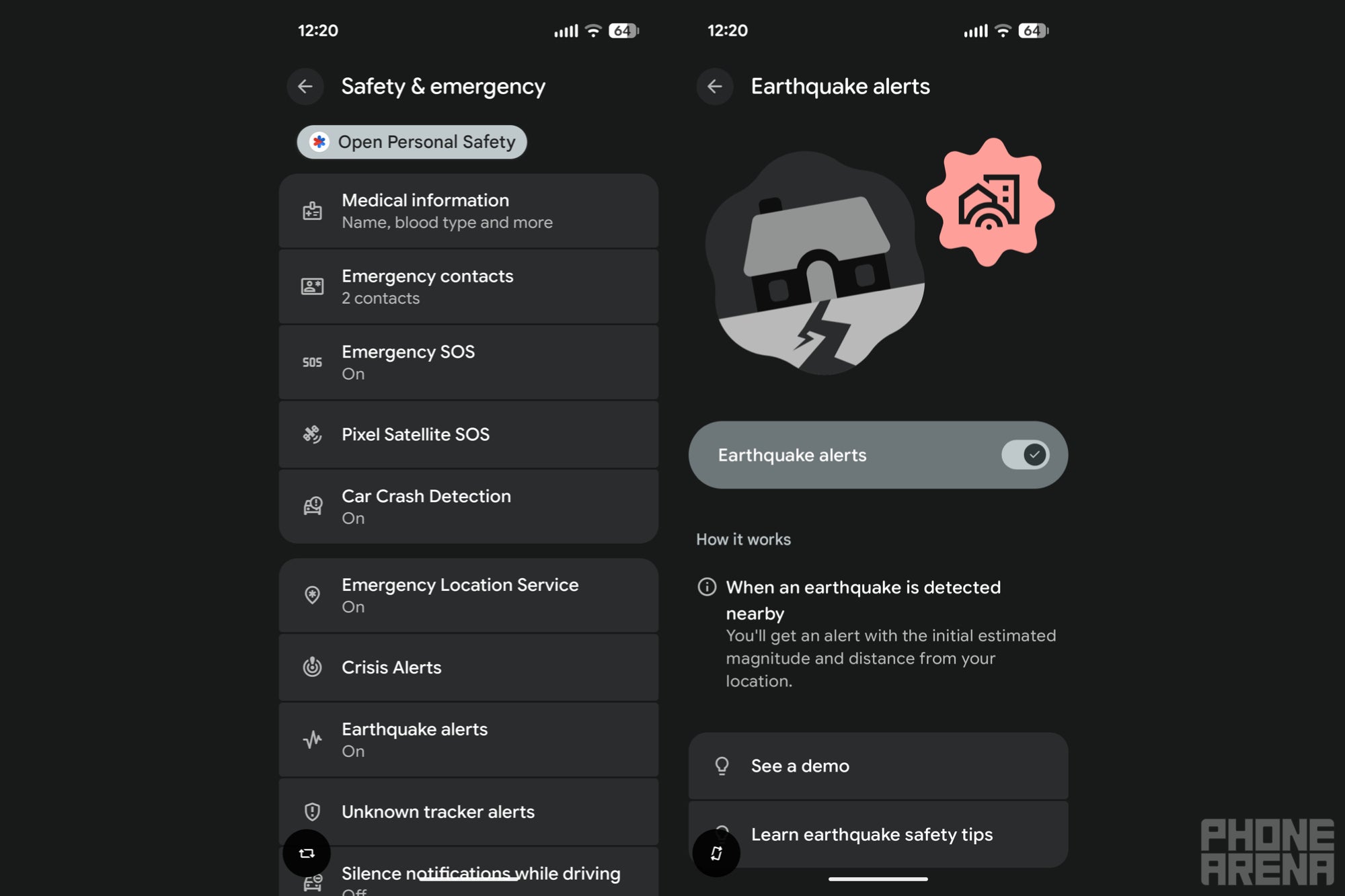
Open the Settings app on your Android phone
Tap Safety & emergency, or search "earthquake" in Settings
Select Earthquake alerts
Switch the toggle on, and keep location enabled
Earthquake alerts sits under Settings, then Safety and emergency on a Pixel, and flips on with a single toggle. | Image by PhoneArena
It takes under a minute, and it's usually on by default, but it's worth checking rather than assuming.
The seconds that matter
I think this is one of the quietly important things Android does, a feature you hope to never need that did exactly what it promised on June 24.
Credit where it's due, Google turned a screen-rotation sensor into a planet-sized warning system that works best where seismic networks don't exist. It bought people seconds in Venezuela, and what I'd love to see next is Apple matching it with real detection instead of relays, plus better awareness so the alert lands the first time.
If you want to go deeper, here's where to head next:
Johanna Romero is a Senior News Writer at PhoneArena, covering mobile technology news across Android, iOS, wearables, and the Google ecosystem she knows best. Drawing on 15 years in IT and tech support from 2007 to 2022, she brings a user-friendly eye for the practical features and lesser-known tricks readers care about. Google named her an official #TeamPixel member in 2022, and she also reviews the latest devices on her YouTube channel, JoJo the Techie.
A discussion is a place, where people can voice their opinion, no matter if it
is positive, neutral or negative. However, when posting, one must stay true to the topic, and not just share some
random thoughts, which are not directly related to the matter.
Things that are NOT allowed:
Off-topic talk - you must stick to the subject of discussion
Offensive, hate speech - if you want to say something, say it politely
Spam/Advertisements - these posts are deleted
Multiple accounts - one person can have only one account
Impersonations and offensive nicknames - these accounts get banned
To help keep our community safe and free from spam, we apply temporary limits to newly created accounts:
New accounts created within the last 24 hours may experience restrictions on how frequently they can
post or comment.
These limits are in place as a precaution and will automatically lift.
Moderation is done by humans. We try to be as objective as possible and moderate with zero bias. If you think a
post should be moderated - please, report it.
Have a question about the rules or why you have been moderated/limited/banned? Please,
contact us.











Things that are NOT allowed:
To help keep our community safe and free from spam, we apply temporary limits to newly created accounts: