The 160 MHz 5G spectrum that the big carriers will be bidding on
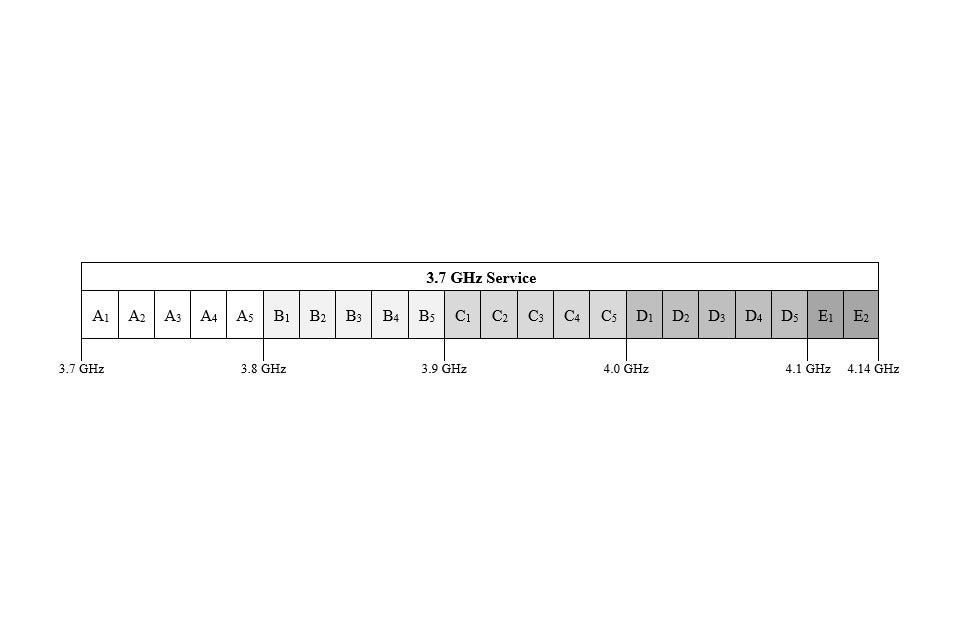
FCC Auction 115 is set to start its bidding on April 27, 2027, and covers 160 MHz of spectrum between 3.98 and 4.14 GHz, known as upper C-band airwaves. This spectrum is set to be split into 3,248 licenses across the US.
The upper C-band joins the 280 MHz lower C-band (3.7 to 3.98 GHz) that was auctioned back in 2020 and 2021 to T-Mobile, AT&T and Verizon, making one 440 MHz block. Both of them joined together in one block can allow carriers to use wider channels or combine more of their spectrum, which results in potentially faster speeds and more capacity.
The new upper C-band blocks extend the same 3.7 GHz band carriers already use for 5G. | Image by FCC
However, winners of this auction won't be able to switch the new airwaves on until December 2030 in big cities and July 2031 elsewhere. Also, although licenses are for land-based service only, SpaceX is still expected to bid.
FCC Chairman Brendan Carr has said that he expects the auction to help drive prices down, as well as drive more mid-band innovation. I'd love that, but the last C-band auction gives me a reason to wait and see how this plays out.
Recommended For You
Poll
0 Votes
What's most likely to lower your phone bill?
The record $81 billion C-band bill from 2021
The last C-band auction, in 2021, raised about $81 billion. This made records as the old one was a little bit more than half at $44.9 billion in 2015. The bill for this monumental purchase can be broken down as follows:
$45.4B for 3,511 licenses went to Verizon.
$23.4B for 1,621 licenses went to AT&T.
$9.3B for 142 licenses went to T-Mobile, though the company already had Sprint's mid-band spectrum.
It should be noted that spectrum buys more MHz, which means wider channels, and then more capacity for people connected at full speed without slowdowns. However, there is nothing in the auction rules that ties the acquisition of new spectrum to wireless plan prices. It is still very much each carrier's own business call what they will charge.
In other words, for the consumer, more spectrum means more reliable 5G in busy places, but not necessarily an automatic bill discount. The wireless bill only drops if that person's carrier decides to compete on price.
To be fair, more spectrum lets carriers add capacity and serve more customers, which should help competition. This is precisely the FCC's argument for lower costs. Still, last time, the same three carriers won almost all of the spectrum, and a fourth bidder like SpaceX is what could change that.
Some AT&T customers say they still saw a price hike while service stayed the same
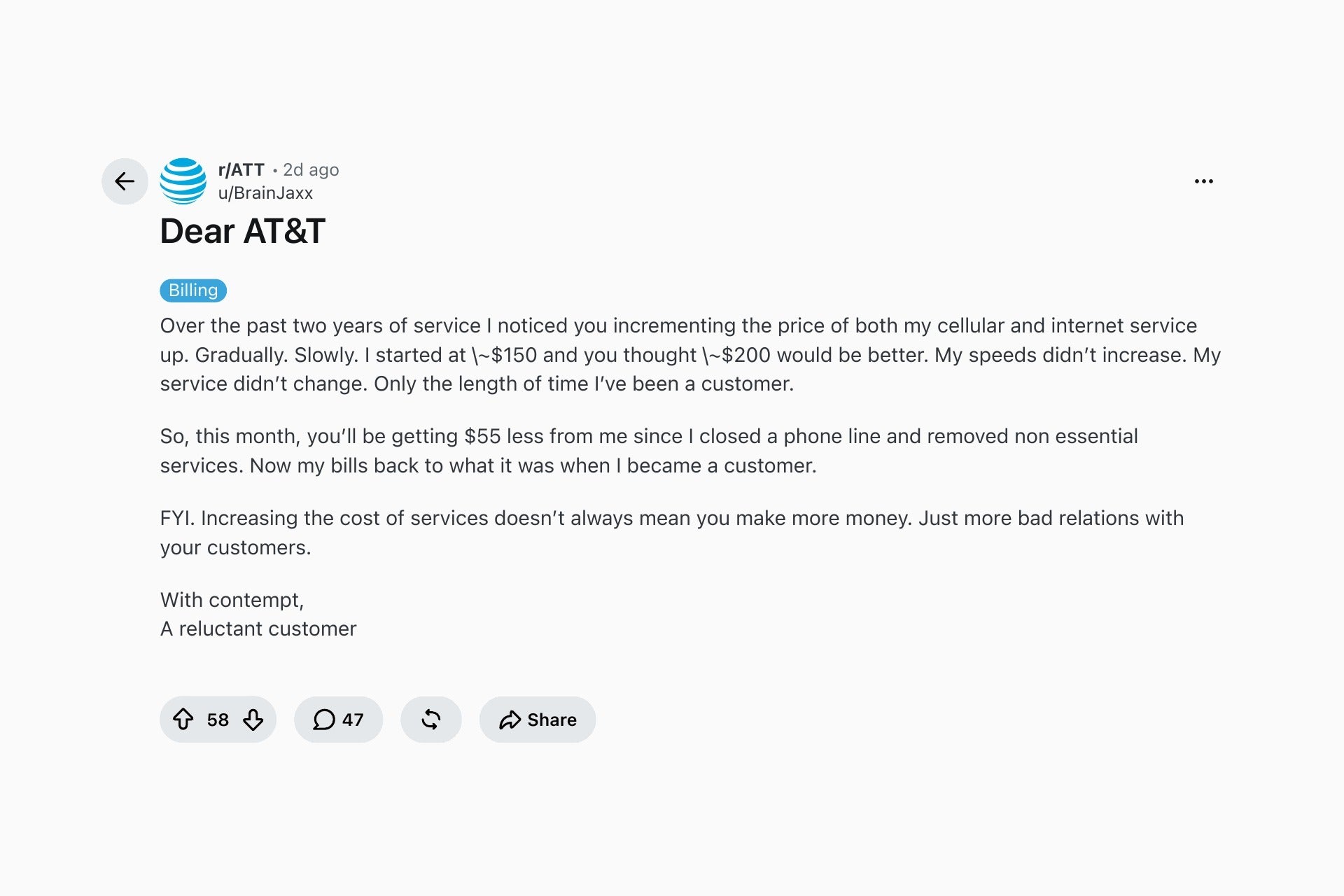
I came across a "Dear AT&T" post on r/ATT where a customer says their phone and internet bill crept up from about $150 to $200 a month over the span of two years. Meanwhile, the speeds and the service didn't change, only how long they'd been a customer.
An AT&T customer's open letter about rising bills on r/ATT. | Image by BrainJaxx via Reddit
This customer ended up closing a phone line and dropping extras from their plan, cutting about $55 a month. That resulted in their bill going back to where it started.
In the replies, one person said their combined AT&T bill went from $320 in 2020 to $460 for 3 phone lines, home internet, and DirecTV. Another person said their AT&T Air internet went from $65 to $70 with no notice, so they ended up canceling.
Not everyone piled on, though. One commenter pointed out that companies are facing higher wages, power and tax costs, and that Verizon and T-Mobile subreddits have the same complaints too.
However, it should be noted that this was just one thread with 58 upvotes and 47 comments the last time I looked, so this is just a snapshot in time of that sentiment.
Of course, C-band did bring faster mid-band 5G to customers and it helped 5G home internet take off. Recon Analytics' Roger Entner also said that the real inflation-adjusted price of an average connection fell 57% since 2007.
You shouldn't pick your phone plan based on an FCC promise
I'm all for carriers getting more room to grow, but I'll believe that this will lower prices when my bill reflects that. Certainly, if I were on a legacy plan, I'd keep an eye on hike notices and not what the FCC says may happen.
If I could ask for one thing, it would definitely be for the carriers to pass some of the gains on as lower prices and not just faster speeds. Personally, I'd love to be proven wrong and write the "my bill went down" article instead.
Johanna Romero is a Senior News Writer at PhoneArena, covering mobile technology news across Android, iOS, wearables, and the Google ecosystem she knows best. Drawing on 15 years in IT and tech support from 2007 to 2022, she brings a user-friendly eye for the practical features and lesser-known tricks readers care about. Google named her an official #TeamPixel member in 2022, and she also reviews the latest devices on her YouTube channel, JoJo the Techie.
A discussion is a place, where people can voice their opinion, no matter if it
is positive, neutral or negative. However, when posting, one must stay true to the topic, and not just share some
random thoughts, which are not directly related to the matter.
Things that are NOT allowed:
Off-topic talk - you must stick to the subject of discussion
Offensive, hate speech - if you want to say something, say it politely
Spam/Advertisements - these posts are deleted
Multiple accounts - one person can have only one account
Impersonations and offensive nicknames - these accounts get banned
To help keep our community safe and free from spam, we apply temporary limits to newly created accounts:
New accounts created within the last 24 hours may experience restrictions on how frequently they can
post or comment.
These limits are in place as a precaution and will automatically lift.
Moderation is done by humans. We try to be as objective as possible and moderate with zero bias. If you think a
post should be moderated - please, report it.
Have a question about the rules or why you have been moderated/limited/banned? Please,
contact us.















Things that are NOT allowed:
To help keep our community safe and free from spam, we apply temporary limits to newly created accounts: