US consumers aren't supposed to be enjoying 6G connectivity until 2030. There are still so many things that have yet to be decided on and tested, and so many standards still need to be agreed on.
Ericsson and Verizon combine to make the first 6G call in the field usijng 7 GHz airwaves
This past May, we did tell you that as far back as 2024, the National Telecommunications and Information Administration (NTIA) seemed to prefer the 7 GHz band for 6G in the US.Verizon and Ericsson recently had the first 6G call in the field over the 7 GHz spectrum. The pair were testing the outdoor performance and the indoor coverage of the spectrum.
The call was made using proof-of-concept equipment
The call was made using proof-of-concept equipment at a parking lot in Concord, California, allowing performance both inside buildings and outside to be evaluated. Installed at Verizon's site shelter was an Ericsson proof-of-concept (PoC) 6G base station using experimental 6G code that has yet to be finalized by official global standard bodies like the 3GPP. Thus, we can't say that this was the first call over an official 6G network, but it is as close as we can get to a 6G network at this point in time.
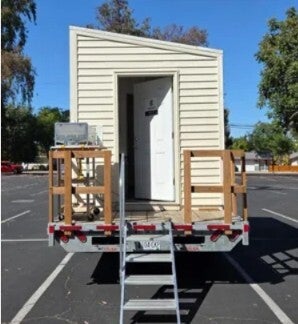
The mobile testing lab called a house was used to simulate indoor offices and homes
A mobile testing lab on wheels was built for this occasion, measuring 12 feet by 8 feet. This "house," as it is called, is designed to simulate a real home or office environment, and has devices inside it that are connected to the 6G network being tested.
A mobile testing lab used in the 6G tests also known as a house. | Image by Ericsson
These mobile testing labs are used by engineers to measure how signal waves (like high-band mmWave or experimental 6G signals) pass through exterior walls, windows, and inside spaces compared to an outdoor direct, line-of-sight signal.
When will 6G get to US consumers?
2 Votes
Besides receiving signals inside and outside the mobile lab, to test the capabilities of the experimental 6G network, the lab was moved into specific positions, placing the devices inside it within 100 meters (328.08 feet) and 200 meters (656 feet) of the 6G base station.
What Verizon and Ericsson were testing
Discussing the test, Verizon and Ericsson said "The confirmed field result is an outdoor call, while the broader proof-of-concept examines how 6G performance carries from open air into indoor spaces."
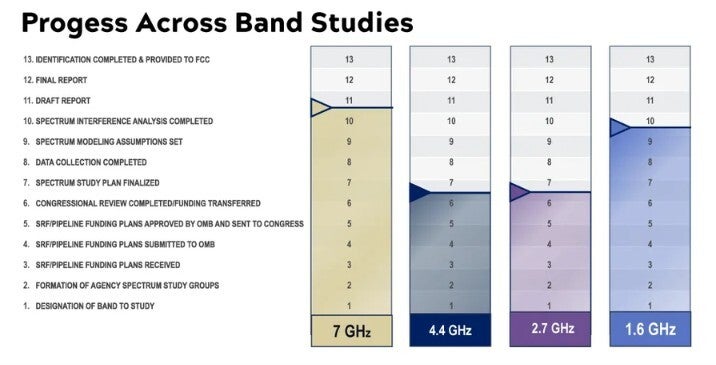
Chart shows the progress made across four bands being looked at for 6G. | Image by NTIA
The partners also explained what they were testing for. "Testing characterizes coverage, throughput, latency, stability, and feature behavior under realistic conditions, including line-of-sight and non-line-of-sight paths, foliage, obstacles, and outside-in penetration through different glass and building materials," they said.
The NTIA is looking at four bands for 6G
We don't know exactly what part of the 7 GHz band was used for the test. The NTIA has been examining the lower part of the band (7125 MHz–7400 MHz) as well as the 4.4 GHz, 2.7 GHz, and 1.66 GHz airwaves. The FCC has given the NTIA until this December to complete a one-year study of 7 GHz and work out a plan to relocate current federal users of the spectrum.
Get a free Galaxy A17 with Straight Talk. To claim this deal, you need to pair the phone with activation on a Silver Unlimited Plan or higher. This tier costs $45 per month. Offer valid through 01/10/27 while supplies last online.
Alan, an ardent smartphone enthusiast and a veteran writer at PhoneArena since 2009, has witnessed and chronicled the transformative years of mobile technology. Owning iconic phones from the original iPhone to the iPhone 15 Pro Max, he has seen smartphones evolve into a global phenomenon. Beyond smartphones, Alan has covered the emergence of tablets, smartwatches, and smart speakers.
A discussion is a place, where people can voice their opinion, no matter if it
is positive, neutral or negative. However, when posting, one must stay true to the topic, and not just share some
random thoughts, which are not directly related to the matter.
Things that are NOT allowed:
Off-topic talk - you must stick to the subject of discussion
Offensive, hate speech - if you want to say something, say it politely
Spam/Advertisements - these posts are deleted
Multiple accounts - one person can have only one account
Impersonations and offensive nicknames - these accounts get banned
To help keep our community safe and free from spam, we apply temporary limits to newly created accounts:
New accounts created within the last 24 hours may experience restrictions on how frequently they can
post or comment.
These limits are in place as a precaution and will automatically lift.
Moderation is done by humans. We try to be as objective as possible and moderate with zero bias. If you think a
post should be moderated - please, report it.
Have a question about the rules or why you have been moderated/limited/banned? Please,
contact us.








Things that are NOT allowed:
To help keep our community safe and free from spam, we apply temporary limits to newly created accounts: