Microsoft no longer allows you to activate Windows or its other products over the phone.
A decade-old activation service is now gone
Microsoft requires you to activate Windows and its other products using the product key that comes with your purchase. Activation allows Microsoft to ensure that the software copy you are using is genuine and eligible to receive support. Over the years, there have been a few ways to activate Microsoft products, one of which involved calling the activation hotline.
You simply had to call the regional activation number, provide your installation ID, and receive a confirmation ID in return. And just like that, your copy of Windows was successfully licensed.
However, there are multiple reports claiming that Microsoft has stopped supporting this activation method. The change was first spotted by a Reddit user almost a month ago, who noted that calling the activation number now states that the activation process has moved online. Another user later shared a video on YouTube illustrating the same experience. Below is the exact response you hear when you call the activation number.
Support for product activation has moved online. For the fastest and most convenient way to activate your product, please visit our online product activation portal at aka.ms/aoh. The ability to activate Windows using a phone has been available since the Windows XP days. The main reason for its popularity is that it allows activation of the OS without an internet connection.
Recommended For You
There were no issues activating Windows using this method until a couple of months ago, as I still remember activating a Windows 10 copy on one of my virtual machines using this procedure in September last year. That said, Microsoft interestingly still lists phone activation as one of the ways to activate a Windows copy on its support page and mentions the exact steps you need to follow.
No more anonymous activation
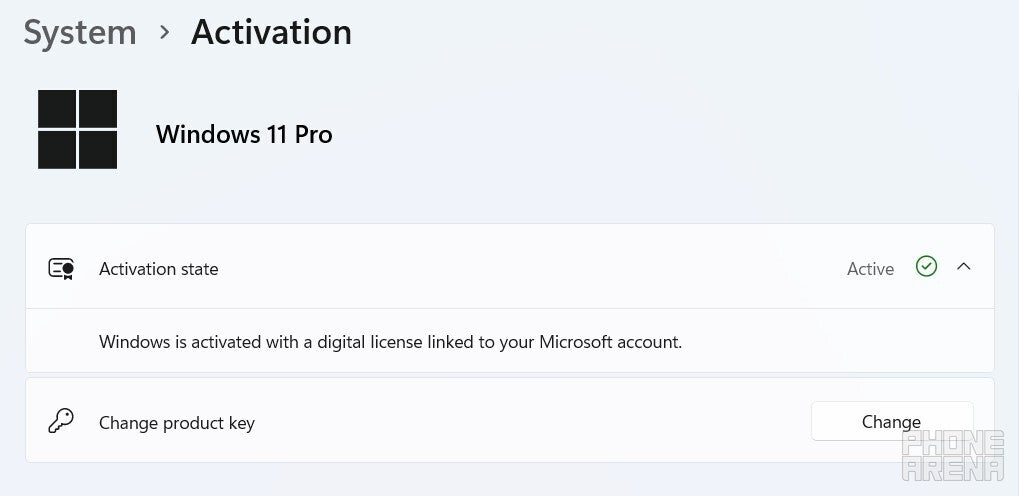
Activation page in Windows 11 Settings menu. | Image by PhoneArena
Since very few people activate their Windows copy through their phones these days, you may think that it is actually a good move by Microsoft. While someone like me with a Microsoft account might agree with you, others who prefer anonymity will not.
You see, the main drawback with the online activation portal is that you must sign in with a Microsoft account to complete the activation process. The phone activation process, on the other hand, was completely anonymous and didn't require a Microsoft account for activation. That's why it was quite popular among users running legacy system. It was a quite popular activation method in enterprise environments as well, such as manufacturing plants that cannot afford to connect systems to the network, as it could pose a security risk.
The online activation portal reportedly also allows users to activate older Windows versions, such as Windows XP and Windows 7. However, you need an internet connection and a Microsoft account to do so, which ultimately defeats the purpose of why people used to rely on the phone activation method.
Which OS would you switch to if you were given the choice to ditch Windows?
81 Votes
ChromeOS.
14.81%
macOS.
23.46%
Linux.
61.73%
Your privacy is taking a hit too
I also think there is a privacy concern with this move that you need to be aware of. Once your Windows or any other Microsoft product license is linked to your Microsoft account, the company could start tracking your online usage and other diagnostic data from different Microsoft products.
That said, this is not the only move related to the Windows OS that has received mixed reactions from its users. The Redmond giant recently blocked workarounds such as using commands like "bypassnro," so you are now required to have an internet connection and a Microsoft account during the Out of Box Experience (OOBE), which basically refers to the setup process you go through while installing a new copy of Windows.
Furthermore, the company also blocked a quite popular KMS38 activation method that many users relied on to activate their Windows copy without an internet connection. All these recent moves strongly indicate that Microsoft wants its users to stop relying on offline capabilities and shift to an always‑online ecosystem.
Mint Mobile's 6-month plans now cost $10/mo
$10
/mo
$35
$25 off (71%)
Mint Mobile is celebrating its 10-year anniversary with a special offer on its six-month subscription plans. For a limited time, you can get your preferred tier (6GB, 17GB, 23GB or unlimited) for just $10/mo. That saves you between 50% and 71% on the carrier's mobile plans, making it way easier to recommend.
Aman Kumar is a news writer at PhoneArena covering Google Pixel phones, Android features, AI-powered smartphone tools, and mobile tech news. Before joining PhoneArena, he spent over five years writing about consumer technology for publications like MakeUseOf, How-To Geek, and Guiding Tech. His current daily drivers are the Pixel 10 and Samsung Galaxy S26 Plus, while his red iPhone SE (2nd gen) remains a personal favorite. Aman also appreciates bold smartphone experiments and still considers the Nokia N-Gage one of the industry’s most iconic designs.
A discussion is a place, where people can voice their opinion, no matter if it
is positive, neutral or negative. However, when posting, one must stay true to the topic, and not just share some
random thoughts, which are not directly related to the matter.
Things that are NOT allowed:
Off-topic talk - you must stick to the subject of discussion
Offensive, hate speech - if you want to say something, say it politely
Spam/Advertisements - these posts are deleted
Multiple accounts - one person can have only one account
Impersonations and offensive nicknames - these accounts get banned
To help keep our community safe and free from spam, we apply temporary limits to newly created accounts:
New accounts created within the last 24 hours may experience restrictions on how frequently they can
post or comment.
These limits are in place as a precaution and will automatically lift.
Moderation is done by humans. We try to be as objective as possible and moderate with zero bias. If you think a
post should be moderated - please, report it.
Have a question about the rules or why you have been moderated/limited/banned? Please,
contact us.









Things that are NOT allowed:
To help keep our community safe and free from spam, we apply temporary limits to newly created accounts: