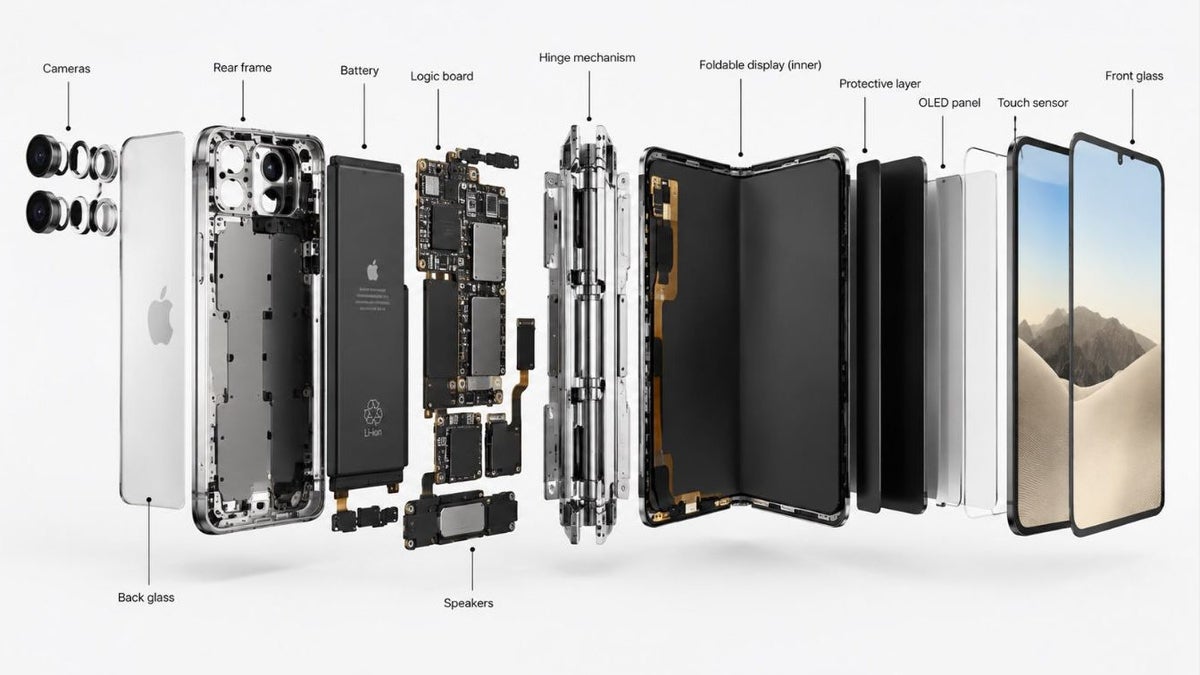
The iPhone Duo has been all over the news lately, and it's been a controversial ride. However, there's one area where Apple has gone above and beyond in order to deliver the best foldable experience with the Duo — its hinge and the crease on top of it.
iPhone Duo's hinge — Grade 5 titanium and more than 100 parts
The hinge is one of the most important mechanisms, from a mechanical point of view, when it comes to foldable phones. It's the link between the two folding elements; it supports the flexible screen, and it must also withstand tens of thousands of folds and unfolds.
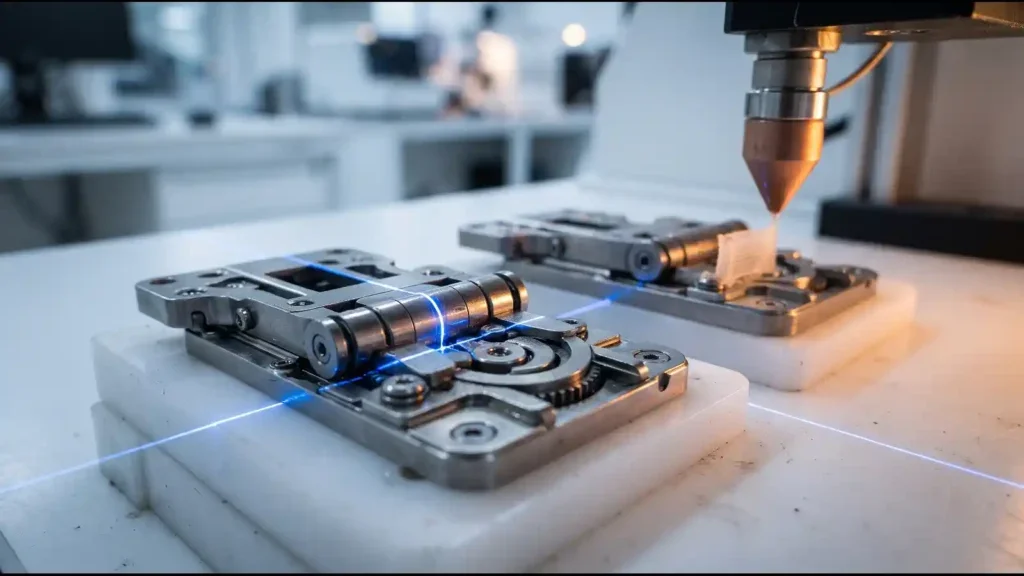
3D-printed outer shell
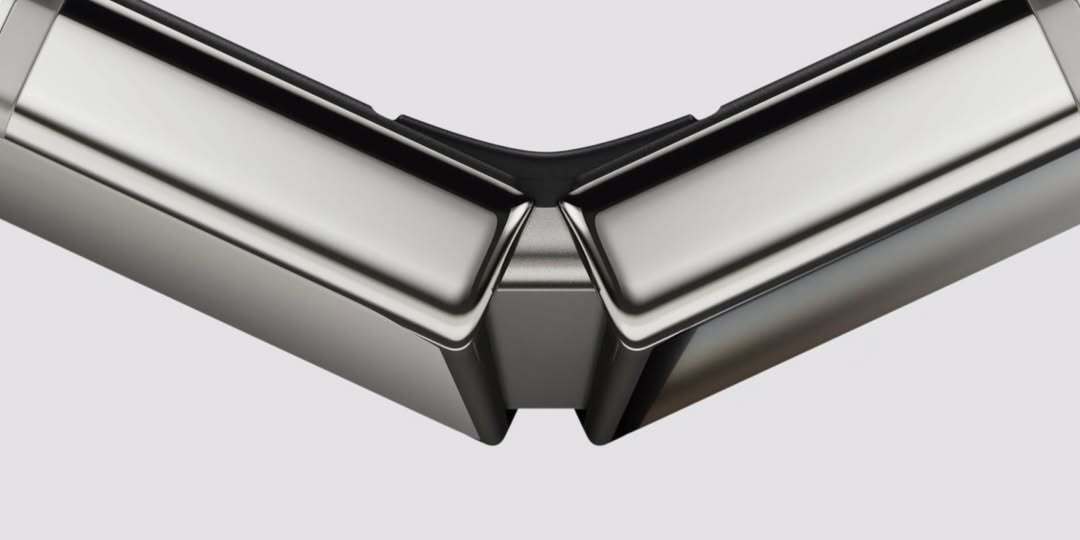
The outer shell of the iPhone Duo's hinge uses 100% recyclable, 3D printed titanium. | Image by Apple
The outer shell of the iPhone Duo's hinge is made from Grade 5 titanium. Apple used an advanced 3D printing technology called Laser Powder Bed Fusion (LPBF) to mass-produce the outer shell of the hinge from 100% recyclable titanium.
This technology uses high-power lasers to melt titanium powder into complex structures. Using this method, Apple was able to achieve the exceptionally thin walls, micro-blasted finishes, and complex geometries required for the iPhone Duo's hinge.
But the real magic lies inside the hinge, under the 3D-printed cover.
More than 100 parts with synchronized dual-axis gears
There are more than 100 parts inside the iPhone Duo's hinge. | Image by clipsnshxt01
Ever wonder how foldables unfold so fluidly and symmetrically? The answer is synchronized dual-axis gears. This mechanism uses interlocking precision gears that connect the two "wings" of the phone.
Recommended For You
When you start unfolding the phone by opening the left part, for example, the gear connected to that part starts rotating. Because it's interlocked and synchronized with the gear connected to the right part, both gears move in opposite directions and rotate at exactly the same angle.
This gives a perfectly symmetrical movement to both sides no matter how you try to open the phone, regardless of grip or force.
The iPhone Duo will hold any angle between 15 and 145 degrees
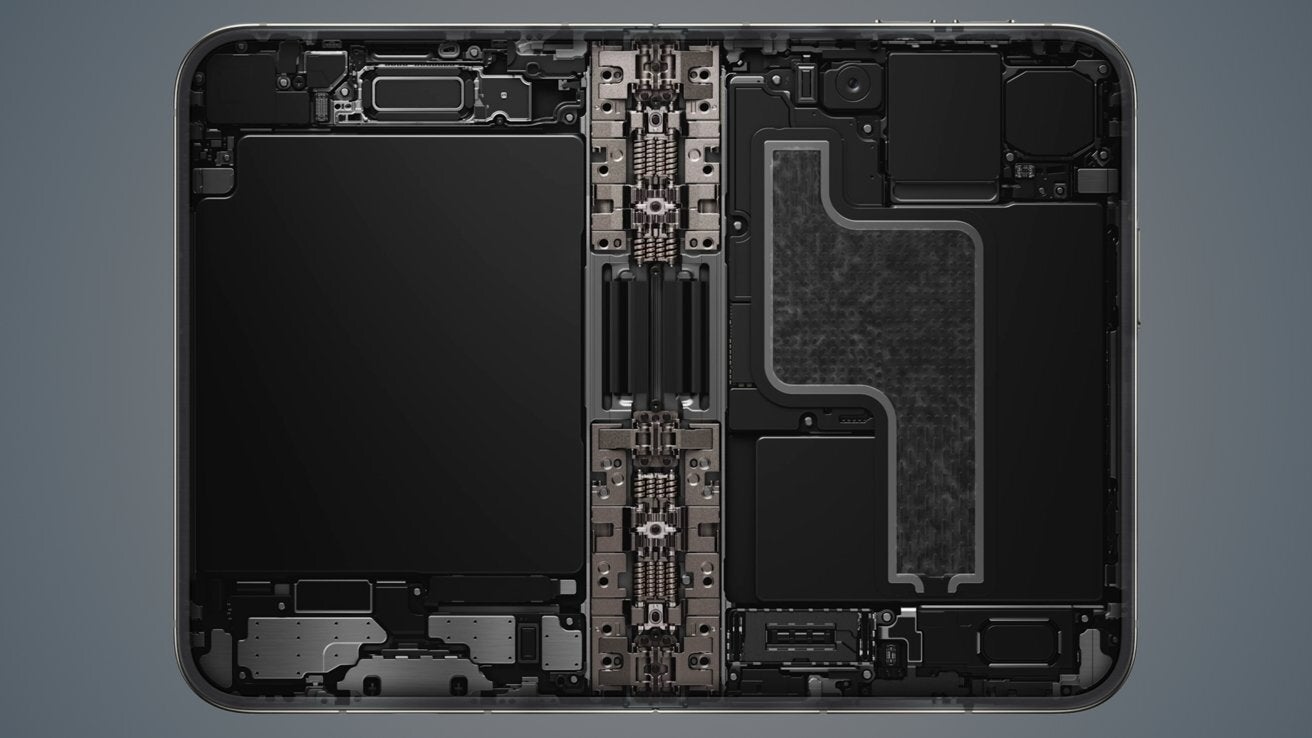
You can see the dual-axis gears, cams and springs inside the hinge. | Image by Apple
Some foldables only have two or three positions you can use them in: completely folded, completely unfolded, and at 90 degrees, mimicking a laptop. The iPhone Duo's hinge features a special mechanism of cams and springs that allows the phone to stay open at any angle between 15 and 145 degrees.
This not only gives you the ability to partially open the phone and leave it standing while on a Zoom call or while watching videos, but it also gives you a solid feel when folding and unfolding the device. The hinge stays locked and responds only to your input — it won't fold or unfold under its own weight.
Hollow channel with no moving parts
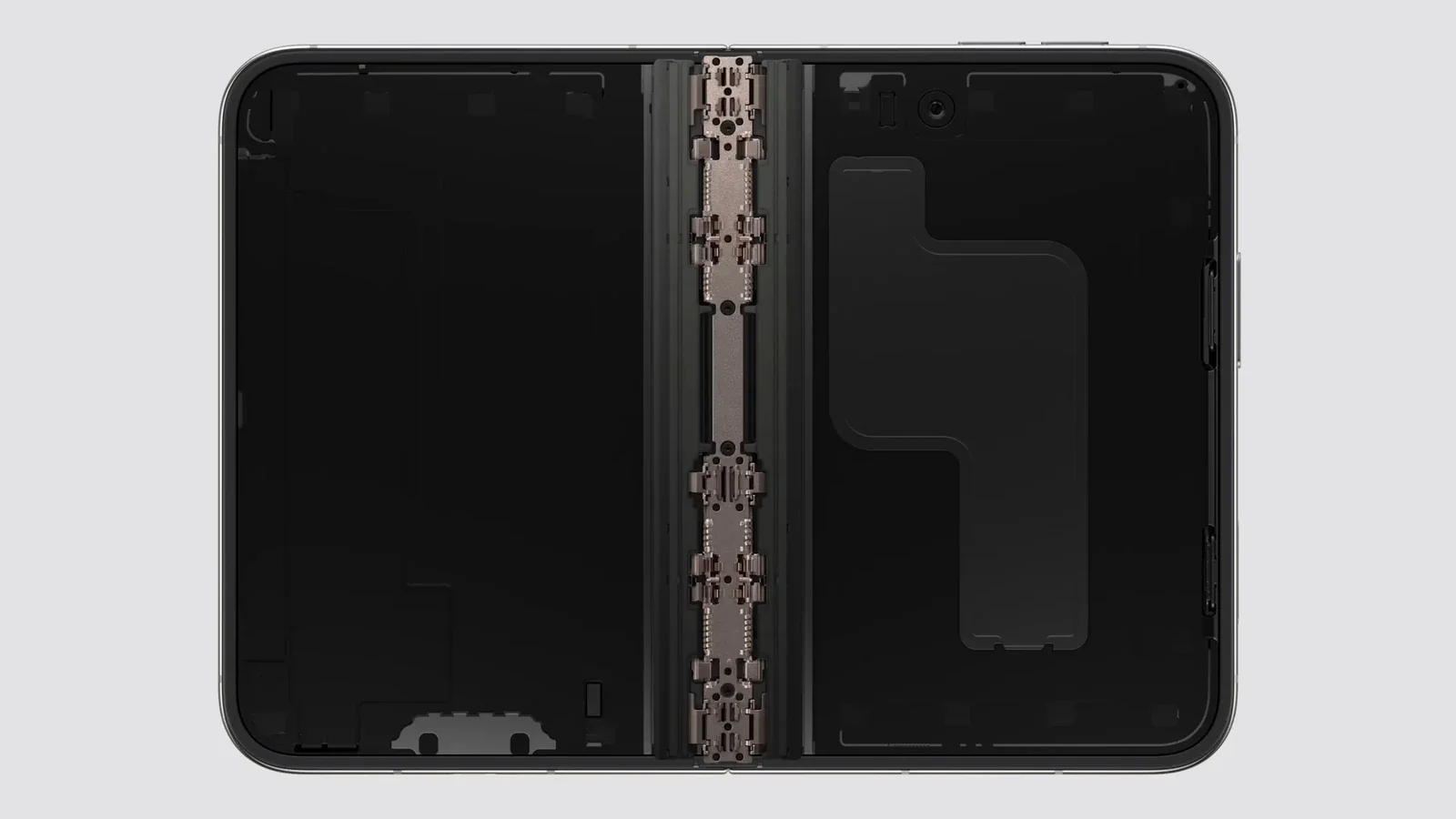
There's a central conduit with no moving parts and it houses all the cables and also the graphite heat pipe. | Image by Apple
The center of the hinge features a hollow channel with no moving parts, and this serves a clear purpose. All the internal flex cables, along with the graphite cooling pipe, are housed there, which means they don't twist or bend when you're opening or closing the phone.
Early foldable models, and even some current devices, sometimes suffer critical failures due to pinched or broken cables in this exact zone. Speaking of the hollow channel and heat management, Apple did another clever thing with the hinge.
This unique design allows for uniform heat distribution, prevents heat spots when the phone is closed, and also allows the phone to run at higher CPU and GPU speeds without thermal throttling.
Let's now move to the crease and find out what Apple did to hide it so well.
The iPhone Duo crease is almost gone — It's smoke and mirrors
The iPhone Duo crease is almost invisible. | Image by 9to5Google
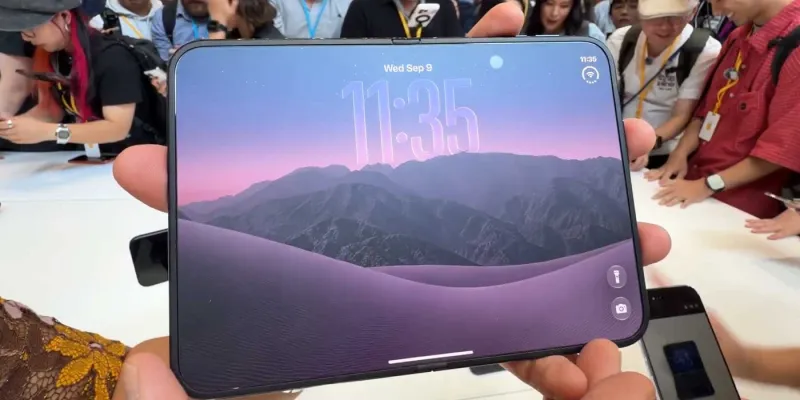
When Apple first showed the iPhone Duo, many people noticed that the crease was almost invisible when the phone was unfolded. Apple used a combination of clever mechanical and optical tricks to achieve this. Some would call this modern "smoke and mirrors."
Multi-layer design with flexible glue
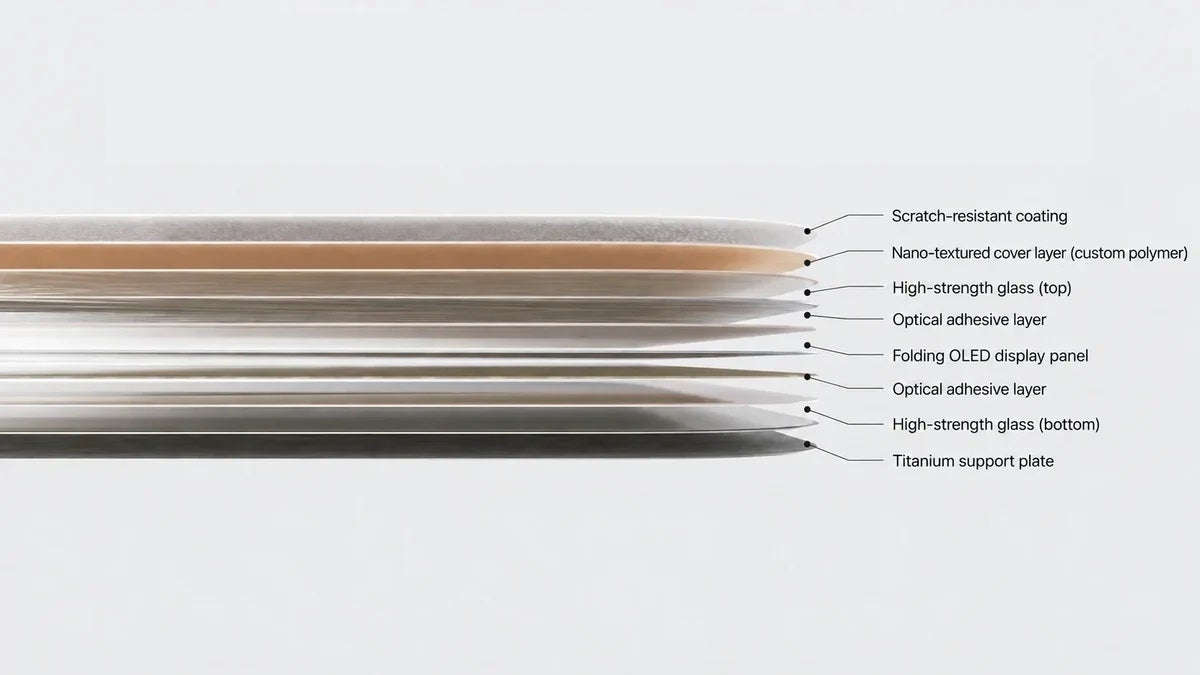
Apple used a multi-layer design for the iPhone Duo's screen. | Image by Apple
The first part of the equation is the multi-layered design of the screen. It features a complex set of layers, including polymer, nano-texture coating, and the glue itself.
To prevent the layers from buckling or pinching when bent, Apple uses a special flexible glue. This allows the individual layers to slide slightly past one another as the phone closes, mimicking the way pages move in a book.
The iPhone Duo's display has variable thickness
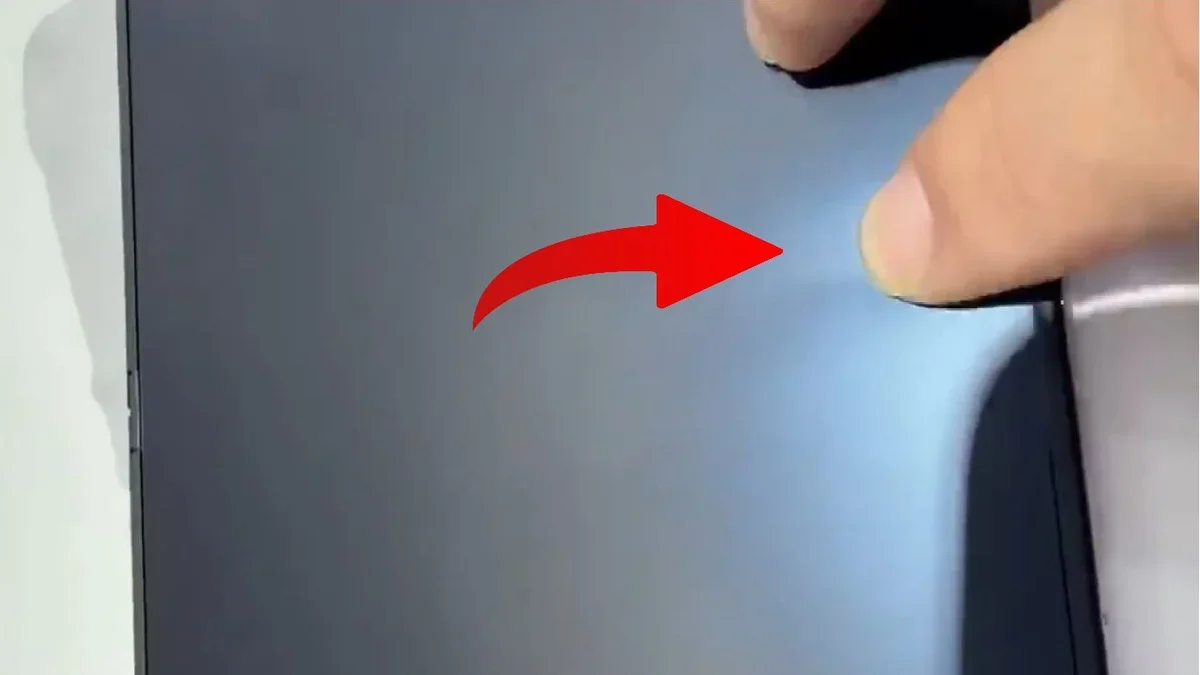
The iPhone Duo's display is extremely soft around the crease. | Image by Weibo
Thick and rigid glass or polymer are hard to bend and also hard to make perfectly flat. That's why Apple uses a variable-thickness glass matrix on the iPhone Duo. In layman's terms, the glass toward the ends of the two "wings" is thicker, while in the center, right on top of the hinge where the screen bends, there's a microscopically thin, pliable strip.
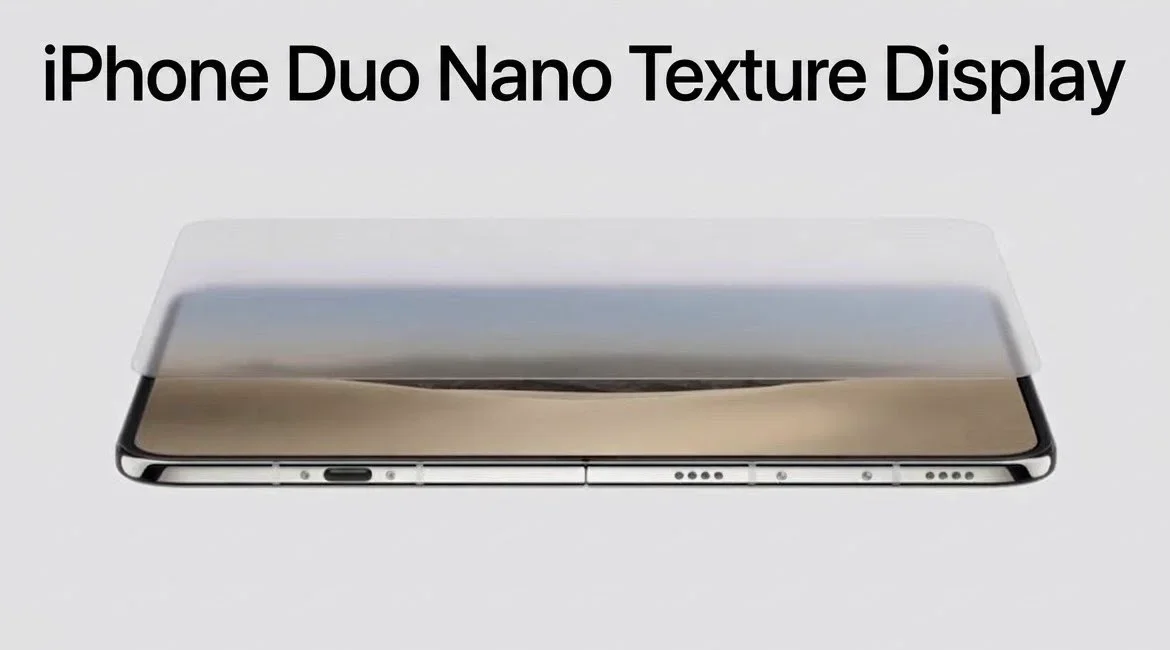
Apple used a special layer that scatters light rather than reflecting it. | Image by Apple
All foldable models prior to the iPhone Duo used glossy polymer screens to give the user a premium glass feel and look. However, this glossy plastic catches reflections and makes the crease much more visible.
Apple decided to go the matte route, covering the glossy sheet with a nano-texture finish. It's not just a non-reflective surface — that wouldn't have worked. Apple used a process called maskless laser lithography.
The company treated every microlens of that matte cover that goes over every single pixel of the screen individually. Apple did it in such a way that the material diffuses light rather than reflecting it. This is the optical effect that hides the crease. In this case, it's the opposite of "smoke and mirrors."
What do you think about all the innovations that went into making Apple's first foldable?
2 Votes
The AI manufacturing innovation no one talks about
Apple decided to employ AI in the iPhone Duo's manufacturing in a genius way. | Image by BriefFlash
A technological advancement can't happen without AI nowadays. I know some people think it's bad and all, but it's a tool, and when used the right way, it can produce great things.
With the iPhone Duo, Apple used AI in a brilliant way — creating one of the most distinct manufacturing innovations in smartphone production.
The method is called AI-assisted component matching, and it's as simple as the name suggests. Every manufacturing process creates tolerances and errors, no matter how precise you set them.
Rather than aiming for higher precision, Apple decided to use AI to match components in such a way that imperfections fit like a microscopic puzzle. Any remaining imperfections are filled with a polymer applied by a precision printer. Frankly, this approach is pure genius.
So, that's the iPhone Duo's hinge and crease. Apple really outdid itself when designing and manufacturing this device. What do you think about it now that you know all the innovations that went into making Apple's first foldable?
Mariyan, a tech enthusiast with a background in Nuclear Physics and Journalism, brings a unique perspective to PhoneArena. His childhood curiosity for gadgets evolved into a professional passion for technology, leading him to the role of Editor-in-Chief at PCWorld Bulgaria before joining PhoneArena. Mariyan's interests range from mainstream Android and iPhone debates to fringe technologies like graphene batteries and nanotechnology. Off-duty, he enjoys playing his electric guitar, practicing Japanese, and revisiting his love for video games and Haruki Murakami's works.
A discussion is a place, where people can voice their opinion, no matter if it
is positive, neutral or negative. However, when posting, one must stay true to the topic, and not just share some
random thoughts, which are not directly related to the matter.
Things that are NOT allowed:
Off-topic talk - you must stick to the subject of discussion
Offensive, hate speech - if you want to say something, say it politely
Spam/Advertisements - these posts are deleted
Multiple accounts - one person can have only one account
Impersonations and offensive nicknames - these accounts get banned
To help keep our community safe and free from spam, we apply temporary limits to newly created accounts:
New accounts created within the last 24 hours may experience restrictions on how frequently they can
post or comment.
These limits are in place as a precaution and will automatically lift.
Moderation is done by humans. We try to be as objective as possible and moderate with zero bias. If you think a
post should be moderated - please, report it.
Have a question about the rules or why you have been moderated/limited/banned? Please,
contact us.













Things that are NOT allowed:
To help keep our community safe and free from spam, we apply temporary limits to newly created accounts: