Verizon wanted more of its customers to be able to access the latest wireless technology
The goal is to have more Americans connected to high-speed wireless and fiber. Verizon had sought permission to replace the copper in nine states and the carrier was hoping to obtain this permission as soon as possible.
The nine states that Verizon requested FCC permission to remove “POTS” from include:
Arizona
Delaware
New Jersey
New Mexico
Ohio
Rhode Island
South Carolina
Utah
Virginia
The faster the FCC gave the wireless provider, in this case Verizon, permission to dismantle its copper network, the faster it can offer certain services to its customers that demand lower latency and the fast data speeds not available via copper connectivity.
Verizon expected to get the FCC approval this past weekend
Verizon expected to receive the approval from the FCC to remove the copper on Saturday, but the regulatory agency decided that it needs additional time to study the proposal from Verizon so it can figure out whether the consumers and communities impacted by the loss of copper networks have a legitimate complaint.
Recommended For You
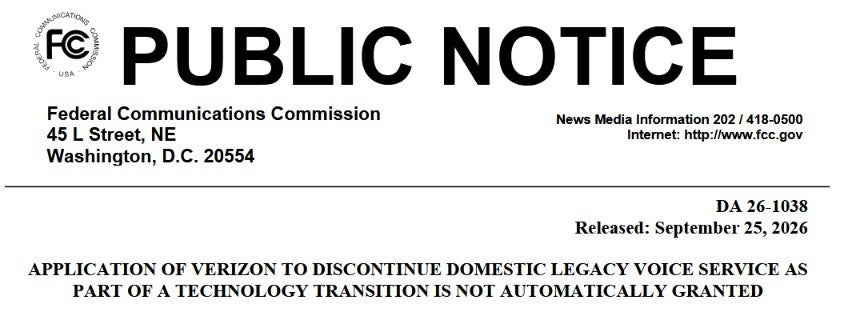
The FCC fails to approve Verizon's request to disable some copper-powered POTS. | Image by the FCC
Consumers who prefer using a legacy copper network and those who live in rural communities have filed complaints with the FCC. This led the agency to say on Friday, "The Commission requires additional time to complete its review."
The FCC decides not to automatically approve Verizon's request
Some of the FCC statement noted that Verizon’s application will not be automatically approved. The regulatory agency made it clear that the ruling is not the last word on Verizon’s request. "We emphasize that our removal of Verizon’s application from the automatic grant process is also not a final determination on the merits of Verizon’s request for authority to discontinue service," the FCC said.
Considering the advanced services consumers receive from using fiber or wireless over copper, such as massive speed improvements and lower latency, you might wonder why any Verizon subscriber would complain about removing the copper network. But in some remote parts of the country, there is concern that removing the copper network would leave an inferior wireless network. That’s because in some locations, Verizon’s network has issues reaching remote areas far from traditional cell towers.
US Rep. Ben Cline (R-Virginia) sent a letter to the FCC earlier this month telling the FCC to look closely at Verizon's proposal. He complained that large parts of his district are cellular dead zones making wireless a poor replacement for copper networks. The other option, fiber, is not a viable choice all over his district because "fiber to the home has not yet been built out across these communities, leaving some households with no wireline alternative once copper is retired."
Verizon tells the FCC that it won't replace copper in some areas
Last week, before the FCC announced its decision, Verizon sent a letter to the agency stating that it won’t replace the copper network in areas where the carrier’s alternatives fall short.
The FCC did get approval in several states to replace the copper related to payphones and low-speed business services
Meanwhile, it appears that the FCC did grant Verizon the approval to replace the copper-based services related to “legacy, low-speed business services” such as payphone service and business dial tone line.
Earlier this month, Verizon filed another application seeking permission to remove the copper networks serving these states and the District of Columbia:
California
Connecticut
District of Columbia,
Illinois
Maryland
Massachusetts,
Michigan
New York
Pennsylvania
West Virginia
In these locations, approximately 750,000 consumer and business customers, or 2.7%, still receive legacy voice services.
Alan, an ardent smartphone enthusiast and a veteran writer at PhoneArena since 2009, has witnessed and chronicled the transformative years of mobile technology. Owning iconic phones from the original iPhone to the iPhone 15 Pro Max, he has seen smartphones evolve into a global phenomenon. Beyond smartphones, Alan has covered the emergence of tablets, smartwatches, and smart speakers.
A discussion is a place, where people can voice their opinion, no matter if it
is positive, neutral or negative. However, when posting, one must stay true to the topic, and not just share some
random thoughts, which are not directly related to the matter.
Things that are NOT allowed:
Off-topic talk - you must stick to the subject of discussion
Offensive, hate speech - if you want to say something, say it politely
Spam/Advertisements - these posts are deleted
Multiple accounts - one person can have only one account
Impersonations and offensive nicknames - these accounts get banned
To help keep our community safe and free from spam, we apply temporary limits to newly created accounts:
New accounts created within the last 24 hours may experience restrictions on how frequently they can
post or comment.
These limits are in place as a precaution and will automatically lift.
Moderation is done by humans. We try to be as objective as possible and moderate with zero bias. If you think a
post should be moderated - please, report it.
Have a question about the rules or why you have been moderated/limited/banned? Please,
contact us.








Things that are NOT allowed:
To help keep our community safe and free from spam, we apply temporary limits to newly created accounts: