Google to limit memory usage by Play Store apps and games
With a memory shortage affecting smartphone RAM, Google wants apps to be careful with their memory usage.

Android apps must conserve memory | Image by PhoneArena
Thanks to AI, smartphone manufacturers have faced a shortage of RAM memory chips. AI data centers require huge numbers of High-Bandwidth Memory (HBM) chips. As a result, memory chip manufacturers like Samsung, SK Hynix, and Micron have to choose between producing standard RAM chips, or higher-margin HBM chips. Since the latter makes more money for them, these companies are choosing to make more HBM and fewer RAM chips causing the shortage.
Memory chip pricing has taken off
As a result, pricing for memory chips has skyrocketed. In the middle of 2025, LPDDR5/LPDDR5X memory cost $3.50 to $5.50 per GB on bulk contracts. This year, contract prices for flagship LPDDR5X memory modules have surged to a range of $19.00 to $21.00 per GB. A 12GB LPDDR5X module last year cost an estimated $40 to $50 wholesale. As of the second quarter of 2026, that same module had a wholesale price of $145.90.
The Android Developers Blog addresses this issue with a new requirement for app developers that is designed to help them "navigate industry-wide hardware constraints and Android's broader memory limits." As a result, "Android is addressing this challenge head-on with broader memory limits that aim to protect the overall user experience from apps using excess memory and causing system-wide slowdowns."
Android apps and games must follow strict memory limits starting in February
If you love articles about the Google Play Store, check these out:
Starting this coming February, Android apps and games will have strict limits on the amount of system memory that an app or game can consume. If an app exceeds these limits starting in February, it will be "punished" using the penalties that Google uses on apps that use deceptive behavior, misrepresent an app, distribute malware, change system settings, subscribe the user to hidden subscriptions, or use fake "X" close buttons on ads.
The penalties make it harder for an app to be discovered as rankings can be lowered, or apps can be suspended or permanently banned. In less than six months, Google will punish apps that hog system resources because they can slow down a user's phone, force other apps to crash, or drain the handset's battery.
Google tries to prevent apps and games from using too much RAM
Google wants apps and games not to use more than a certain amount of RAM, and a certain amount of Bitmap memory used to display images, graphics, textures, and UI elements. Google says typical violations causing massive memory spikes include high-resolution images and unoptimized textures.
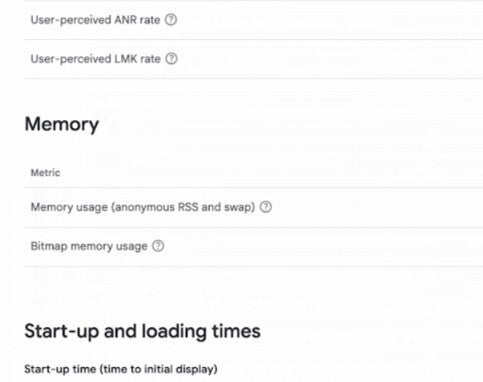
Google doesn't want apps and games overusing memory. | Image by Google
When an app is in the foreground, the bitmaps occupy memory, which makes sense. But in non-visible situations, such as when in the background or when cached, bitmaps should not be held in memory for extended periods of time. This makes sense too.
Developers are given a deadline to optimize three areas of their app's RAM usage:
- Core background code.
- Images/graphics.
- Executable code.
If app developers cannot stay under their memory limits, their apps will be flagged for poor performance. While the blog is mostly published for developers to read, the goal is to improve how users experience using these apps and playing these games. At the same time, knowing that there is a shortage of memory chips, Google wants game developers to keep memory use at a minimum, especially when an app or game is at a stage where it is not forward-facing.
Later this year, Google is expected to give app developers more diagnostic tools and information about the Android Memory Limiter. A feature in Android 17, it prevents individual apps from using too much system memory. Memory is assigned to each app based on what the app is doing and whether it is visible on the screen, or running in the background. The Android Memory Limiter prevents the Android system from shutting down processes that are critical.
Zero Tap Sign-In makes it easier and faster to open apps when switching to a new Android device
Google said that it is also working on making app log-ins faster and safer when a user transfers to a new device. Starting in April 2027, Google Play will require apps to meet the Zero Tap Sign-In requirement in order to continue listing the app in the Play Store and maintain "optimal visibility."
The Zero Tap Sign-In allows users with a new Android device to automatically transfer their log-in credentials for the same app on your new phone. This will save them time and eliminate a hassle. Games are currently not covered by the April 2027 requirement.


Popular stories






Latest News






Things that are NOT allowed:
To help keep our community safe and free from spam, we apply temporary limits to newly created accounts: