Do T-Mobile investors smell some bad news coming the carrier's way?
Aberrations in T-Mobile's shares could be a sign that there is some bad news coming.

T-Mobile shares point to bad news ahead | Image by T-Mobile
T-Mobile's market capitalization, the total market value of the carrier's outstanding shares, dropped like an order of large french fries through a greasy Five Guys takeout bag today. The stock of the carrier plunged by $9.81 a share or 5.57% to $166.45. That puts the stock very close to its 52 week low of $165.66.
Despite a blue chip rally, T-Mobile shares decline almost $10 a share
Despite a greater than 300 point rally in the Dow Industrials on Thursday, the shares of the US Big 3 carriers all declined. T-Mobile had the worst performance on Thursday as AT&T (-1.82%) and Verizon (-2.87%) both declined by a smaller percentage than T-Mobile did. What that means is up to various interpretations, but Wall Street loves aberrations and this one could be a flashing red light indicating that bad news is coming to T-Mobile.
Aberrations bode poorly for T-Mobile
Here is another aberration that bodes very poorly for T-Mobile. As we already pointed out, the latter's 52-week low of $165.66 is 79 cents or .48% below Thursday's close. On the other hand, AT&T's shares closed 27.65% above its 52-week low, and Verizon's close on Thursday was 25.89% above its 52-week low. That is a big enough difference between T-Mobile and the other two that I really feel that dark clouds are forming around T-Mobile.
The carrier's transition to a digital-first provider is probably the biggest story to watch when it comes to T-Mobile. This move, which forces T-Mobile subscribers to use the T-Life app to make purchases and manage their accounts, has already resulted in a drop in the carrier's headcount as Mobile Experts have been let go.
T-Mobile also has been shuttering stores, something that we expected to see as the T-Life app became more important to T-Mobile customers. Another big story has been the forced migration of customers on older grandfathered plans such as Simple Choice, T-Mobile ONE, and Magenta. The reasons given by T-Mobile for doing this include its desire to end legacy billing and provide upgraded 5G features to those on older plans.
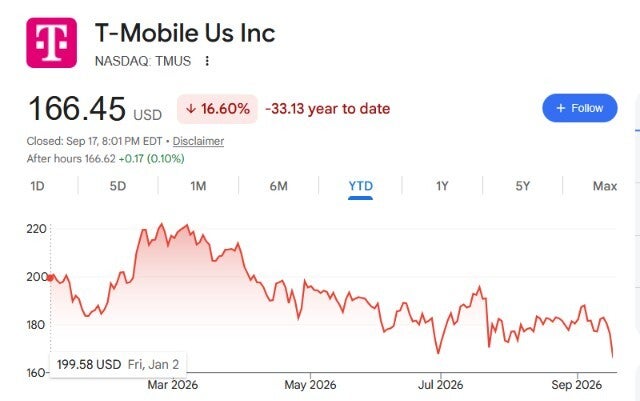
T-Mobile is about to make a new 52-week low. | Image by Google
T-Mobile is not worried that satellite-based direct-to-cell service could challenge the terrestrial wireless providers due to physical limitations including the inability of the satellite firms to penetrate certain structures with their signals. While T-Mobile might take an Alfred E. Neuman "What? Me worry?" carefree attitude about possible competition from SpaceX/Starlink and others, Wall Street seems to have concerns as the price of T-Mobile's stock has gone up and down on news about possible competition from the satellite firms.
T-Mobile's largest shareholder thinks about combining with the company
Lastly, T-Mobile's majority stockholder, Deutsche Telekom, said this past April that it was analyzing a combination with T-Mobile that would create the most valuable telecom company in the world, topping China Mobile and its $235 billion market cap at that time. The goal of the German telecom company is to narrow a valuation gap between Deutsche Telekom and T-Mobile as a dollar of T-Mobile's earnings is valued higher than a dollar of Deutsche Telekom's earnings.
Ever since Deutsche Telekom announced that it was considering a combination with T-Mobile, the latter's shares have been floundering. Consider the tale of what happened to an investment in T-Mobile made by Andre Almeida, Chief Broadband, Enterprise & Emerging Business at T-Mobile US.
T-Mobile executive has a large paper loss on his last purchase
On May 1, Almeida bought 5,097.44 shares of T-Mobile's U.S. common stock, paying prices ranging from $196.12 to $196.18. The total cost of the stock was $1,000,015. Those shares are now worth $848,467, giving him a paper loss of $151,548. Obviously, Almeida is not a short-term investor. Almeida owns 44,849.602 shares of T-Mobile which have declined by about $1.31 million in value since May 1.
The publicly traded Big 3 carriers have been moving opposite to the broad market and this has been going in for some time. This indicates that the big monied funds see the carriers as a defensive play, which is unusual for an industry that is still considered to be in the technology game. It also could mean that the best periods of growth for T-Mobile, AT&T, and Verizon have long passed them by.
Here are some additional articles you can read now:


Popular stories





Latest News




Things that are NOT allowed:
To help keep our community safe and free from spam, we apply temporary limits to newly created accounts: