T-Mobile has landed in a legal gray area and public relations hot water.
The US government is currently prosecuting around 40 activists who protested an Immigration and Customs Enforcement action outside a Minnesota church in January. As part of its investigation, the government is aggressively gathering data on those involved. But while Google didn't comply with the government's request, T-Mobile fell right in line. That isn't going over well.
Digging deep
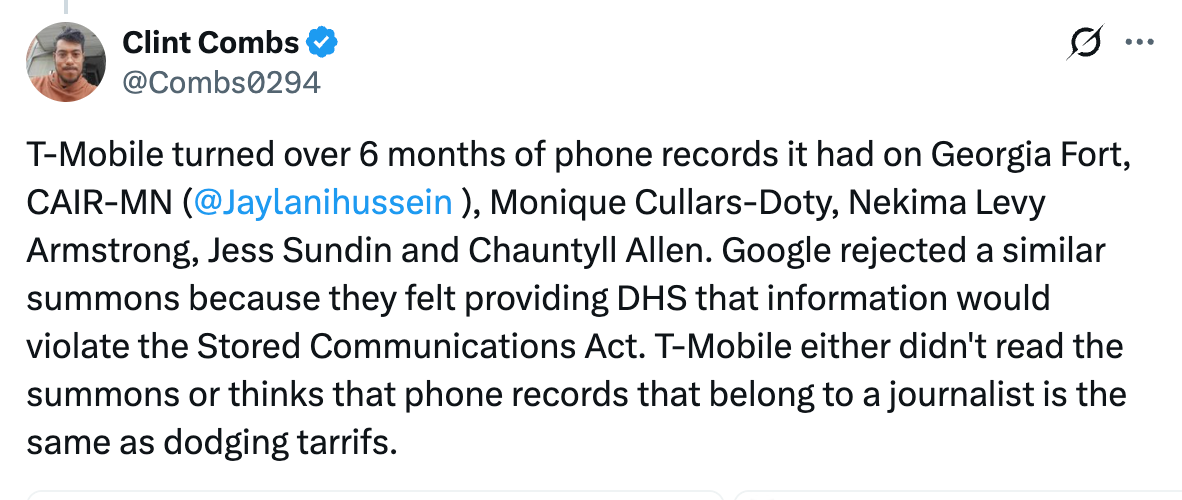
T-Mobile is getting criticized for groveling to the administration. | Image by Clint Combs
The government has been ruthlessly pursuing what it views as rogue agitators standing in the way of its immigration crackdown. The administration is using administrative subpoenas that don't require a judge to sign off to obtain information. The defense lawyers have criticised it for weaponizing a law (19 U.S.C. 1509) designed for customs investigations, such as imports and duties, not for domestic criminal investigations.
This legal maneuver was used to obtain data on the likes of reporter Georgia Fort. Judges previously said there wasn't any evidence of her committing the crimes the government wanted to charge her with.
The government used administrative summonses to attempt to obtain data on Fort held at Google and T-Mobile.
What should have T-Mobile done?
293 Votes
Told the government to take a hike.
78.5%
It did the right thing.
11.26%
At least notify Fort.
10.24%
Could have said no
The government successfully used customs summonses to get its hands on six months' worth of data belonging to Fort from T-Mobile, including 10,000 call and text message records. This was a log of communications, not actual content. It could still compromise a journalist and allow the government to get to confidential sources.
That’s very concerning because the information demanded can help the government uncover a journalist’s confidential sources.
Caitlin Vogus, Freedom of the Press Foundation's senior adviser, August 2026
Recommended For You
Some journalists pointed out that the carrier wasn't obligated to do so.
Google didn't comply with a similar order because it believed that doing so would violate the Stored Communications Act. This federal law protects the privacy of stored communications held by service providers. Google held its ground and demanded evidence of how the investigation was related to a customs investigation.
Some experts believe domestic situations are outside of 19 U.S.C. 1509's scope.
Fort was not informed about the request for her records, nor was she given a chance to block the effort.
Here's why T-Mobile wouldn't want to get on the government's bad side:
T-Mobile says that it was simply adhering to the law and continues to take customer privacy seriously.
We take our responsibility to protect customers’ privacy and personal information very seriously. Our team carefully reviews government demands for customer information and responds in accordance with the law. We don’t comment on specific law enforcement demands.
T-Mobile spokesperson, August 2026
The government has also used 1509 summonses to get social media companies and financial services to hand over data on users.
The administration says it's well within its rights to use the summons to collect information on potential assailants. It claims that Section 1509 isn't limited to customs duties and taxes and could be used to ensure compliance with any Customs Service laws.
Damned if you do, damned if you don't
Since there is contention over what the 1509 law entails, T-Mobile has some legal cover for not pushing back like Google did. Besides, the company wouldn't want to piss off the government while it's actively looking to expand its fiber footprint with mergers.
However, some may see this as a violation of the Fourth Amendment, which protects citizens from unreasonable searches by the government.
Even if T-Mobile was going to comply, it was unbecoming of the company not to notify Fort and instead keep her in the dark. After all, according to The Guardian, companies are free to ignore 1509 summons.
Free Galaxy A17 5G with Straight Talk
Get a free Galaxy A17 with Straight Talk. To claim this deal, you need to pair the phone with activation on a Silver Unlimited Plan or higher. This tier costs $45 per month. Offer valid through 01/10/27 while supplies last online.
Anam Hamid is a computer scientist turned tech journalist who has a keen interest in the tech world, with a particular focus on smartphones and tablets. She has previously written for Android Headlines and has also been a ghostwriter for several tech and car publications. Anam is not a tech hoarder and believes in using her gadgets for as long as possible. She is concerned about smartphone addiction and its impact on future generations, but she also appreciates the convenience that phones have brought into our lives. Anam is excited about technological advancements like folding screens and under-display sensors, and she often wonders about the future of technology. She values the overall experience of a device more than its individual specs and admires companies that deliver durable, high-quality products. In her free time, Anam enjoys reading, scrolling through Reddit and Instagram, and occasionally refreshing her programming skills through tutorials.
A discussion is a place, where people can voice their opinion, no matter if it
is positive, neutral or negative. However, when posting, one must stay true to the topic, and not just share some
random thoughts, which are not directly related to the matter.
Things that are NOT allowed:
Off-topic talk - you must stick to the subject of discussion
Offensive, hate speech - if you want to say something, say it politely
Spam/Advertisements - these posts are deleted
Multiple accounts - one person can have only one account
Impersonations and offensive nicknames - these accounts get banned
To help keep our community safe and free from spam, we apply temporary limits to newly created accounts:
New accounts created within the last 24 hours may experience restrictions on how frequently they can
post or comment.
These limits are in place as a precaution and will automatically lift.
Moderation is done by humans. We try to be as objective as possible and moderate with zero bias. If you think a
post should be moderated - please, report it.
Have a question about the rules or why you have been moderated/limited/banned? Please,
contact us.










Things that are NOT allowed:
To help keep our community safe and free from spam, we apply temporary limits to newly created accounts: