T-Mobile Fiber came out of an ad fight with Spectrum owner Charter with almost every claim intact, after the ad industry's watchdog backed T-Mobile's case that fiber beats cable. The one exception is the "Break free from big cable contracts" pitch tied to T-Mobile's offer to pay off your early termination fees, and T-Mobile has agreed to change it.
Charter took T-Mobile Fiber's ads to the NAD and mostly lost
BBB National Programs' National Advertising Division (NAD) shared its decision in an announcement on October 1. The NAD is the ad industry's own watchdog, and carriers bring each other's ads to it all the time, as we've seen before.
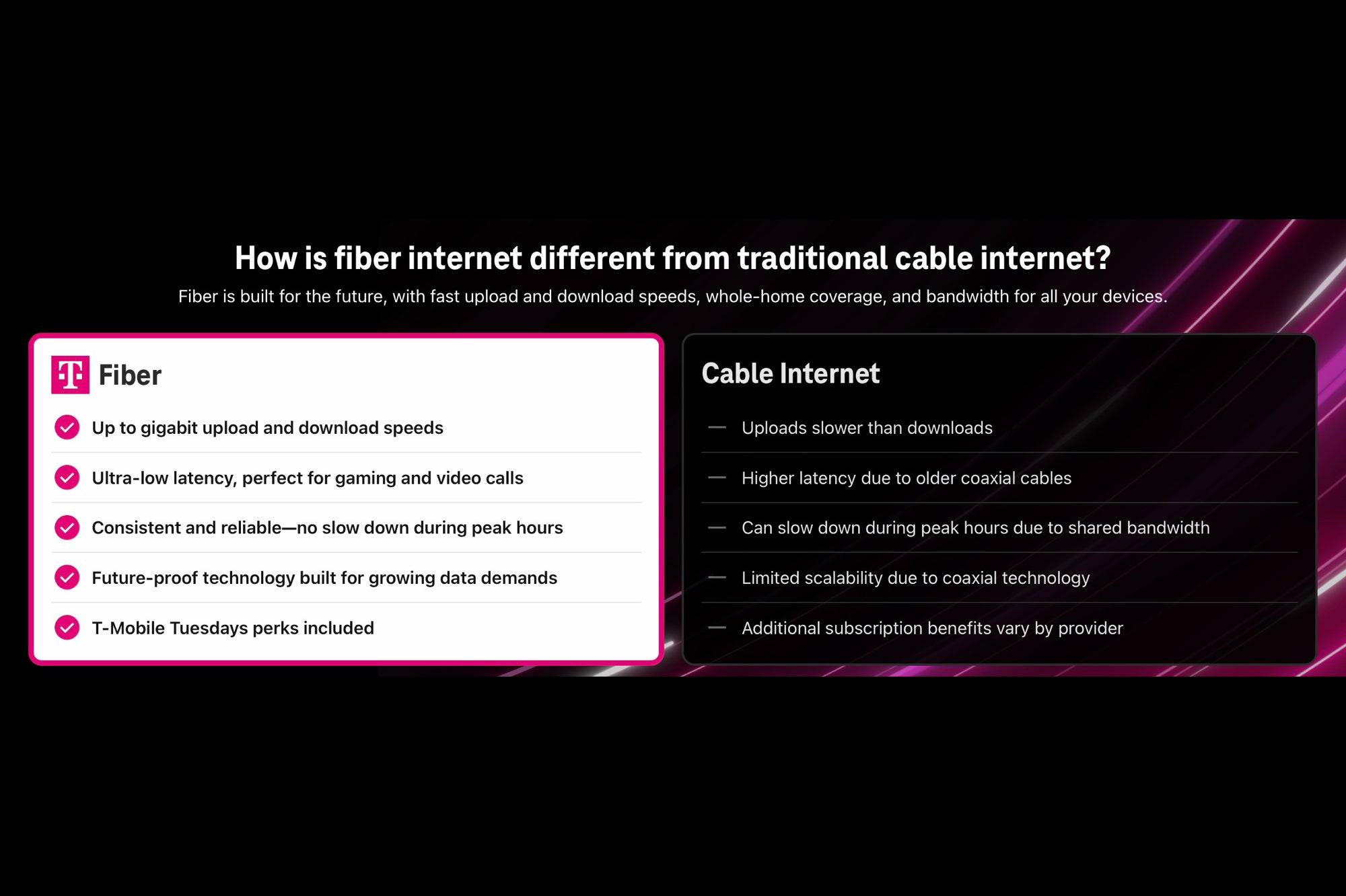
Charter, which sells home internet as Spectrum, challenged several T-Fiber claims. The NAD found T-Mobile could back up its gigabit upload and download speeds, its lower latency for gaming and video calls, its "no slow down during peak hours" line and its claim that fiber is more future-proof.
However, the NAD said the contracts headline, paired with the fee payoff, suggests big cable providers (Spectrum included) lock you into contracts with early termination fees. It recommended T-Mobile change the claim, and T-Mobile said it will comply.
NAD found that the broader message is not supported and recommended that T-Mobile modify the claim to avoid conveying the unsupported message that big cable internet providers, including Spectrum, necessarily require long-term contracts or impose early termination fees.
National Advertising Division, BBB National Programs case decision summary, October 1, 2026
Recommended For You
The NAD only asked for new wording, so I'm assuming the up-to-$750 payoff itself sticks around for now.
Which T-Mobile Fiber selling point matters most to you?
1 Votes
Why cable uploads can't keep up with T-Fiber
Spectrum calls its service "Fiber-Powered Internet," which sounds a lot like what T-Mobile sells. However, the two aren't built the same way.
Spectrum's own FAQ explains that its network is hybrid fiber-coaxial (HFC), so fiber carries your data most of the way and a coaxial cable handles the last stretch to your home. T-Fiber runs fiber all the way to the house, which is why its plans upload as fast as they download.
That last stretch of coax is where uploads fall behind, since most cable plans give far more room to downloads. In everyday terms, it's the difference between a video call that stays sharp and a cloud backup that crawls along overnight.
T-Mobile's fiber vs. cable chart, which the NAD reviewed claim by claim. | Image by T-Mobile
Spectrum, of course, says "No contracts" right on its internet page, which is why the contracts line didn't hold up. This isn't the first time Charter has taken T-Mobile's ads to the NAD either, since it won an earlier challenge over a wireless savings claim before a review board reversed that decision.
What the T-Fiber ruling means for your home internet bill
If you're on a contract with a smaller or regional provider, the up-to-$750 payoff is the part of this deal worth paying attention to, since those are the companies that charge these fees.
If you're with Spectrum, there's no fee to pay off, so the choice comes down to speed, uploads and price.
T-Mobile's marketing is back in front of the NAD, again
I don't think T-Mobile did anything sneaky here, since most of its claims held up and it agreed to the change without a fight. Still, contracts were an odd thing to build a headline around when its biggest cable rival doesn't use them.
I'd personally love to see T-Mobile lean on upload speeds instead, since that's the part of the pitch that held up and the part I'd notice most on a busy video call.
Johanna Romero is a Senior News Writer at PhoneArena, covering mobile technology news across Android, iOS, wearables, and the Google ecosystem she knows best. Drawing on 15 years in IT and tech support from 2007 to 2022, she brings a user-friendly eye for the practical features and lesser-known tricks readers care about. Google named her an official #TeamPixel member in 2022, and she also reviews the latest devices on her YouTube channel, JoJo the Techie.
A discussion is a place, where people can voice their opinion, no matter if it
is positive, neutral or negative. However, when posting, one must stay true to the topic, and not just share some
random thoughts, which are not directly related to the matter.
Things that are NOT allowed:
Off-topic talk - you must stick to the subject of discussion
Offensive, hate speech - if you want to say something, say it politely
Spam/Advertisements - these posts are deleted
Multiple accounts - one person can have only one account
Impersonations and offensive nicknames - these accounts get banned
To help keep our community safe and free from spam, we apply temporary limits to newly created accounts:
New accounts created within the last 24 hours may experience restrictions on how frequently they can
post or comment.
These limits are in place as a precaution and will automatically lift.
Moderation is done by humans. We try to be as objective as possible and moderate with zero bias. If you think a
post should be moderated - please, report it.
Have a question about the rules or why you have been moderated/limited/banned? Please,
contact us.











![Another batch of Galaxy S26 series users in the US are getting a nice surprise today [UPDATED]](https://m-cdn.phonearena.com/images/article/183643-wide-two_350/Another-batch-of-Galaxy-S26-series-users-in-the-US-are-getting-a-nice-surprise-today-UPDATED.webp)
Things that are NOT allowed:
To help keep our community safe and free from spam, we apply temporary limits to newly created accounts: