Study about the future of AI gets pulled for containing too many hallucinations
Big 4 accounting firm KPMG defines irony.
Ironically, study about AI marred by hallucinations | Image by GPTZero
Last October, KPMG, one of the "Big Four" accounting firms in the world, released a study on AI that was titled, "Total Experience: Redefining Excellence in the Age of Agentic AI." The paper was about the ways companies have started using AI to give customers what they want.
AI hallucinates when it provides an incorrect, fabricated, or nonsensical reply
As good as AI is at providing you with in-depth answers on a wide variety of subjects, it does have the tendency to hallucinate. These answers are considered a hallucination when the AI model provides an incorrect, fabricated, or nonsensical reply that is not backed by its training data.
Unlike humans, who hallucinate for other reasons, AI models hallucinate because of various factors. AI predicts the most likely word based on statistics, which means that sometimes it answers by choosing fluency over accuracy. Training on flawed, outdated, or incomplete data can also lead AI to guess which word to use to fill in a blank space.
KPMG's study about AI was full of hallucinations
Also, potentially causing AI hallucinations are vague or overly complicated prompts. You're more likely to receive an answer with hallucinations if the topic you are asking about deals with specific, rare, or complex information. The threat of receiving an answer that is a hallucination keeps some people from using AI.
The reason why we are discussing AI hallucination is because of the aforementioned study issued by KPMG. As it turns out, the report was full of hallucinations and included examples of agentic AIs that do not exist or do not have the capabilities mentioned in the study. GPTZero, a company that developed a tool used to detect whether text is AI-generated, and the Financial Times both discovered a number of factual mistakes and fake footnotes in the report.
GPTZero discovered that only five citations out of 45 cited legitimate sources. The investigations also found that half of the claims in the paper were not real or were misattributed. As an example, KPMG wrote about a mobile chatbot for Emirates Airline called Sara that could talk to passengers and make changes to their flight plans. As it turns out, Sara was a mobile assistant launched in 2023 and did not have the capability to change passengers' flight information.
KPMG's study included several hallucinations
The study also claimed that global Swiss investment bank UBS had integrated agentic AI throughout its "investment advisory, risk management and compliance monitoring." That sounds quite interesting until you understand that UBS told the Times that the information was "factually incorrect."
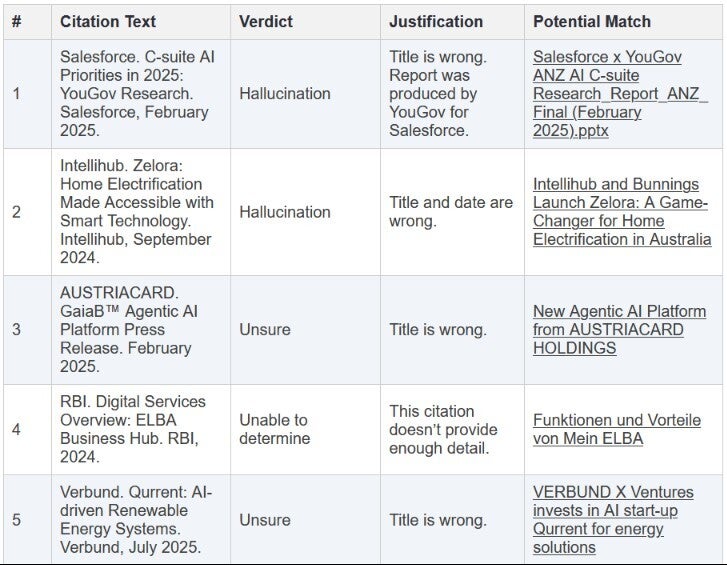
A small example of the AI hallucinations found in the KPMG study. | Image by GPTZero
In another example, KPMG said in its report that Swiss Federal Railways (SBB) had AI agents that would plan and book trips for passengers based on their preferences. This also turns out to be "factually incorrect." The accounting firm told the Times that it takes the integrity and accuracy of the content it publishes very seriously. KPMG has since pulled the paper "reviewing the circumstances surrounding its publication."
Five things you can do to reduce the odds of receiving hallucinations
For those of you on the fence about AI, you might feel that these hallucinations defeat the purpose of having a tool that can gather information for you. If you still want to use AI, there are some things you can do to reduce the possibilities of receiving answers to your queries that are marred by hallucinations:
- Keep the prompts you write clear and precise, and include context.
- Give the AI source material to analyze directly.
- Assign the AI a specific role.
- Use multi-step prompting and ask it to think step-by-step.
5. Reduce the AI temperature, which tells the model not to improvise, thus reducing the possibility that the model will start going off course and start hallucinating to fill blank spaces.
It is ironic that a study that focused on the benefits of AI was pulled because of AI hallucinations.


Popular stories






Latest News





Things that are NOT allowed:
To help keep our community safe and free from spam, we apply temporary limits to newly created accounts: