SpaceX doesn't want to be AT&T, T-Mobile, or Verizon, and that's the whole point
SpaceX wants to take a modern approach to networks, and analysts are split on whether it can deliver.
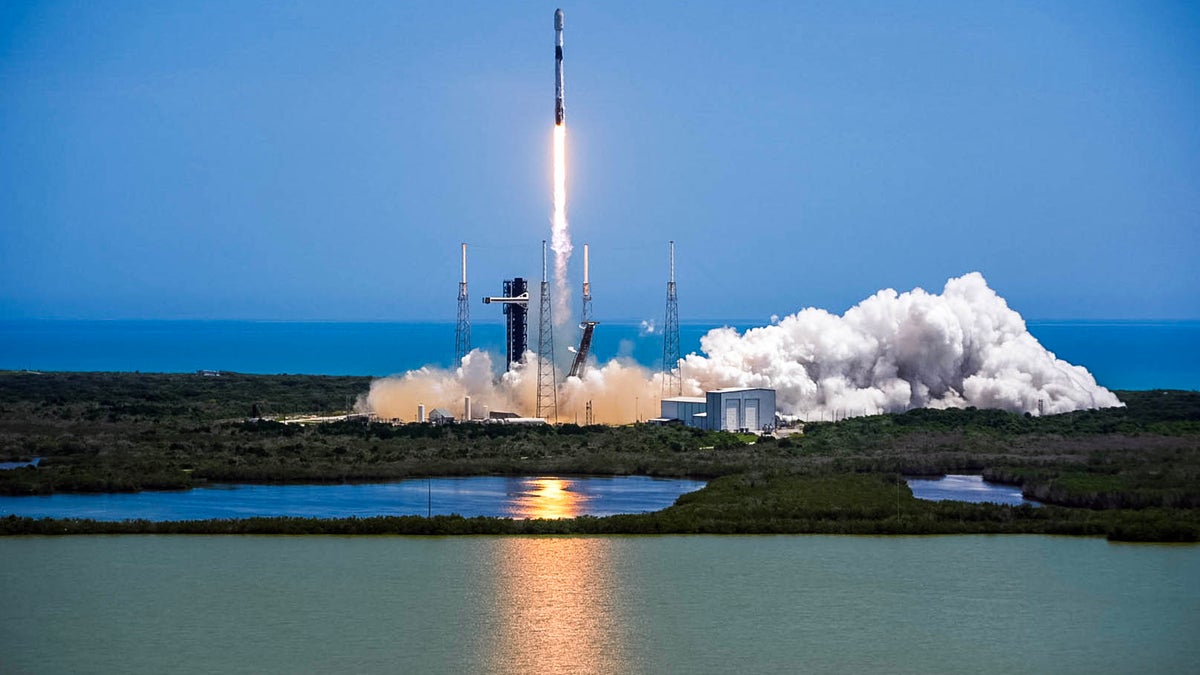
A Falcon 9 launch. | Image by SpaceX
SpaceX reiterated during its Q2 2026 earnings call that it plans to build its own terrestrial network. Rather than going the capital-intensive traditional route, the company wants to leverage existing Starlink internet dishes and spectrum acquired from EchoStar to take on AT&T, T-Mobile, and Verizon.
Since the announcement, telecom analysts have been racking their brains trying to figure out how Elon Musk's rocket company plans to pull this off. Most doubt the idea is practical, but a few think SpaceX might be onto something.
Standard mobile networks work by broadcasting signals from cell towers.
Instead, SpaceX wants to build a hybrid network. Alongside some basic terrestrial infrastructure and satellites, the plan is to mount femtocells (small cellular base stations) onto Starlink dishes while expanding its spectrum portfolio.
Starlink dishes require a clear view of the sky to connect to satellites and provide an internet connection. SpaceX wants to integrate cellular-radio equipment into them that can operate on mobile spectrum bands. This would turn the dishes into micro cell towers, casting cellular signals across surrounding areas.
Meanwhile, the company is gearing up to launch its next-generation V2 satellites next year.
Many remain skeptical. BNP Paribas Equity Research senior analyst Sam McHugh, for instance, doesn't think the company thought this through. For instance, Starlink broadband penetration isn't high enough to make femto deployment a reliable wireless solution.
Furthermore, given SpaceX's enormous capital commitment to data centers and AI chips, pouring money into building a fourth national carrier doesn't sound like the best of ideas.
SpaceX also wrongly put the combined Big Three wireless revenue at $600 billion, when the actual figure is closer to $220 billion, underscoring that the plans are in their infancy.
A femtocell would only be able to cover tens of meters or feet, and piggybacking on a residential broadband connection will drain bandwidth.
There's also the issue of penetrating concrete and steel infrastructure in dense urban areas. Independent analyst Benedict Evans points out that this obstacle is why there are approximately 250,000 macro cell sites and more than a million small and indoor cells in the US. SpaceX would have to save enough in rural areas to offset the cost of deploying traditional infrastructure in dense cities.
If there's someone who can make an unconventional network work, it's Musk. But as Bloomberg notes, the network could end up falling short of the grand vision, much like Tesla's driverless taxis and humanoid robots.
SpaceX won't want to spend years and billions of dollars only to create a network that's not quite as good as AT&T, T-Mobile, and Verizon.
A network without traditional towers
Standard mobile networks work by broadcasting signals from cell towers.
SpaceX currently holds just 65 MHz of spectrum, while each of the Big 3 carriers boasts roughly 300 MHz. The company doesn't want to build towers either, as they are far too costly and slow to deploy.
Instead, SpaceX wants to build a hybrid network. Alongside some basic terrestrial infrastructure and satellites, the plan is to mount femtocells (small cellular base stations) onto Starlink dishes while expanding its spectrum portfolio.
Starlink dishes require a clear view of the sky to connect to satellites and provide an internet connection. SpaceX wants to integrate cellular-radio equipment into them that can operate on mobile spectrum bands. This would turn the dishes into micro cell towers, casting cellular signals across surrounding areas.
The system has around 650 satellites right now and uses 5 MHz of spectrum from mobile network partners. It only supports messaging and light data. The new constellation will have more satellites and will use additional capacity from EchoStar spectrum to support broadband data and IoT connectivity.
Which route should SpaceX take?
85 Votes
Satellite and terrestrial hybrid
70.59%
Land-based only
4.71%
MVNO
24.71%
Theory, meet reality
Many remain skeptical. BNP Paribas Equity Research senior analyst Sam McHugh, for instance, doesn't think the company thought this through. For instance, Starlink broadband penetration isn't high enough to make femto deployment a reliable wireless solution.
Coverage is another hurdle. Network consultant Paul Rhodes compares Starlink's current Direct-to-Cell service to 2G, predicting that with femtocells, SpaceX would be able to provide a 3G-like service at best.
A lot of fanbois get upset when people state that the Starlink d2d service is a ‘#2G service’ in a #5G world. Well, the bad news is that FemtoCells are a #3G service in a 5G world. Better, yes, but if the aim is to make a 100% Starlink service comparable with Terrestrial networks this has ‘more fail written all over it’.
Paul Rhode, network consultant, August 2026
A femtocell would only be able to cover tens of meters or feet, and piggybacking on a residential broadband connection will drain bandwidth.
First of all, the thing that people in tech often don’t get is that cellular is not just about coverage and speed. That’s the easy part. The hard part is having coverage in a city with steel and concrete blocking every signal past 50 yards, and having capacity to deliver those speeds when there are thousands or tens of thousands of people in a few hundred square yards.
Benedict Evans, independent analyst, August 2026
History isn't on Musk's side, either. Dish, Ligado Networks, and Sprint all tried similar workarounds and failed to get off the ground. That said, S&P Global's analyst Lynnette Luna notes that SpaceX has the advantage of already having Starlink terminals installed on many rooftops and vehicles across the US.
However, many wrinkles still need to be ironed out, including preventing satellite signal interference and meeting the FCC's ground network buildout requirements.
Even so, some analysts believe critics are taking a short-sighted view.
Open Device Alliance's President Trevor McLaughlin highlights Comcast Xfinity, which already routes 90% of its mobile data traffic over Wi-Fi, proving a modern carrier doesn't need to own towers everywhere to succeed.
Zooming out
Even so, some analysts believe critics are taking a short-sighted view.
Open Device Alliance's President Trevor McLaughlin highlights Comcast Xfinity, which already routes 90% of its mobile data traffic over Wi-Fi, proving a modern carrier doesn't need to own towers everywhere to succeed.
I don't find it to far outside of the realm of possibilities that a version of the CableCo playbook could be iterated on and be successful.
Trevor McLaughlin, Open Device Alliance's President, August 2026
Recon Analytics founder Roger Entner notes that Musk isn't trying to copy legacy networks anyway. Satellites will handle rural areas, and SpaceX certainly has the cash to deploy a terrestrial component in cities. Most of all, it could be five to ten years before this hybrid network is rolled out. By that time, the satellite constellation will have grown more powerful, and the 5G New Radio Non-Terrestrial Networks (NR-NTN) standard will have become mainstream.
He has the permission to put more satellites up. The gen 2s are 10 times more, and the gen 3 are 100 times more than the current satellites. That will take care of that problem. We're talking about more like 2030, 2031, 2032, which is also where the buildout requirements are hitting for the upper C band. This all timing wise nicely comes together.
Roger Entner, Recon Analytics founder, August 2026
Uncertainty
If there's someone who can make an unconventional network work, it's Musk. But as Bloomberg notes, the network could end up falling short of the grand vision, much like Tesla's driverless taxis and humanoid robots.
SpaceX won't want to spend years and billions of dollars only to create a network that's not quite as good as AT&T, T-Mobile, and Verizon.
Read more about SpaceX's cellular ambitions:
- The company wants to build its own network...
- In an open challenge to AT&T, T-Mobile, and Verizon
- But these talks might be a ploy to get an MVNO deal


Popular stories
Latest News
![Another batch of Galaxy S26 series users in the US are getting a nice surprise today [UPDATED]](https://m-cdn.phonearena.com/images/article/183643-wide-two_350/Another-batch-of-Galaxy-S26-series-users-in-the-US-are-getting-a-nice-surprise-today-UPDATED.webp)
Things that are NOT allowed:
To help keep our community safe and free from spam, we apply temporary limits to newly created accounts: