Google paid off carriers, phone manufacturers and app developers to protect the Play Store

Google, concerned that the large U.S. carriers like Verizon, T-Mobile, and AT&T were planning to launch their own Android app storefronts to compete with the Play Store, agreed to pay off companies that have the capability to develop alternative app stores. Besides sharing revenue with some wireless providers, Google included several app developers and device makers in the scheme.
So why would Google feel threatened by these third parties? The firm was concerned that device manufacturers and carriers could pre-install a third-party Android app storefront on new devices. Unlike iOS, which is a walled garden inside a walled garden surrounded by a walled garden, Google allows Android users to sideload apps from third-party app stores. And should Google even hint at a change to this, in the current state of lawmakers' relationships with big tech, the Alphabet unit is likely to be branded anti-competitive.
Google ferociously guards its 30% cut of Play Store revenue
To prevent alternative app stores from appearing on Android phones, Google signed deals with companies such as LG and Motorola; in exchange for a cut of Play Store revenue generated by users of these companies' phones, the manufacturers promised not to preload alternative Android app stores on their devices. Of the 30% cut of in-app revenue collected by Google, 20% to 25% would be given to Mobile Network Operators (MNOs) to pay them off from competing with the Google Play Store.
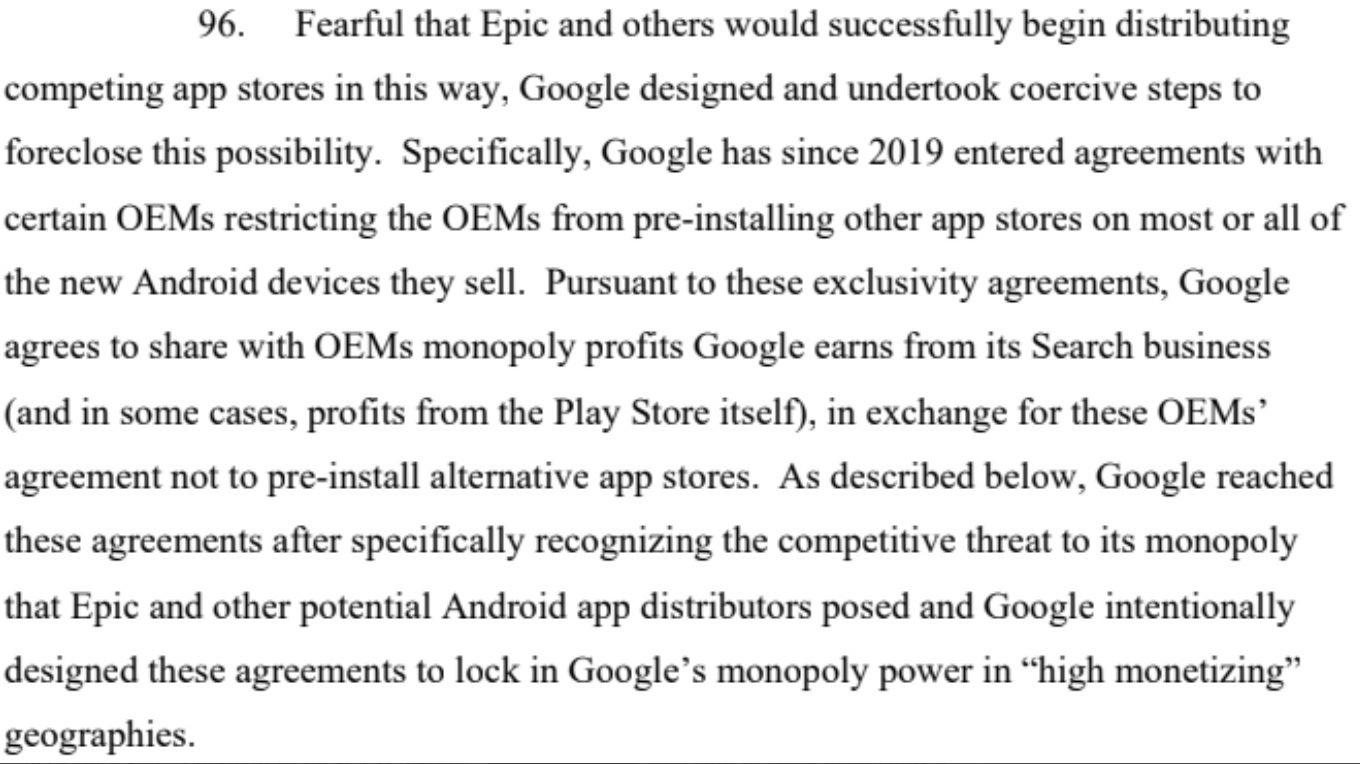
Now unrerdacted, court documents reveled Google's plan to protect the Google Play Store
The information about these deals was discovered by Mashable after unredacted portions of court documents were released. One part of the document filed by Epic Games states that since 2019, Google has entered into agreements with OEMs restricting them from including third-party Android app stores with their devices. In exchange, "Google agrees to share with OEMs 'monopoly profits Google earns from its Search business (and in some cases profits from the Play Store itself)."
Epic states that Google entered into these deals once it realized that the carriers and the phone manufacturers constituted a threat to what the lawsuit calls Google's monopoly. Earlier this month, court documents revealed that Google was considering the purchase of Fortnite developer Epic Games. Google reportedly considered Epic and other Android app developers to be threats to the Google Play Store.
Google considered buying Epic Games, but never approached it with an offer
As for the popular Fortnite game, Google feared that it would lose its 30% slice of the pie once Epic offered the game from its own website. As a result, the Search Giant supposedly discussed internally a plan to buy Epic. While Google did discuss a possible transaction internally, it never approached the game maker with any proposal or offer. It did hope to give Epic a special deal in return for an exclusive launch in the Play Store, a plan that did not reach fruition.
Like Apple's App Store, the Google Play Store has been under attack by lawmakers who have called out both app storefronts for anticompetitive behavior. Last month, 36 state attorneys general filed a lawsuit against the Play Store. The suit accused Google of paying off Samsung so that the latter would not compete with Google's Android app storefront. And yes, these suits are more than just a pesky pain in the butt for Google. Consider that Utah Attorney General Sean Reyes called Google's monopoly is a menace to the marketplace.
In addition, in both the House and Senate, a bill has been proposed called "The Open App Markets Act" that would allow app developers to inform consumers of cheaper in-app purchasing options, and protect the sideloading of apps (which as we've noted, Google allows and Apple doesn't). If turned into legislation, the Act would give consumers more control over their own devices, protect the privacy, security, and safety of consumers, amd prevent app stores from taking advantage of app developers.


Popular stories



Latest News


Things that are NOT allowed:
To help keep our community safe and free from spam, we apply temporary limits to newly created accounts: