The debate over whether SpaceX can challenge AT&T, T-Mobile, and Verizon using Starlink dishes and femtocells rages on. Most analysts remain skeptical, presenting more reasons why the idea is unlikely to work, as detailed in a new Light Reading report.
How is SpaceX going to pull this off?
AT&T, T-Mobile, and Verizon customers don't worry about hardware installations. They just pop in a SIM card (or add an eSIM), and move on.
SpaceX's plan is a little convoluted. The company wants to mount small cellular base stations onto existing residential Starlink terminals. Users would need to stay close to a femtocell to get service, which would draw on broadband capacity and worsen service for everyone.
You need a real antenna in three sectors. To deploy this, it means you have to have a pole on a roof that's good enough to hang three radios and three antennas, which is going to be hard. You would have to go through the standard permitting for any macro cell site, and at that point why do you want a small cell?.
Earl Lum, EJL Wireless Research founder, August 2026
Earl Lum, founder of EJL Wireless Research, dubbed the strategy "one of the top three dumbest ideas" he has heard in four decades. An outdoor small cell draws around 5 watts per channel and requires radios and antennas. It could be difficult to set up on residential properties. SpaceX will also need permits for any macro cell site. The hassle might not be worth avoiding conventional cellular sites. If SpaceX opts for a low-powered 1-watt indoor transmitter, it would barely cover a single house.
Recommended For You
You would need five of them to cover a major house.
Earl Lum, EJL Wireless Research founder, August 2026
Paul Rhodes, wireless network and EdgeDC expert at Real Wireless, is equally dubious, pointing out that a 60-watt Starlink dish doesn't have enough power or backhaul capacity to handle multiple cellular radios.
Then you've got far more RF capacity than you will have backhaul capacity.
Paul Rhodes, Wireless Network and EdgeDC Expert at Real Wireless, August 2026
Urban problems
The problem will be more profound in urban markets, where Starlink isn't as popular as it is in rural and suburban areas. A Starlink network of femtocells will likely provide patchy service, making it a hard pass for urban dwellers with better, lower-cost options.
SpaceX could target multi-dwelling units (MDUs), but that didn't work so well for Starry. Management is unlikely to allow residents to install Starlink dishes on their balconies.
If you're starting to effectively use your customer terminals as basestations, what happens when they get their electricity bill for this and suddenly it's gone up by four? Can you imagine the outcry?
Amit Nagpa, Aetha Consulting partner, August 2026
Even if SpaceX somehow makes it work, the use of Starlink equipment as a mini cell tower would skyrocket electricity bills, which customers wouldn't want to foot, according to Aetha Consulting's Amit Nagpal.
What's SpaceX trying to do?
69 Votes
Build a network.
37.68%
Coax AT&T, T-Mobile, or Verizon into an MVNO agreement.
21.74%
Plot a takeover of a cellular company.
40.58%
D2D dreams
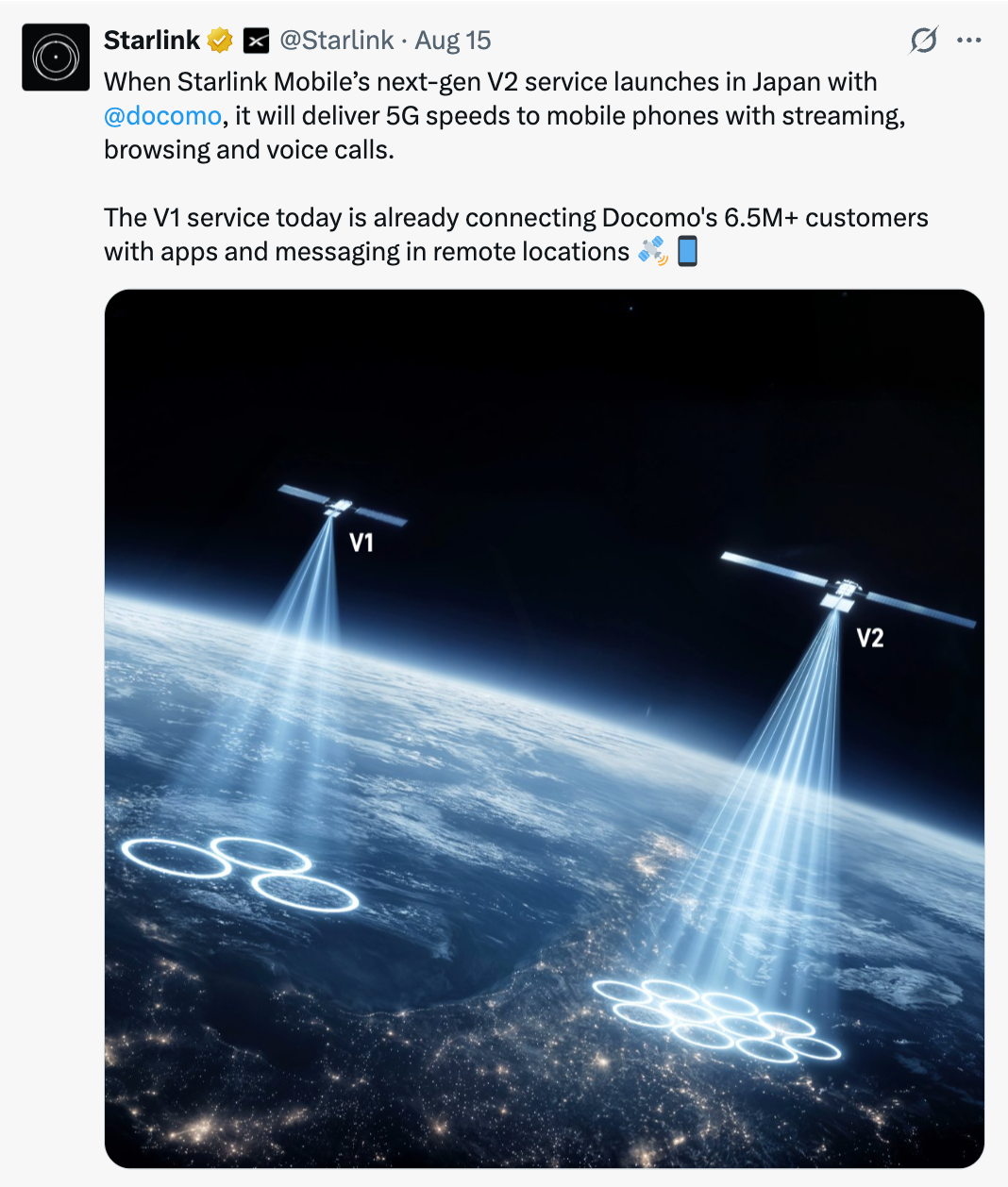
Why bother with femtocells then? | Image by Starlink
SpaceX CEO Elon Musk has been hyping up the next-gen direct-to-device (D2D) satellites that are supposedly capable enough to support broadband data and IoT connectivity. If that were the case, why would he propose femtocells? Something doesn't add up, and the contradiction makes it a little harder to put stock in SpaceX's cellular plans.
Lum doesn't expect D2D to match terrestrial service anytime soon.
Never say never
Starlink has 12 million customers across the world, with 3 to 4 million in the US. Homebodies might find a Starlink cellular service sufficient. Even if SpaceX manages to sway some customers, it would represent a huge loss for AT&T, T-Mobile, and Verizon.
Besides, some analysts have argued that a hybrid network may not be that hard for SpaceX to concoct, though it wouldn't launch right away.
Yesterday, we heard something about femto. Guys, we had a femto discussion years ago, remember that? [] some of these aspirations are very far-fetched and very conceptual.
Timotheus Höttges, Deutsche Telekom CEO, August 2026
Anam Hamid is a computer scientist turned tech journalist who has a keen interest in the tech world, with a particular focus on smartphones and tablets. She has previously written for Android Headlines and has also been a ghostwriter for several tech and car publications. Anam is not a tech hoarder and believes in using her gadgets for as long as possible. She is concerned about smartphone addiction and its impact on future generations, but she also appreciates the convenience that phones have brought into our lives. Anam is excited about technological advancements like folding screens and under-display sensors, and she often wonders about the future of technology. She values the overall experience of a device more than its individual specs and admires companies that deliver durable, high-quality products. In her free time, Anam enjoys reading, scrolling through Reddit and Instagram, and occasionally refreshing her programming skills through tutorials.
A discussion is a place, where people can voice their opinion, no matter if it
is positive, neutral or negative. However, when posting, one must stay true to the topic, and not just share some
random thoughts, which are not directly related to the matter.
Things that are NOT allowed:
Off-topic talk - you must stick to the subject of discussion
Offensive, hate speech - if you want to say something, say it politely
Spam/Advertisements - these posts are deleted
Multiple accounts - one person can have only one account
Impersonations and offensive nicknames - these accounts get banned
To help keep our community safe and free from spam, we apply temporary limits to newly created accounts:
New accounts created within the last 24 hours may experience restrictions on how frequently they can
post or comment.
These limits are in place as a precaution and will automatically lift.
Moderation is done by humans. We try to be as objective as possible and moderate with zero bias. If you think a
post should be moderated - please, report it.
Have a question about the rules or why you have been moderated/limited/banned? Please,
contact us.



Things that are NOT allowed:
To help keep our community safe and free from spam, we apply temporary limits to newly created accounts: