Report shows how poor indoor cell signals are in the US compared to other markets
Weaker cell signals mean slower data speeds inside US buildings

Cell signals inside US buildings trail those in many countries. | Image by Ookla
Ookla, the company behind the Speedtest app you check all of the time to view your device's data speed, and Downdetector (now part of the Speedtest app and is also a stand-alone website), took a look at a year's worth of 4G data covering 100 cities in 60 countries. What Ookla discovered won't make smartphone users in North America too happy.
North America is one of the worst markets when it comes to indoor cell signals
It turns out that based on 4G indoor signal strength, North America is near the bottom with Oceania and is behind the Middle East, Latin America, and Africa. Looking at individual US cities, the data might leave you stunned-or reaching for your passport. Of course, it all depends on where you live in the US. New York City was the best performer in the country based on the percentage of buildings with a poor indoor signal (only 25% of measured buildings had a weak signal indoors). But the Big Apple can't compete with Seoul as the South Korean capital had weak indoor 4G signals in only 2% of its buildings.
After New York City's US-leading 25% rate, other US cities such as Houston (26%), Boston (27%) and Las Vegas (29%) followed. At the top of the list, the worst performer cited by Ookla was Miami where 41% of measured buildings had to deal with weak indoor 4G signals. Seattle was next in the US with 39% of buildings dealing with a weak 4G signal.
Some of these US cities are losing a smaller percentage of their outdoor 4G signal when they move inside but that is only because their outdoor signals are weak to begin with. If you're wondering whether measuring 4G signal strength is a waste of time, 15% to 20% of mobile connections in the US still rely on 4G LTE as their active or fallback network.
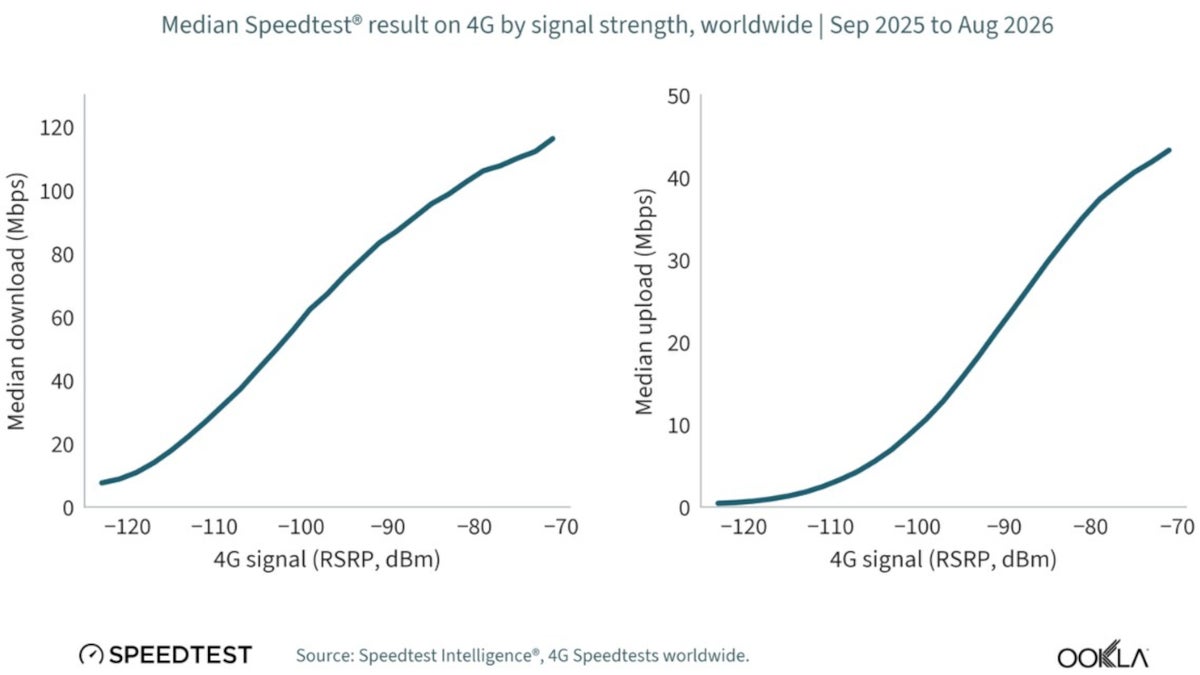
Besides producing a small number of signal bars on your phone, poor wireless signals can cut your download data speed by as much as a whopping 65% and reduce upload speeds by as much as 87%. Have you ever been unable to send a video from inside a dwelling? This could be the reason why.
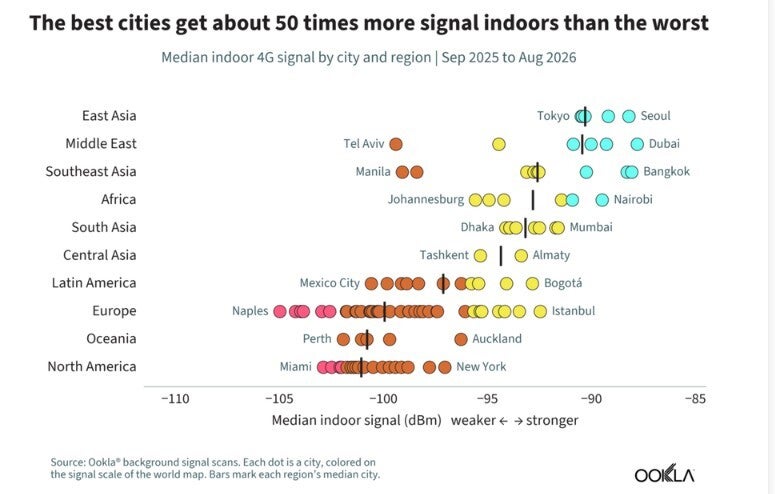
The best cities get 50 times more indoor signals than the worst. | Image by Ookla
Ookla did come away with something for carriers to think about. After discovering that large buildings in North America with their own cellular gear get better reception that those buildings without this equipment, carriers could improve the quality of their outdoor networks even without making major upgrades by investing in cellular equipment for the occupants of large buildings.
Here's something else that Ookla found. In buildings where phones are connected to a Wi-Fi signal 80% or more of the time, their indoor signals were significantly lower in 96% of cities.
Meanwhile, most countries do not regulate indoor cell signals. In the US, such regulation is in place only for first responders.
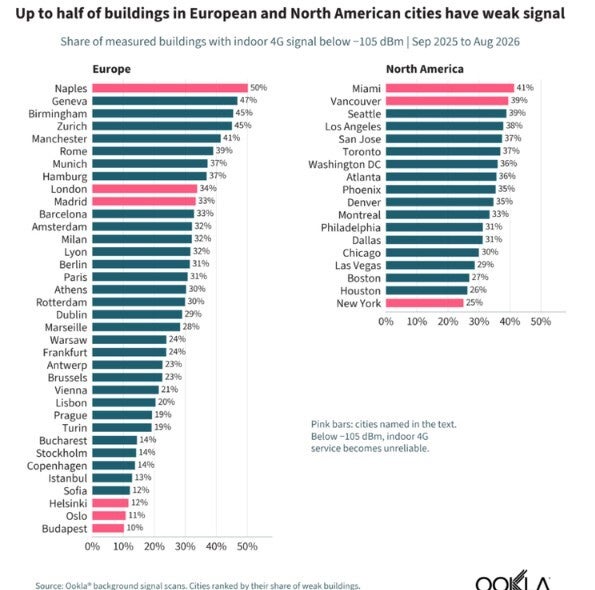
Up to half of the buildings in Europe and North America have weak signals. | Image by Ookla
Low-band airwaves are more likely to penetrate walls and travel longer distances than even mid- and high-band spectrum. This is probably why phones use low band indoors more often. From September 2025 to August 2026 in North America, signals measured outside came in at less than 1 GHz 12% of the time, compared to 14% for signals measured indoors. Europe has the biggest difference with 11% of the outdoor signals weighing in at less than 1 GHz compared to 18% of the indoor signals measuring 1 GHz or less.
Weaker signals lead to lower data speeds
Why does all of this matter? It's because weaker signals lead to slower data speeds. Based on data from Ookla's Speedtest, median 4G download speeds worldwide declined from 85.20 Mbps with a weak signal to 29.61 Mbps with an even weaker signal. Median upload speeds were even more affected. With the same decline from a weak to an even weaker signal the median upload speed declined sharply from 22.57 Mbps to 2.88 Mbps.
What we have learned from this report is that North America's indoor mobile coverage trails those in many other countries. Ookla considers -105dBm (decibels-milliwatts) to be the line at which indoor wireless service becomes unstable. In the median North American city, one-third of measured buildings have signals that fall below the -105dBm line compared to only 6% in East Asia, and just 2% in Seoul. This means that North America experiences slower data speeds inside buildings.

Popular stories
Latest News

Things that are NOT allowed:
To help keep our community safe and free from spam, we apply temporary limits to newly created accounts: