Sony Xperia Z1 Compact vs Apple iPhone 5s
Introduction
High-end Android smartphones have been successfully competing with the iPhone for quite some time now, but despite their undeniable popularity, there's one ubiquitous differentiating feature that sticks out like a sore thumb – each and every recent Android flagship has tried to target a slightly different audience than the typical iPhone crowd. With their massive screens and excessive focus on hardware prowess, devices like the HTC One, Galaxy S4 and LG G2 have always been cherished by the slightly more geeky part of society. The same goes for Sony's full-size flagship – the Xperia Z1, which is especially imposing with its dimensions.
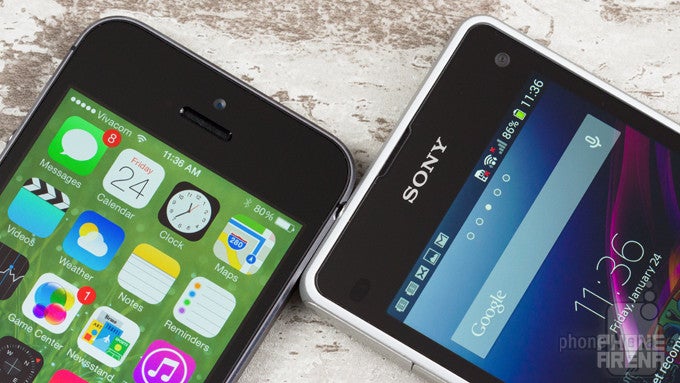
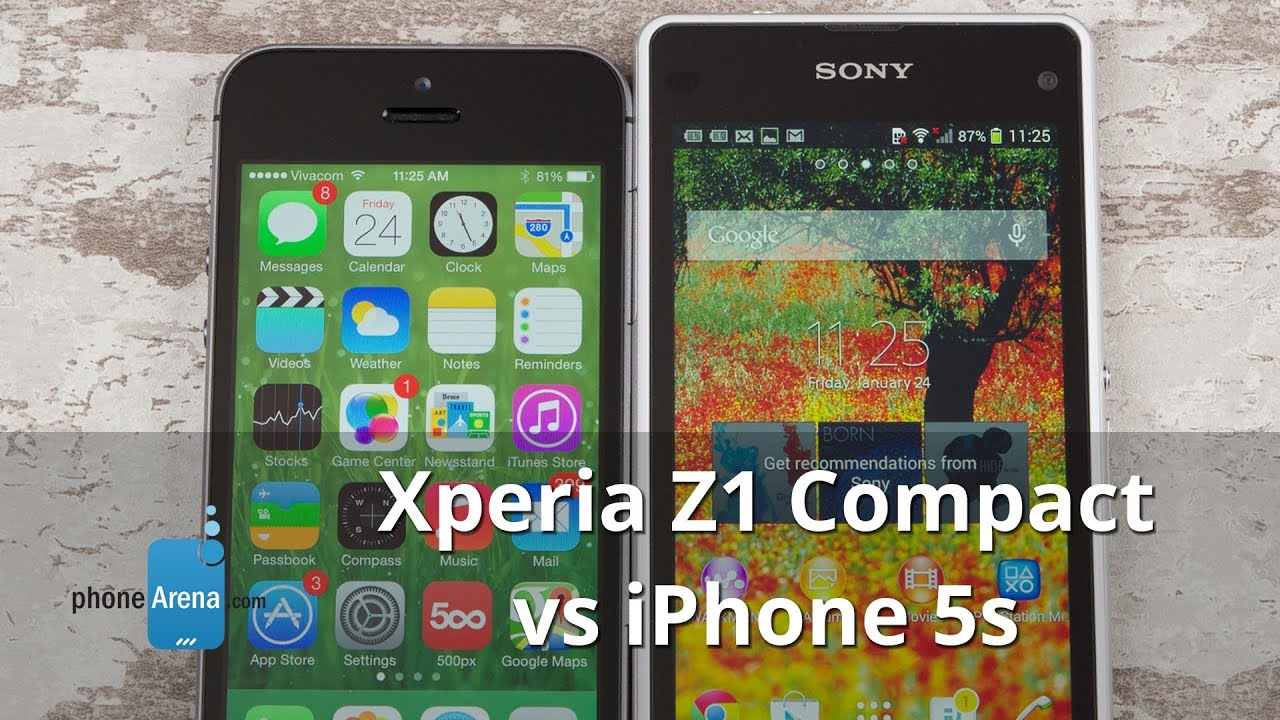
What could this particular market situation mean? Well, we could read this as a way for Android manufacturers to avoid competing directly with the iPhone, but why haven't they even tried to produce a smaller device with the same powerful hardware that they usually bestow upon their creations? Sure, there are the 'mini' versions of the Galaxy S4 and the HTC One, but those phones are significantly weaker than their high-end brethren. Time and time again, we've asked for an Android flagship of great strength and easily-pocketable dimensions, but our requests have remained unanswered. Luckily, here comes Sony with the Xperia Z1 Compact – an ambitious handset of iPhone-like size that not only takes advantage of Sony's beautiful OmniBalance design, but also of the latest and greatest silicon that's available to Android manufacturers. It's a phone that we're extremely excited about, so what better way to say what it's made of than to pit it against the king of compact smartphones itself? Ladies and gents, prepare to witness an epic struggle of compact proportions: Xperia Z1 Compact vs iPhone 5s!
Design
The Sony Xperia Z1 Compact has a great design language, that's actually reminiscent of the iPhone 4/4s. With its flat front and back sides, made of glass and plastic, respectively, held together by a sturdy metal frame, the Z1 Compact looks and feels great. However, the busier design, with numerous port and slot covers, doesn't allow the Z1 Compact to elevate itself to the clean and stylish industrial design of the iPhone 5s. The significantly thinner profile of Apple's handset, as well as its overall cleaner look makes it appear just a bit more premium in the looks department. Anyway, the trade-off isn't really big, and in exchange for a slightly thicker handset, you're getting quite a few niceties with the Z1 Compact, such as a microSD card slot, and easily-accessible SIM card slot, a dedicated camera-shutter key, and, of course, water-resistance!
Not that the Z1 Compact's construction isn't of high quality, but the iPhone 5s is simply unsurpassed in this respect. You can tell that the 5s is going to be the more expensive device just by pressing the physical keys, like the volume rocker and the power key. On the iPhone, these buttons have a nice and clicky feel, while on the Z1 Compact, their movement isn't so well-defined.
In terms of dimensions, the Z1 Compact (5.00 x 2.56 x 0.37 inches) is very close to the iPhone 5s (4.87 x 2.31 x 0.30 inches), although it's a bit wider and, as we said, thicker. The slightly bigger size of the Xperia doesn't make it more uncomfortable to hold or operate with, so users who aren't into big smartphones can rest assured that both devices are almost equally small.
As we said, in addition to the bonus features of the Compact, such as microSD card slot, Sony's handset is also water- and dust-proof (IP58), which is something that the iPhone 5s can't offer. However, Apple's device does feature an excellent fingerprint sensor, which can make your device very secure and easy to unlock (by you) at the same time.

5 x 2.56 x 0.37 inches
127 x 64.9 x 9.5 mm
4.83 oz (137 g)

4.87 x 2.31 x 0.3 inches
123.8 x 58.6 x 7.6 mm
3.95 oz (112 g)

5 x 2.56 x 0.37 inches
127 x 64.9 x 9.5 mm
4.83 oz (137 g)

4.87 x 2.31 x 0.3 inches
123.8 x 58.6 x 7.6 mm
3.95 oz (112 g)
See the full Sony Xperia Z1 Compact vs Apple iPhone 5s size comparison or compare them to other phones using our Size Comparison tool.
Display
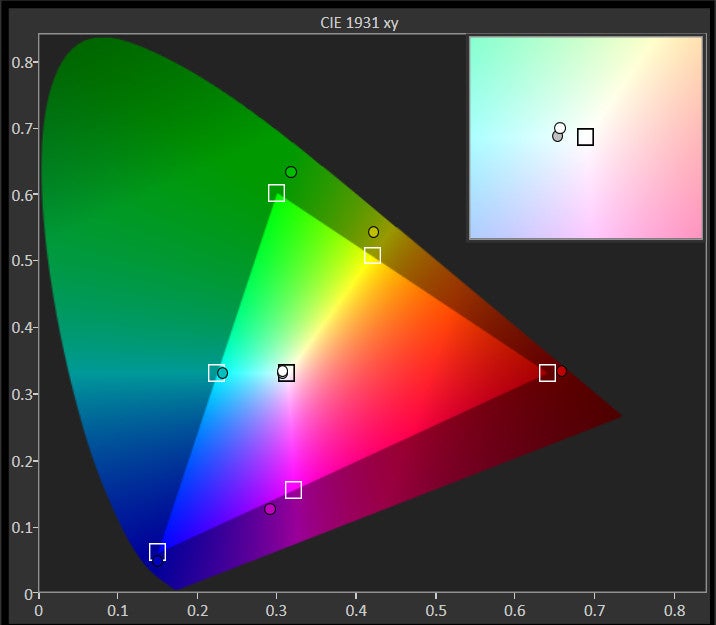
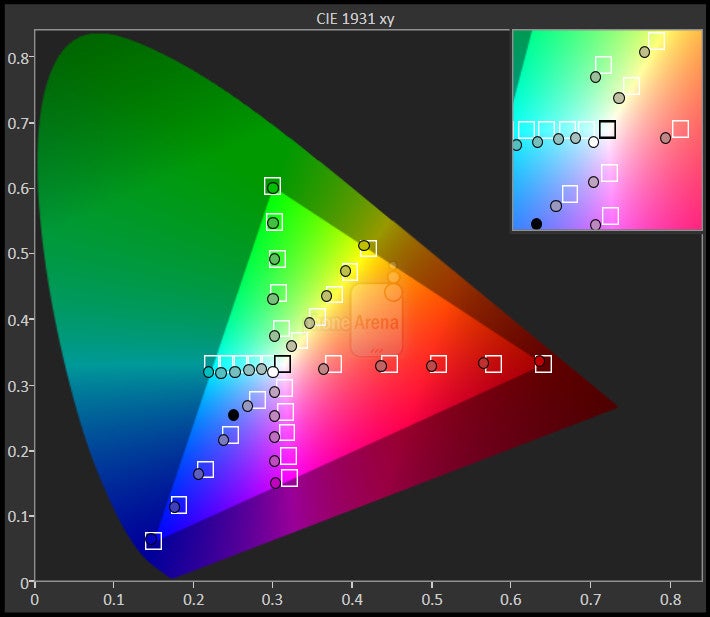
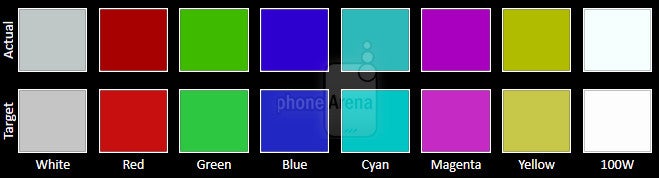
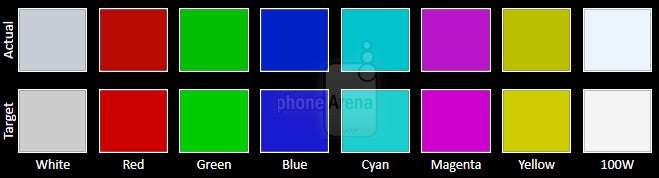
We're happy to see Sony using IPS LCD tech in the Xperia Z1 Compact. Unlike the screens used in its previous devices, this one actually has livelier colors, while viewing angles are finally reasonably good. The 720p resolution results in a slightly higher pixel density (clarity) of 342 ppi, compared to the iPhone 5's 326 ppi. That's despite the fact that the Z1 Compact also has a slightly larger screen (4.3 inches), which makes it a bit more desirable than the iPhone's 4” panel.
That said, if we have to compare these screens in terms of pure quality, the one of the iPhone 5s proves to be better in a number of areas. Maximum brightness is one of them, as Apple's finest can shine with up to 580 nits, while the Z1 Compact manages to reach the still-respectable 515 nits. In addition, the 5s can get dimmer, which is helpful when you want to read something in the dark, while its gamma is also more accurate (2.2 for the 5s versus 2.6 for the Z1 Compact).
It's once again a matter of trade-off with these displays, as the one of the iPhone 5s is considerably better, but the larger size of the Z1 Compact is a definite advantage that shouldn't be overlooked.


Interface and functionality
Despite their similar footprints, the Z1 Compact and iPhone 5s remain entirely different when it comes to their software experiences. On one hand, we have Android 4.3 on the Xperia, and on the other, there's iOS 7 on the iPhone. Without a doubt, Android and Sony's custom UI make for an overall harder-to-learn software platform, while iOS presents us with a more straightforward interface.
There's a lot of action going on with the Sony Xperia Z1 Compact and its homescreen and main menu. You can have app shortcuts, widgets of varying sizes, directories and what not. Then, there's the main menu, which is choke-full of all kinds of applications and services right out of the box. Sadly, Sony isn't asking you whether you actually need all of this stuff or not – it's going to stay there no matter what. So, we definitely think that the Z1 Compact has a steeper learning curve, though it is by no means too difficult to handle. And, of course, if you aren't new to the world of Android, you'll feel right at home with Sony's little golden-boy. Besides, the harder-to-get-used-to Android platform has some definite advantages for the tech-savvy people out there, like easier access to information (using widgets), microSD card support, USB mass storage mode, as well as higher customizability of the whole platform.
UI of the Sony Xperia Z1 Compact
Interface of the Apple iPhone 5s
Still, other aspects on how the two platforms function are almost identical, just like how they handle notifications – they’re aggregated in a centralized spot that’s accessed at any time by doing a swipe-down gesture from the top bezel.
Although the Xperia Z1 Compact has a slightly bigger display, its QWERTY keyboard doesn’t prove to be any more advantageous than the one in the iPhone 5s. There's a bit of a trade-off here, as the Compact's keyboard features some additional keys that aren't present on the iPhone 5s, but Apple's handset makes up for it with a slightly better layout.
Keyboards
Processor and Memory
As we know, the iPhone 5s is unique in the mobile space for featuring a 64-bit based dual-core 1.3GHz Apple A7 processor. Still, we can’t quite count out the piece of silicon under the hood of the Xperia Z1 Compact, the always familiar quad-core 2.2GHz Qualcomm Snapdragon 800 SoC. No doubt, the two processors are speed demons in every capacity – handling even intensive gaming with no fluff. However, there’s still just a smidgen more snappiness seen with the iPhone 5s’ performance. It’s not dramatic, but rather, it’s enough to show us that it has the better response time.
Apple’s prodigy, as we know, is available in 16GB, 32GB, and 64GB capacities. In comparison, there’s only a single model of the Xperia Z1 Compact, which is stuffed with 16GB of storage. As we mentioned earlier, Sony’s flagship has more flexibility due to its microSD card slot.
Internet and Connectivity
The default browser on the Xperia Z1 Compact is Google's Chrome, while the iPhone 5s is, naturally, sporting Safari. Both browsers work very quickly and fluidly, though the lightning quick response of the Safari browser remains unsurpassed to this day. The text-size inflating feature of Safari also seems to work better in certain scenarios.
Browser of the Sony Xperia Z1 Compact
Safari browser
Both handsets feature LTE connectivity, and in theory, they can achieve faster speeds with their LTE Cat4 downlink of up to 150 Mbit/s. Of course, HSPA+ is there for those users who don't have access to LTE yet, which, we guess, is most users out there in other parts of the world.
GPS and Glonass are supported by both devices, as well as Bluetooth 4.0 and all the latest Wi-Fi protocols, except for '802.11 ac', which is only supported by the Z1 Compact. NFC and DLNA are only available on the Z1 Compact, though right now there isn't really that much use for them.
Camera
Before getting into the nitty-gritty, let’s briefly recall the camera gear stuffed within these two handsets. Certain to pique more interest, the Sony Xperia Z1 Compact is outfitted with a beefy 20.7-megapixel, 1/2.3” sensor, and a wider aperture of f2.0. Oppositely, the iPhone 5s isn’t a slouch either with its 8-megapixel, 1/3” sensor and f2.2 aperture lens. The 1/2.3” sensor of the Z1 Compact is 64% larger than the 5s' one, allowing for high image resolution, while maintaining a decent pixel size (1.1 microns for the Z1 Compact versus 1.5 microns for the iPhone 5s).
Camera UI of the Sony Xperia Z1 Compact
Camera interface of the Apple iPhone 5s
In terms of features, the iPhone 5s is bare-bones as always, as it only features a few settings to let you enable the HDR shooting mode, display a grid, and change the LED flash mode. Meanwhile, on the Xperia Z1 Compact, you get a lot more control over the camera, thanks to the Manual mode, which lets you tweak a host of different settings. In addition, there are several fun camera modes that help to liven-up the experience – like the Info-eye, Social live, Timeshift burst, and AR effect modes.
Let’s not argue that they’re indeed capable devices that can snap amazing looking photos, especially when it boils down to detail. Seeing that we have more than double the amount of pixels with the Sony Xperia Z1 Compact, it really delivers the better detail between the two.
Even though the pictures from the iPhone 5s look very pleasing, it must be noted that Apple's handset tends to boost the contrast and color saturation a bit in order to produce those fancy results. On the other hand, the color reproduction in the Z1 Compact’s photographs is slightly more natural and true-to-life in its better photos. It's worth noting, however, that the Z1 Compact doesn't always get the exposure right, while this problem is rarely observed with the iPhone 5s.
There’s no denying that both cameras are also effective enough to record some spiffy-looking 1080p videos, making them visually pleasing to the eye. For the most part, they match one another in many categories, though it appears that the iPhone 5s produces just slightly more detailed footage. Plus, its auto-exposure capabilities seems to be a bit better. Under low lighting, the iPhone 5s also seems to perform better, as it’s less noisy looking than the Xperia Z1 Compact. We should also note iPhone 5s' great slow-motion implementation.
Sample Videos
Multimedia
Neither the Xperia Z1 Compact, nor the iPhone 5s are especially cool for video playback or gaming, due to their relatively small displays. Still, we have to admit that the iPhone 5s sports a brilliant 4” screen that's probably the best in the industry, in terms of quality. We're also glad that Sony has finally embraced the IPS LCD technology - the Z1 Compact's display quality is pretty good, plus we appreciate the option to tweak the color temperature, but overall, it can't quite reach the same level of perfection as the iPhone 5s.
The Z1 Compact comes with Sony's favorite music player – the Walkman. It looks modern and functional, and allows you to quickly find additional data such as lyrics and artist information on the internet. Of course, it also features an equalizer and displays album art. The same thing goes for the music player on the iPhone 5s. Once again, it works extremely quickly and treats us to a beautiful, new design. In addition, it now sports iTunes Radio, which is a new streaming radio service by Apple, similar to Pandora.
Galleries
Call quality
We're happy to report that both smartphones feature very good sound quality through their earpieces. Both sound loud and clear on the incoming side, while callers on the outgoing side will also be delighted, as they'll be treated to an equally wonderful experience.
Both speakerphones are good enough to let you have decent calls, though the higher power of the iPhone 5s obviously make it a slightly more appropriate choice for the task.
Battery
There are a lot of factors in play when it comes to battery life. For example, the iPhone 5s' battery has a smaller capacity of 1570 mAh, while the thicker Xperia Z1 Compact has managed to fit a juicier, 2300 mAh unit. Sure, Android tends to be a bit more demanding in terms of power-consumption, but it looks like there isn't such a big difference, as the Z1 Compact easily outlasts the iPhone 5s. 3G talk-time with the Z1 Compact, for example, is rated at the cool 18 hours (versus 10 hours for the iPhone 5s), while 3G stand-by time for the Compact stands at 25 days (versus 10 days for the iPhone 5s).
Conclusion
And here we are, looking at what's probably the only two compact high-end smartphones on the market today. Which one to choose? Well, while we can't really say that it's an easy choice, at least both options are quite safe ones, as neither will disappoint you with their advanced features and characteristics. That's the cool thing when you're dealing with cutting-edge products – there are no compromises or drawbacks that you have to take into account before making the move. The only thing that you need to decide is what type of device you want: a curated and mature phone that's slightly limited in its functionality, or a more open and flexible one that's just slightly less perfected.


Popular stories



Related Content


Latest News

Things that are NOT allowed:
To help keep our community safe and free from spam, we apply temporary limits to newly created accounts: