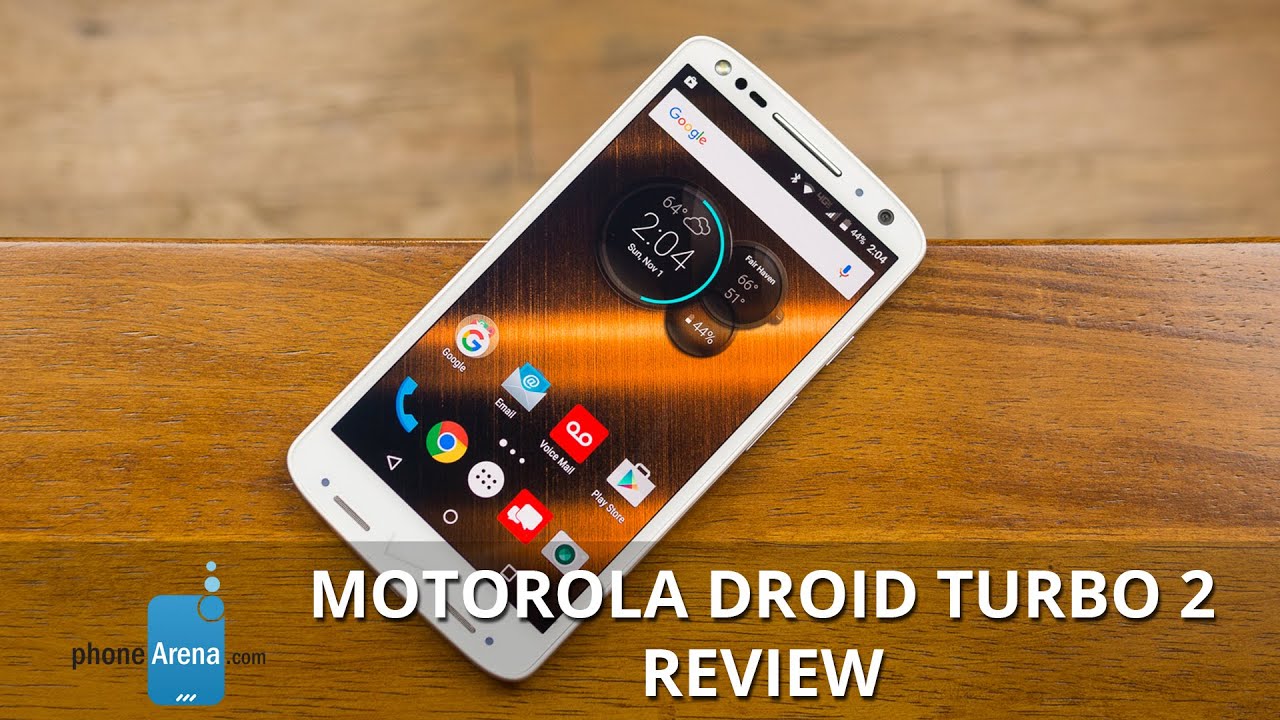
Motorola DROID Turbo 2 Review

Introduction
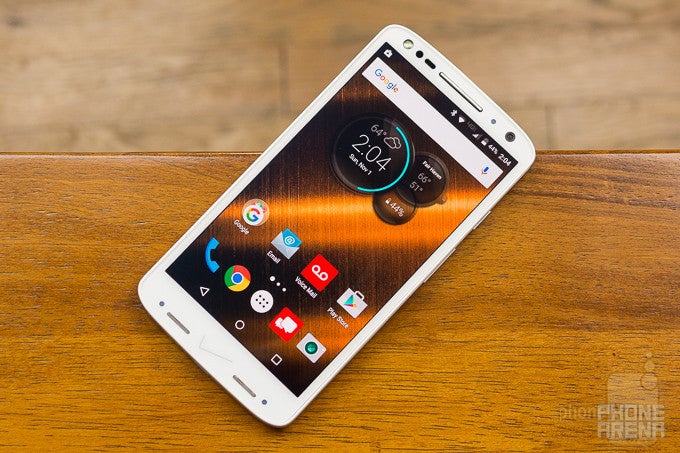
Now, it wouldn’t be Motorola-like without its prized DROID line for Verizon Wireless. Needless to say, it’s a longstanding relationship between the two companies. Last year, the DROID Turbo impressed many folks not only for its better specs sheet than the 2014 Moto X, but it also proved to the critics that today’s high-end phones are still capable of delivering long-lasting battery life.
Back for round two, its successor in the aptly named DROID Turbo 2 hopes to continue the trend – while also being greeted with the usual array of improvements and upgrades. With this year’s model, however, it tacks on one peculiar quality that’s lacking in many of today’s premium devices. That, folks, is none other than sporting an impenetrable design that can withstand the pitfalls that we sometimes encounter in our lives.
The package contains:
- Motorola Droid Turbo 2
- Turbo charger
- Quick start guide
- Safety & warranty information
- SIM removal tool
Design
Its rugged-like construction is complemented by its highly customizable design via Moto Maker.
Aesthetically, the DROID Turbo 2 has less of an aggressive design than its predecessor. That’s not a bad thing per se, seeing that its slimmer footprint makes it vastly easier to handle than say, the Moto X Pure Edition. While it shares some of the design aesthetics of Motorola’s prized darling, the DROID Turbo 2 favors a design with a more subtle arch to its casing – complemented by a thicker metal trim bezel. From afar, it’s distinctively boasting many of the design characteristics of the Moto X Pure Edition, like the metal plate that’s encompassing the Motorola logo and camera lens on the back, but the “DROID” name plastered on the back makes it unmistakable.
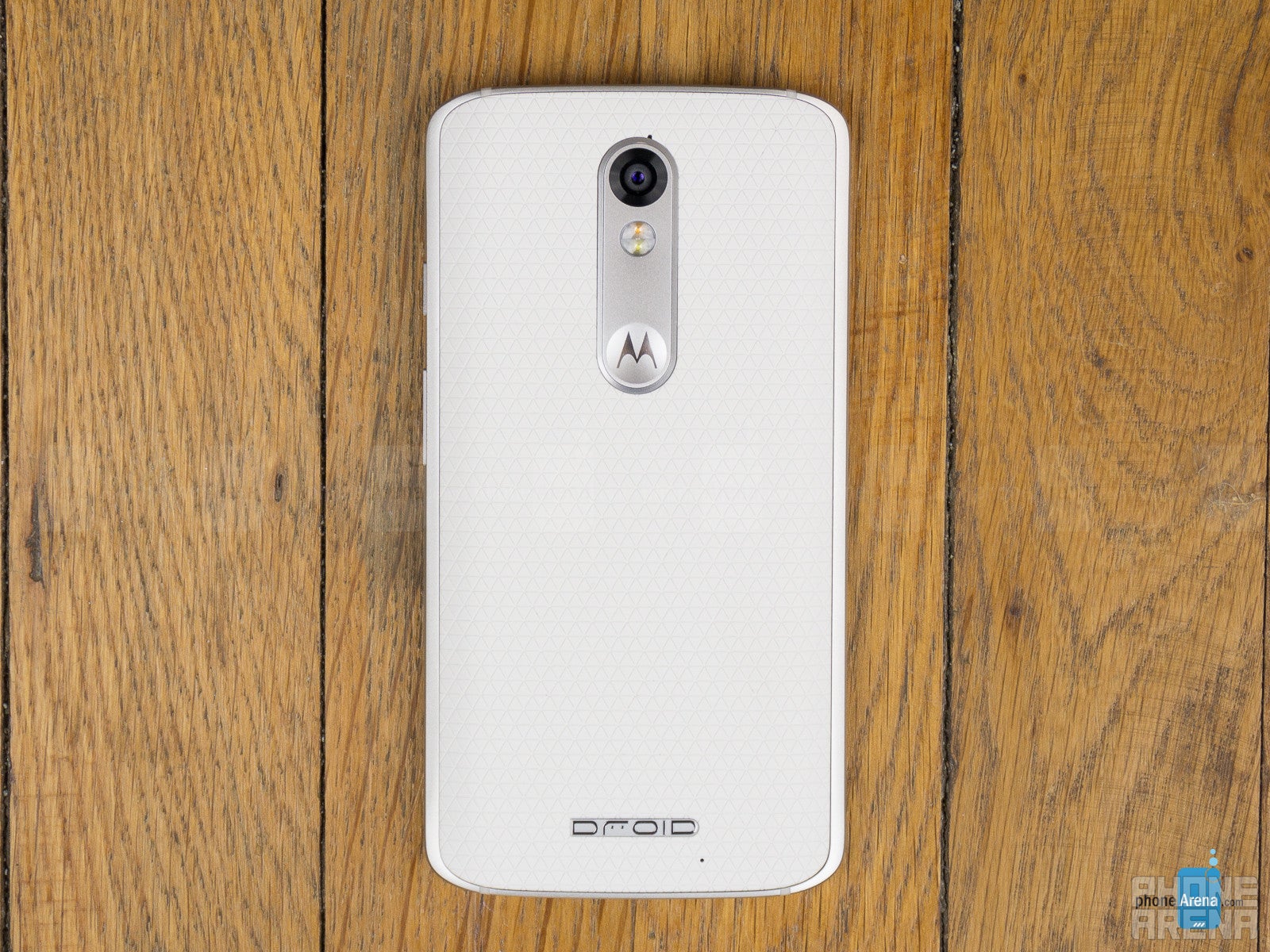
Our particular unit is a white DROID Turbo 2 with an embossed triangle pattern stitched across its casing that emphasizes texture. There’s definitely a subtle plastic feel to the entire thing, but more importantly, it helps in giving it a clean finish that doesn’t show any fingerprints or smudges. Going with this particular setup is crucial, as the materials employed here all help to give the DROID Turbo 2 its increased durability – where it’s able to absorb shocks due to drops, without fear of the phone’s construction being compromised.
While the design is slightly subdued over last year’s aggressive styling, the DROID Turbo 2 benefits by offering more customization with its design via Moto Maker. Similar to the Moto X Pure Edition, you can design the DROID Turbo 2 to your liking – choosing the kind of materials, colors, and even engraving. Besides the soft grip body casing, you can opt to go with a ballistic nylon or pebbled leather finish, giving it a more sophisticated look and feel. This alone boosts its design tremendously, whereby very few phones have this level of customization.
Motorola’s modern design DNA is obviously well-intact with the DROID Turbo 2, but it does see one specific difference to the Moto X Pure Edition in the form of built-in wireless charging, which is an added treat for this DROID.
Besides that, it pretty much follows after the Moto X Pure edition, which shouldn’t be surprising at all. For example, they’ve also fashioned a handy LED flash with the front-facing camera, ensuring that faces are properly exposed in the dimmest of lighting conditions. Also similar, the camera setup in the back with its dual-tone LED flash and the recessed Motorola nub.
Rugged designs are one thing, being waterproof is totally another. Prior to its official announcement, we were teased by the prospect of it being waterproof. Alas, that’s not quite the case, since it offers the same level of water resistance as its predecessor, thanks to its advanced nano-coating technology. More than capable of enduring minor accidental spills, or usage under light rain, it’s not intended to survive complete submersion. Still, we’ll take its level of water resistance.

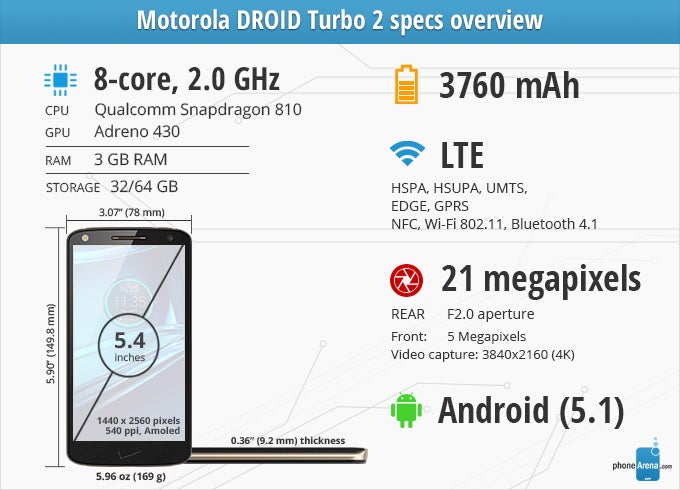
5.9 x 3.07 x 0.36 inches
149.8 x 78 x 9.2 mm
5.96 oz (169 g)

5.65 x 2.78 x 0.27 inches
143.4 x 70.5 x 6.8 mm
4.87 oz (138 g)

5.86 x 3 x 0.39 inches
148.9 x 76.1 x 9.8 mm
5.47 oz (155 g)

5.44 x 2.64 x 0.28 inches
138.3 x 67.1 x 7.1 mm
5.04 oz (143 g)

5.9 x 3.07 x 0.36 inches
149.8 x 78 x 9.2 mm
5.96 oz (169 g)

5.65 x 2.78 x 0.27 inches
143.4 x 70.5 x 6.8 mm
4.87 oz (138 g)

5.86 x 3 x 0.39 inches
148.9 x 76.1 x 9.8 mm
5.47 oz (155 g)

5.44 x 2.64 x 0.28 inches
138.3 x 67.1 x 7.1 mm
5.04 oz (143 g)
Compare these and other phones using our Size Comparison tool.
Display
You’ll never have to worry about dropping your phone thanks to the ShatterShield display.
The biggest attraction in the DROID Turbo 2's 5.4” QHD screen is the new ShatterShield technology.
With it, it's like buying a smartphone with a flawless screen protector pre-installed! But, more importantly, it's the mark of plastic OLED technology finally coming together to offer smartphone users peace of mind. How so?
Simply put, there is no glass on this thing, although it's pretty hard to tell! The DROID Turbo 2 display assembly is split in five layers, engineered for maximum durability. It starts with an aluminum chassis that holds the AMOLED panel, providing structural integrity. On top of the AMOLED panel lie not one, but two touch-sensitive digitizers — if the primary one fails, the second immediately takes over. No compromises here! Moving upwards, we find an "interior lens", which is an optically transparent layer that acts as a clear protective shield. Finally, the interior lens is covered by a second, exterior protective lens with a proprietary hard coating that guards against damage. This is what your fingers end up touching as you operate the touchscreen.
All of this attention might seem overkill, but it’s a necessary one that ensures it continues to work flawlessly despite being dropped. Whereas other screens can crack or shatter after a few drops, the ShatterShield display is able to endure multiple drops without incident. Even from a height of 5 feet, then coming into contact with concrete with the display impacting first, there’s no damage to it whatsoever.
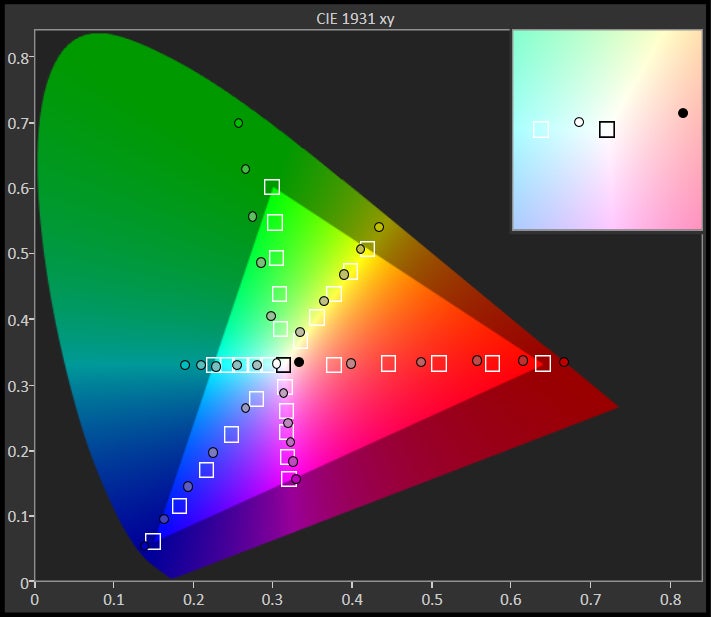
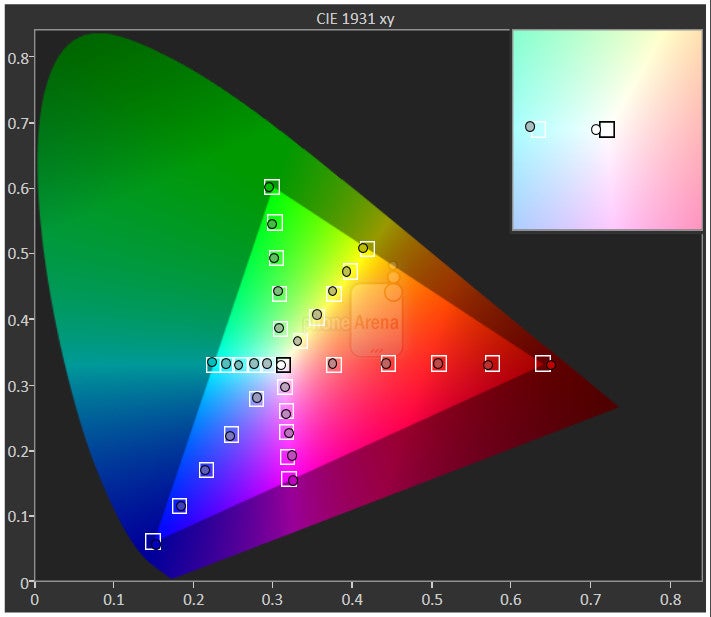
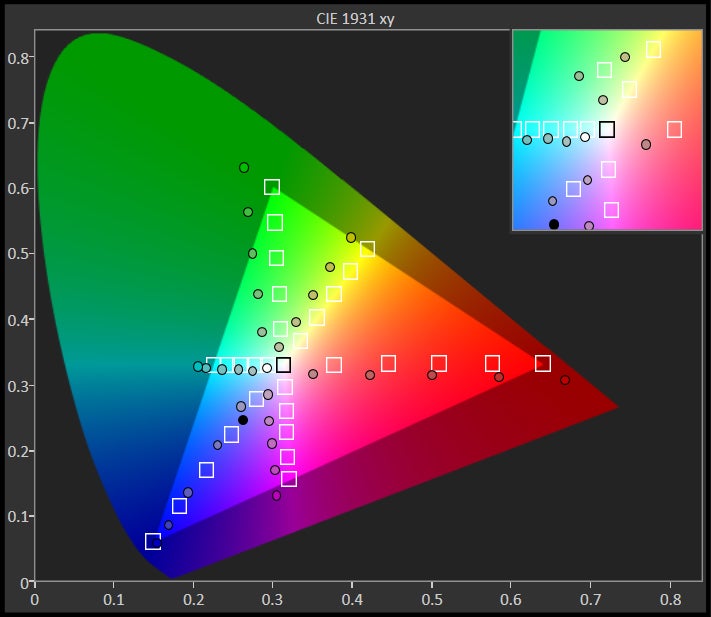
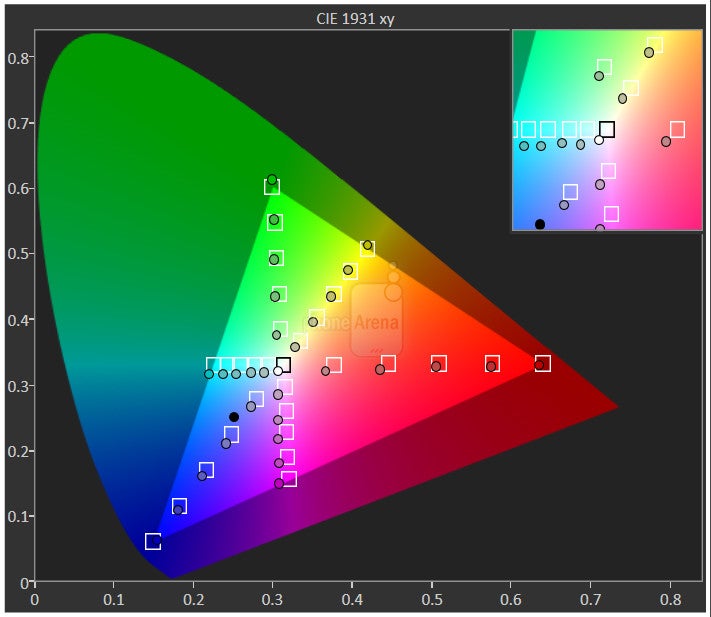
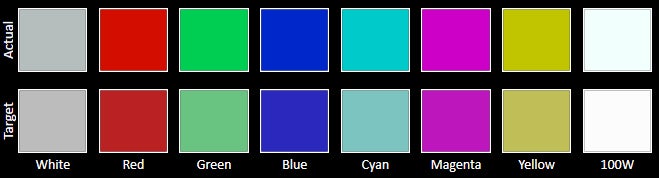
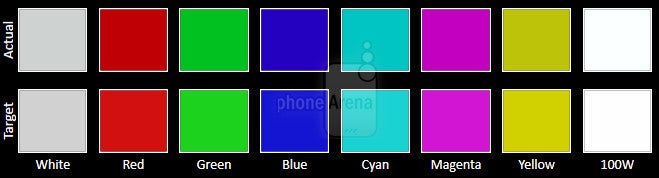
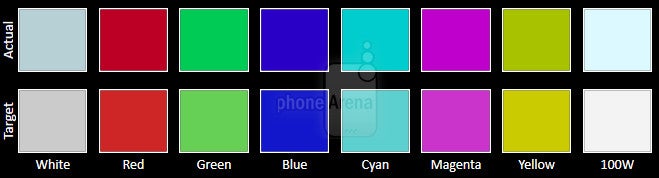
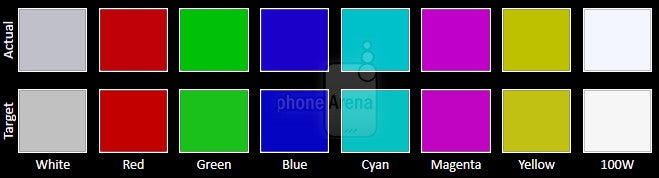
What about the other qualities of its display? Well, it’s typical AMOLED in the way it produces over-saturated colors, wide viewing angles, and that perfect black color. Despite its inaccuracies in the sRGB color gamut chart, the panel actually delivers a pretty good color temperature of 6849K. From the looks of it, however, the screen exhibits a yellowish tone. Recently, we’ve seen improvements made to AMOLED technology when it comes to luminance, but the DROID Turbo 2 tops out at a meager 315 nits. While that tally can be pushed to 445 nits when it’s placed on the automatic setting, where using it with the sun cranks its contrast even higher, it’s still nowhere close as potent as the Moto X Pure Edition.
Nowadays, Quad-HD resolution is hardly a surprise. Motorola manages to differentiate its display here in the DROID Turbo 2 by accompanying it with a shatter-resistant screen. Trust us, it’s an invaluable thing to have, because at some point during your relationship with the phone, you’ll inevitably drop it – whether it be by accident or on purpose. Well, it's just good to know that it's ensured to survive. That alone is a quality that few phones can tout!




Interface and Functionality
Verizon’s bloatware is in full force, but at least it’s not overpowering.
In particular, we have the typical clock/weather/battery widget that we’ve seen in previous DROIDs. Other changes include a different layout to the apps panel, the generally larger size of the icons throughout the interface, and just the obvious realization that it’s not stock-like as the Moto X Pure Edition. Even more pervasive, Verizon’s presence is made well-known by the ridiculous amount of bloatware that’s been preloaded. Sure, we have those Verizon-branded ones out of the box, but then we also have time-killing games like Cookie Jam, Empire, Panda Pop, and Sugar Smash.
As much as purists will find this intrusion unnecessary and redundant, the DROID Turbo 2 also benefits from Motorola’s usual array of enhancements – such as Moto Assist, Moto Actions, Moto Voice, and Moto Display, all of which we find extremely meaningful to the experience. It, too, even utilizes the new double chopping gesture to turn on the LED flash, just like the Moto X Pure Edition.
Verizon’s intrusion might be frowned upon by hardcore users, but in all fairness, the experience still for the most part is relatively straightforward and not too inundated by redundancies. By itself, the subtle customizations and enhancements aren’t overpowering as others out there, like LG’s interpretation or Sammy’s TouchWiz, so to that degree, it eases the stress of being too overwhelming.
Processor and Memory
The Snapdragon 810 proves yet again that it’s a formidable chipset.
Qualcomm’s Snapdragon 810 SoC has proven countless times it’s a beast on its own, so it’s no surprise here that the DROID Turbo 2 is endowed with speed and finesse with its performance. In fact, we didn’t come across any moment when its performance stuttered or lagged with basic operations. Paired with a generous 3GB of RAM, the phone is able to quickly manage several apps without the need to refresh them constantly each time they’re accessed.
Over on the graphics processing side, the Adreno 430 GPU is capable of handling gaming with enough ease and fluidity – albeit, it’s not as smooth as the HTC One M9. Well, that’s partly due to the Quad-HD resolution that the DROID Turbo 2 is faced with, whereas with the HTC One M9, its 1080p resolution isn’t as demanding. Regardless of that, for a phone with a Quad-HD screen, the DROID Turbo 2 does an exceptional job.
Two storage options are available with the DROID Turbo 2 – 32GB and 64GB. The 32GB base model seems sufficient in this day and age, but it’s especially comforting to know that its capacity can also be supplemented thanks to its microSD card slot.
Internet and Connectivity
Combining its high-res screen and snappy performance, on top of its LTE speeds, it makes for a wonderful web surfing experience. Pages are rendered properly without much wait, while navigational controls such as kinetic scrolling and pinch zooming all happen with ease. There’s nothing to complain about the experience, naturally, especially when there’s just a generous amount of real estate for us to enjoy viewing web sites. Even better, Moto Voice is smart enough to open a particular site by just speaking it.
Exclusive to Verizon, the DROID Turbo 2 comes armed with the usual CDMA radios that are necessary for it to ride on Big Red’s network here in the US. Just like nearly all Verizon devices nowadays, the DROID Turbo 2 is also a world phone because it’s accompanied with radios to make it compatible to work on the wealth of GSM networks internationally. Besides that, it comes with all of the usual connectivity features found on any high-end phone – so that consists of aGPS, Bluetooth 4.1, dual-band 802.11 ab/g/n Wi-Fi, and NFC.
Camera
It’s a solid effort for Motorola, but still short when compared to the elites in the space.
Motorola received a substantial boost with the Moto X Pure Edition’s camera, so it makes perfect sense that the DROID Turbo 2 is attached with the same configuration here. That turns out to be a beefy sized 21-megapixel Sony IMX230 CMOS sensor fashioned to the rear, accompanied with an f/2.0 aperture lens, phase detection autofocus, color correlated temperature (CCT) dual-LED flash, and up to 4K video capture. Meanwhile, the front-facing camera is treated to a 5-megapixel camera with a wide-angle lens. In addition, it also bears the same LED flash as well to properly light up those selfies in the dark.
No doubt, the camera hardware sounds delicious enough. The interface, on the other hand, doesn’t see any new acquisitions to its package. Yes, there’s still that quick twisting gesture to launch the camera at any time, but it’s extremely light with its shooting modes and offerings. You get customary things like HDR and panoramic modes, but that’s just about it – there’s no manual mode for advanced settings adjustment.
Image Quality
For Motorola, the quality is a generous improvement over its previous offerings, but it’s still markedly behind the pack. Images actually turn out quite favorable with the DROID Turbo 2, producing sharp looking compositions when the conditions are most ideal. In many of the outdoor scenery shots of the buildings in the background, it’s able to capture good enough details. Colors on the other hand tend to be on the dull side.
However, we’re a bit disappointed by its panoramic and HDR modes. With the former, it just lacks the necessary level of fine details to paint a sharp panoramic shot. And with its HDR mode, it doesn’t apply enough exposure to dimmer areas in the shot to mesh well with the brighter sections.
Low light also proves to be a bit of a challenge for the DROID Turbo 2 as well, seeing that noise has constant presence throughout the scene, which doesn’t help either when details are on the soft and subdued side. Worst yet, the focus can sometimes have trouble in locking on, causing photos to appear blurry.
We’ve seen better, we’ve seen worse. The DROID Turbo 2, overall, is a decent performer in this department, but as we’ve made it clear from the beginning, it doesn’t have the same level of attentiveness that other cameras offer.
Motorola DROID Turbo 2 sample images
Video Quality
Topping out at 4K UHD video recording, the DROID Turbo 2 has the ingredients at its disposal to truly be a beast, but the recipe it opts to use just sours things a bit for it. Indeed, there’s no denying the versatility of 4K recording here, but beyond the fancy resolution, there's some visible jello effect going on at times. At 1080p, the image quality is noticeably smudgier. On the plus side, it’s able to produce stable footage thanks to its digital stabilization.
Finally, it offers a slow motion 720p mode, which is good in really slowing down motion to a crawl, but it’s not particularly detailed – in fact, it doesn't look good at all.
Motorola DROID Turbo 2 sample videos
Multimedia
The DROID Turbo 2 delivers a satisfying multimedia experience.
By now, it’s no shock that the Google Play Music app is the music player of choice. Naturally, it functions in the capacity we all know and love. Going with a slightly different speaker configuration than the one used by the Moto X Pure Edition, the dual front-firing speakers of the DROID Turbo 2 are arranged next to one another – just below the screen. In comparison, they deliver a slightly less potent 75.5 dB of audio power, which is a step down from the Moto X Pure Edition’s mark of 79.1 dB, but it nevertheless musters enough substance and authority to give it a commanding presence.
All sorts of video play smoothly and effortlessly, too, thanks in part to the saturated color tones produced by the AMOLED panel. While it’s effective for the occasion, the only missing thing that solidifies its package is just a multi-tasking aspect that would permit us to do something else simultaneously.
Call Quality
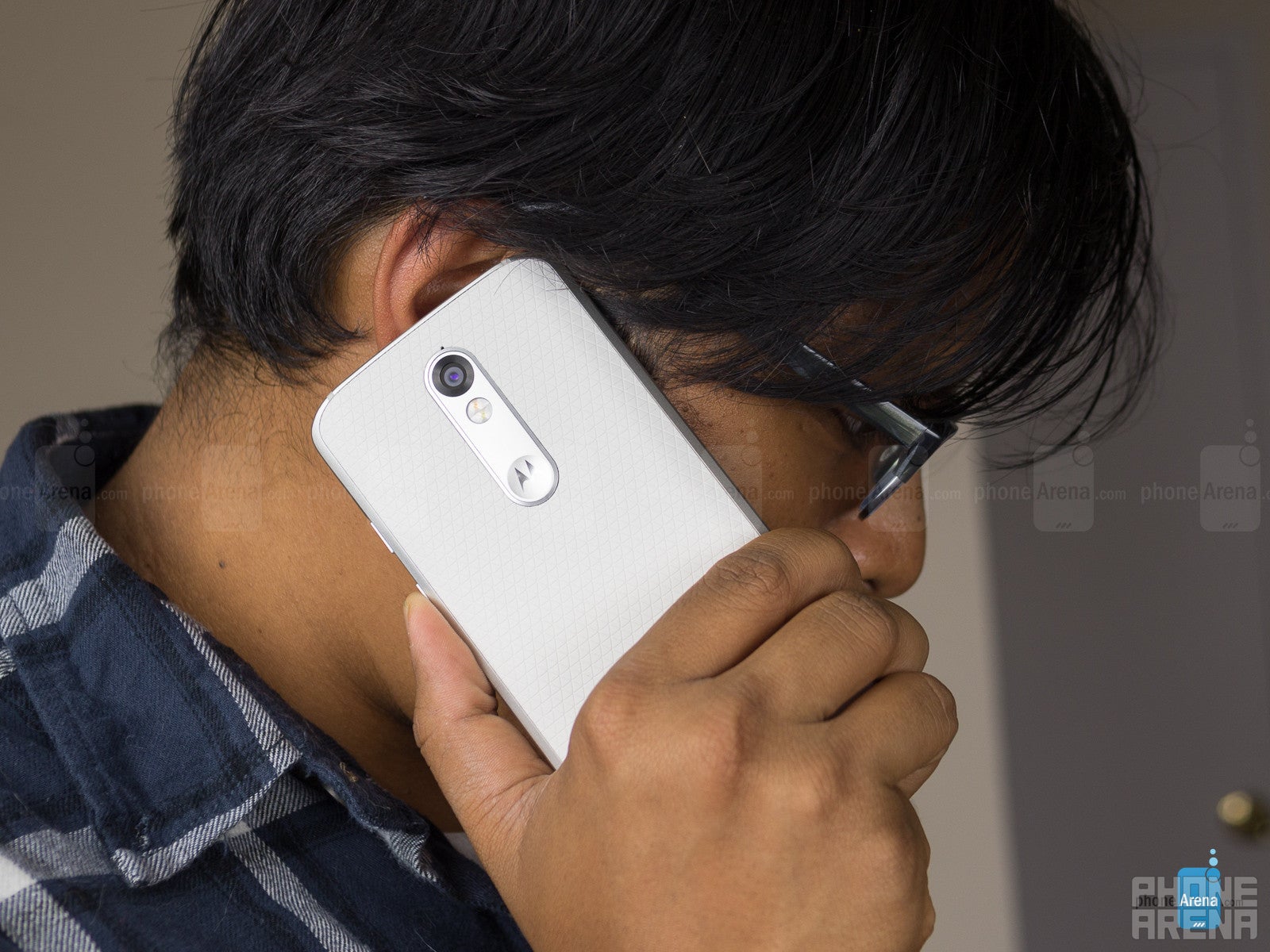
Volume is plentiful, however, the distortion is a bit problematic.
Battery
The lower capacity battery and larger screen size lessens its overall battery life, but it’s still above average.
Beyond the specs, what made last year’s DROID Turbo so noteworthy was the fact that it truly delivered long-lasting battery. Whereas most phones sputter out before the end of a full day, it managed to stay working on through a second. And impressively enough, it remains to be one of the long-lasting smartphones in our custom battery benchmark test.
That’s poignantly made evident in our custom battery benchmark test, where it achieves a mark of 8 hours and 1 minute before it’s completely tapped out. By comparison, the original DROID Turbo etched out a time of 10 hours and 42 minutes. Despite the lower output this time around, it’s one of the fastest charging phones around right now, since using the included 25W Turbo Charger only requires a time of 82 minutes before it’s back to full capacity. Alternatively, it also features built-in wireless charging for those who prefer the convenience of any Qi-compatible chargers.
Conclusion
Verizon’s relationship with Motorola has been a long-withstanding one that dates back to the humble beginnings of Android. Last year’s DROID Turbo extended the healthy relationship by living up to its claim of being one of the longest-lasting smartphones around. While there’s certainly no love lost with its successor, the DROID Turbo 2 has fewer distinctions than what Motorola has already delivered in the Moto X Pure Edition.
By comparison, the DROID Turbo was a substantially superior spec’d phone than the 2014-made Moto X. This time around, however, the only major things differentiating the two are their battery capacities and prices. Starting with the former, the DROID Turbo 2’s main benefit over its sibling is that it delivers a long battery life. That alone might prove to be the strongest determination for some folks, but when we factor in the latter, the disparity in the DROID Turbo 2’s pricing makes it a tougher sell.
Outright, you’re looking at shelling out $624 to buy the DROID Turbo 2, which can be customized via Moto Maker. Conversely, though, the Moto X Pure Edition fetches for $400 starting. As much as we’d like to validate the higher price point to the DROID Turbo 2’s better battery life, built-in wireless charging, and ShatterShield screen, it’s honestly not enough to warrant it as the better buy. That’s unless you’re really clumsy, which is where its ShatterShield display and impervious design proves to be invaluable.
Going beyond the Moto X Pure Edition, it also sees competition from other notable smartphones currently in Verizon’s portfolio that are similarly priced – such as the iPhone 6s, Galaxy S6, Galaxy S6 edge, LG V10, and LG G4. Without a doubt, if battery life and an extra-tough screen are of utmost importance in your decision buying process, the DROID Turbo 2 should be on your list.
Software version of the review unit: Android Version: 5.1.1 | Build Number: LCK23.130-23

Popular stories



Latest News



Things that are NOT allowed:
To help keep our community safe and free from spam, we apply temporary limits to newly created accounts: