PhoneArena is looking for new authors! To view all available positions, click here.
  • Home
  • News
  • Which country has the fastest 4G service? Hint, the U.S. is eighth

Which country has the fastest 4G service? Hint, the U.S. is eighth

Posted: , by Alan F.

Categories:

Share:

Discuss 40
Which country has the fastest 4G service? Hint, the U.S. is eighth
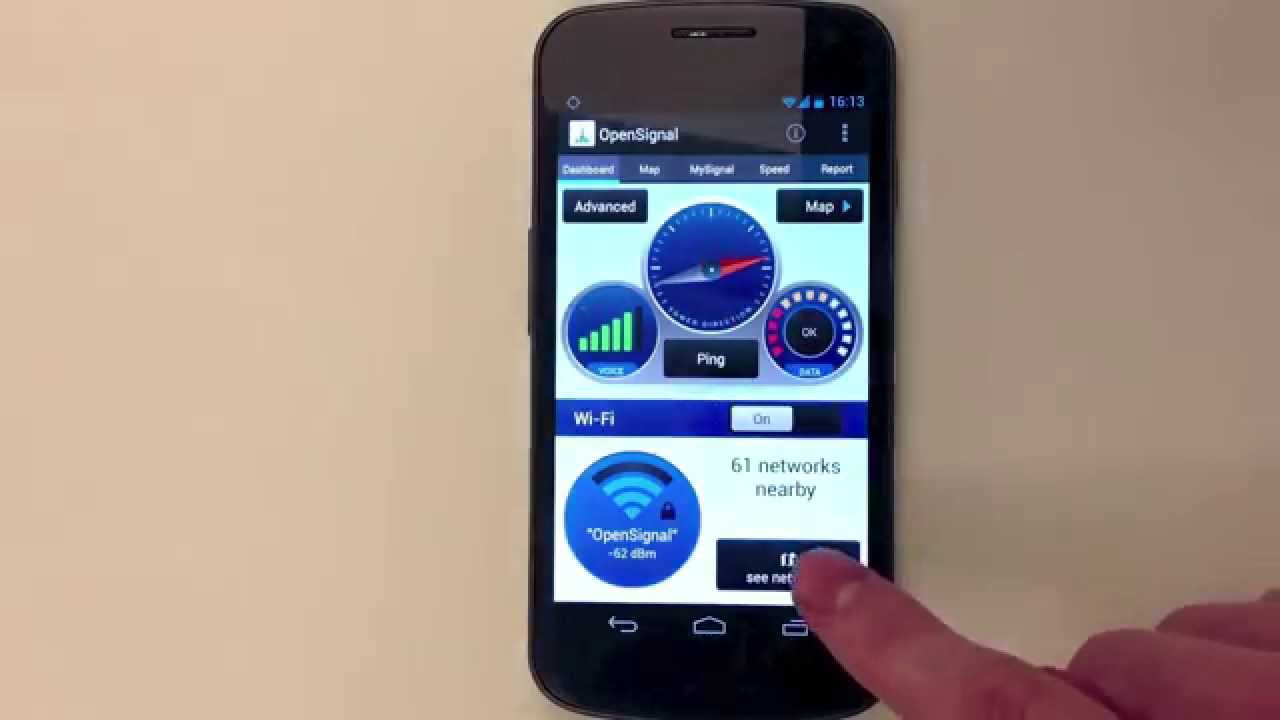
Screenshots from the OpenSignal app

Screenshots from the OpenSignal app

In the U.K., OpenSignal is a company that uses crowdsourcing through its Android app to collect data. Thanks to this data, we can tell you that Sweden, the first country to launch LTE service, has the fastest 4G network with an average download speed of 22.1 Mbps. Right behind is Hong Kong with an average download speed of 19.6 Mbps. Denmark and Canada are third and fourth with average download speeds of 19.1 Mbps and 18.1 Mbps. What about the U.S.? With an average download speed of 9.6 Mbps, the States finished 8th.

Some of the reason for the low U.S. score is that some carriers in the U.S. built their 4G networks around 20MHz for their initial rollouts (Verizon and AT&T) and the LTE networks for Sprint and MetroPCS were built around 10MHz. Meanwhile, the European operators used 40MHz when they built their 4G LTE pipelines.

source: OpenSignal via GIGaom
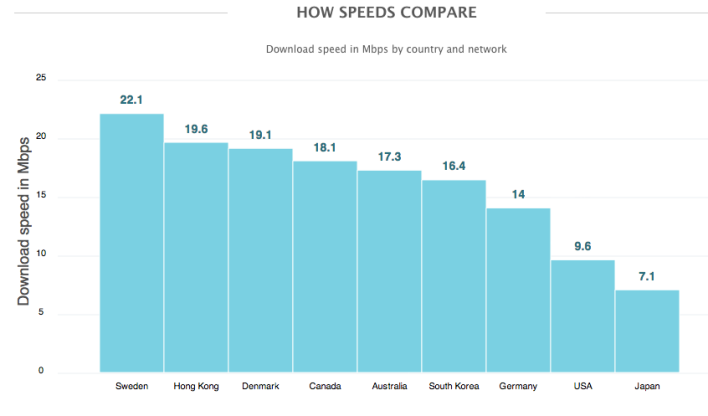
Sweden has the fastest LTE service on the planet
Sweden has the fastest LTE service on the planet


Share:

Discuss40

40 Comments

  • Options
    Close


Want to comment? Please login or register.

1. D_Tech-tive posted on 13 Feb 2013, 21:49 4 1

No surprise about U.S.

2. simplyj posted on 13 Feb 2013, 21:57 10 2

Sprint's dragging down the U.S.

3. StrumerJohn posted on 13 Feb 2013, 22:10 3 2

Hahaha yep!

28. TheRequiem posted on 14 Feb 2013, 08:47 2 1

Incorrect, Sprint has developed Network Vision using new technology from Samsung (the only other country using modular Fiber optic tech is South Korea) and are building a complete redux of their network (basically stripping towers bare and putting up all ne wmodern equipment). Unfortunately, AT&T & Verizone simply upgraded legacy tower's with LTE. In the long run, Sprint/ Softbank and their spectrum assets (which is more then all other US Carriers spectrum, combined) will bring about one of the most advanced wireless networks in North America. Keep in mind, Clearwire, has over 160mhz in high-end LTE Spectrum and Sprint willl be using several frequencies for LTE... this will result in LTE Advanced speeds far past the 100mbps. Verizon and AT&T will have trouble with their spectrum/ subscriber counts. Also, fyi, I have witness Sprint LTE and have hit over 40mbps on it... so alas, you are incorrect.

29. troutsy posted on 14 Feb 2013, 09:23 1 1

So you are a Sprint user, incredibly delusional, and totally biased.... Thanks for stopping by! :-)

40. depeche posted on 16 Feb 2013, 15:29

Sprint did a lot of hardware upgrades with the roll out of Wi-Max; they are just changing software and trying to add the nearly disbanded Iden network bands.

They have a lot of Bands to work with, unlike AT&T

4. Joshing4fun posted on 13 Feb 2013, 22:15

Hong Kong? Is that separate from china?

14. Nathan_ingx posted on 13 Feb 2013, 23:27 10 1

If your geography is based on iMaps, then no.

15. imsickwithsmartphone posted on 13 Feb 2013, 23:35 2

Part of China but Hong Kong have their own administration...

33. hepresearch (unregistered) posted on 14 Feb 2013, 19:30

Are there any LTE networks in China that are not also in Hong Kong? If not, then TD-SCDMA is tops elsewhere in China.

5. faunte posted on 13 Feb 2013, 22:21 9

The U.S. has states with a bigger population than Sweden! If their wireless companies all had the luxury of focusing ONLY on California, this may be a different story. Since we're comparing apples to oranges, let's compare amount of space and number of people covered with cell or data coverage. These countries don't have significant populations of people living in rural areas like the U.S. does. It's a bogus comparison in my opinion.

9. jroc74 posted on 13 Feb 2013, 22:33 2

This is a good point. Because since I've been on LTE, I average 10Mbps down in weaker reception areas. In a good to great areas, 25-30. I have Verizon, live in the DC, MD, VA area; MD to be exact. You could consider all 3 one area...they are so close together.

I live closer to DC...but on speed tests...I get faster speeds from VA or Baltimore servers.

13. threed61 posted on 13 Feb 2013, 23:06 2

Canada is larger in area and Australia nearly as large both with vast rural areas.

20. dsDoan posted on 14 Feb 2013, 01:01 4 1

Canada's boundary contains masses of open water. If you compare strictly land mass, the US is larger.

23. shuaibhere posted on 14 Feb 2013, 01:31 5

Lol..you guys are talking about 4g lte....and here in india even 3g not fully implemented....

25. iWorld posted on 14 Feb 2013, 04:29 3

waiting for 3G scam news.

27. shuaibhere posted on 14 Feb 2013, 08:13

Surely it'll be the news in near future...

6. wendygarett posted on 13 Feb 2013, 22:24 2 1

I thought south Korea is the 1st and Japan 2nd?

7. Tux_Alan posted on 13 Feb 2013, 22:30

Gosh, fourth!

8. richardyarrell2011 (banned) posted on 13 Feb 2013, 22:32 2 6

Both Verizon and Sprint are dragging down the US

10. jroc74 posted on 13 Feb 2013, 22:35 2 2

Sprint, I agree....Verizon.....dont agree. I think Verizon and AT&T are probably fighting for 1 and 2 for fastest, best speeds.

12. simplyj posted on 13 Feb 2013, 22:47 3 1

Verizon has the best LTE speeds. Not sure what you're smoking..

16. PapaSmurf posted on 13 Feb 2013, 23:47 2 2

AT&T is faster than Verizon. But give T-Mobile a few months, and will be faster than both of them thanks to LTE Advanced. :)

19. zibbyzib2000 posted on 14 Feb 2013, 00:49 4

I'm pretty sure AT&T and T-Mobile bring the 4G average down quite a bit since they consider their HSPA+ 4G and it's not even close to LTE speeds.

22. g2a5b0e posted on 14 Feb 2013, 01:26 4

I'm so tired of people saying HSPA+ is not even close to LTE. First off, there are multiple types of HSPA+. The version T-Mobile employs in most of its markets is the dual-band HSPA+42 variety. With it, I average 15-20 down with spikes over 25. Don't tell me that's not comparable to LTE. It is true that the up speeds are lacking in comparison to LTE, though.

38. jroc74 posted on 16 Feb 2013, 09:48

I agree. HSPA+....I would gladly take that if I wasnt on Verizon. Or if Verizon had that.

My issues with other carrriers is coverage. I know even Verizon has dead zones. I live n work in or around one. It just seems like for my area....Verizon's dead zones is smaller than Sprint n T Mo. AT&T.....not sure about...but they might actually be better in my area.

Whats really odd is in my building...Sprint might work better than Verizon. But its like its confined to the building and immediate surrounding area.

21. dsDoan posted on 14 Feb 2013, 01:03 2 1

You can't say AT&T or Verizon is the fastest. It depends on where you live. On Verizon, I average 35 Mbps down 10 Mbps up, but I've gotten peaks of almost 70 Mbps and over 20 Mbps up.

32. lsutigers posted on 14 Feb 2013, 19:25 1

lol, I have been ALL OVER the country with my Verizon phone and NEVER gotten anywhere even close to 70 mbps...C'mon now, I like my Verizon but that's not accurate.

39. jroc74 posted on 16 Feb 2013, 09:51

I agree with this. Mine hasnt either.

But...I have seen ppl with Verizon posts speeds of 50Mbps and up. Its usually ppl with an HTC phone.

Motorola was and probably still is using older LTE tech than Samsung and HTC. So in a way it could depend on the phone, what tech it has inside.

17. g2a5b0e posted on 14 Feb 2013, 00:24 1

I'm pretty sure he wasn't referring to data speeds.

11. Vorsayo posted on 13 Feb 2013, 22:38

I thought South Korea would be first. The entire country has access to a 1000 Mbps IPS. Guess that doesn't translate to having the fastest 4G average. All though no one really has true 4G yet. Definition of 4G being 100 Mbps for mobile (in car or on train) and 1000 Mbps standing still.

18. Edmund posted on 14 Feb 2013, 00:44

So this is nothing more than an advertisement for "opensignal" ??? PA may want to disclose their interest in future.

24. gaby1451 posted on 14 Feb 2013, 03:40 1

Wait, can someone please explain the last part about the U.S. LTE networks being in 10MHz and 20MHz vs. Europe's 40MHz. I don't understand, what's the difference and how does it pertain to download speeds?

30. troutsy posted on 14 Feb 2013, 09:32 1

Higher frequency allows for faster data transmission. If I type this response at 1 letter/second, its going to take twice as long compared to typing it at 2 letters/second.

Higher frequency waves are much higher energy and can't carry for as long of a distance. Hence, it's not as practical in the US.

***I'm not an expert in electromagnetic wave theory, but I did stay at a Holiday Inn Express last night.

34. hepresearch (unregistered) posted on 14 Feb 2013, 19:47

Its about bandwidth. If you are looking at two networks, both operating around the same frequency... let's say 1900 MHz just for this example... that are using identical technology... let's say LTE for this example... then the size of the sliver of that band that they are using is what we are referring to as 'bandwidth'. Basically, this is saying that while an American carrier is using either 10 or 20 MHz of the 1900 MHz band (which is centered around 1900 MHz), the Europeans are using 40 MHz in the same band. Now, as the band center increases, you can get more information into a smaller sliver of bandwidth because the 10 MHz sliver at 1900 MHz is less of a ratio jump than 10 MHz is at, say, 850 MHz. Also, higher power is allowed at lower frequencies, and so longer range of interference becomes a bigger problem at lower frequencies as well.

Sprint's 10 MHz in the 1900 band, and MetroPCS' 10 MHz in the 1700 band, are not bad in comparison to the 20 MHz for AT&T and Verizon in the much lower 700 and 750 bands. They are all very poor, though, when compared to 40 MHz in the 1800, 2100, and 2600 bands elsewhere in the world. That much bandwidth in that high of a frequency band range is a crucial factor in allowing for more simultaneous data sessions and higher data speeds on international LTE networks. Ever wondered why WiFi always got 20 Mbps long before 1xEv-DO could get 3 Mbps? Yeah... WiFi is often found in the 2300 and 2500 bands, where you don't need a lot of bandwidth to get higher speeds and higher numbers of available simultaneous connections, and ran at very low power so as to avoid interference over any significant range.

26. speckledapple posted on 14 Feb 2013, 05:44

we have much more area to cover sure and its the anal carriers again but we should do better

35. hepresearch (unregistered) posted on 14 Feb 2013, 19:57

On the contrary... the coverage is small because of the area, but the speed of data is not a function inverse to area. It is, in fact, the network saturation on a smaller bandwidth that is the issue here in the States. LTE bandwidth here is essentially only a quarter of what they get overseas, is buggy because it is largely in the 700 MHz region where interference and attenuation issues plague the system, and our LTE networks have, thanks to great marketing and urgency expressed by the carriers here and their mutual insane drive to push everyone to consume more and more data at all times on all these newer and faster devices, been choked with a flood of new customers. Our big problem is backhaul... too many customers trying to eat up too much data at once slows everything down for everyone, and the land-based data-line end of things becomes yet another bottleneck in supply and demand. Elsewhere in the world, there are not as many customers who are willing to pay the premium for the newest handsets or the fastest data (or even the highest data caps), and so the overseas networks are often able to accomodate more sessions AND deal with less traffic overall, anyway. It is the effect of having a big shiny new network that is effectively empty... the overseas LTE data speeds can't help but be fantastic under those circumstances.

31. gwuhua1984 posted on 14 Feb 2013, 10:40

Of course, with the carriers jacking up the price and speed caps... It's a no brainer why US is only the 8th and averaging half the speed of the top 1 and 2.

36. longhairbilly posted on 15 Feb 2013, 05:28

Ya, but who pays the most for wireless data? Suck it the rest of the world. U.S.A! U.S.A!

37. hepresearch (unregistered) posted on 15 Feb 2013, 08:00

Proud to pay more? And for less?

Want to comment? Please login or register.

Hot Phones

  • Samsung Galaxy S4Samsung Galaxy S4
  • Apple iPhone 5Apple iPhone 5
  • Samsung GALAXY Note IISamsung GALAXY Note II
  • HTC OneHTC One
  • Sony Xperia ZSony Xperia Z
  • Google Nexus 4Google Nexus 4
  • LG Optimus GLG Optimus G
  • Nokia Lumia 920Nokia Lumia 920