Apple iPad 2 Wi-Fi
- Bookmark
- Posted: 02 Mar 2011 Announced: 02 Mar 2011
- Market Status: Released
- Release date: 11 Mar 2011
-
Do you ...?
- Links: Apple iPad 2 vs Motorola XOOM Apple iPad 2 Review Apple iPad 2 vs BlackBerry PlayBook vs Motorola XOOM vs T-Mobile G-Slate Asus Transformer Prime vs Apple iPad 2
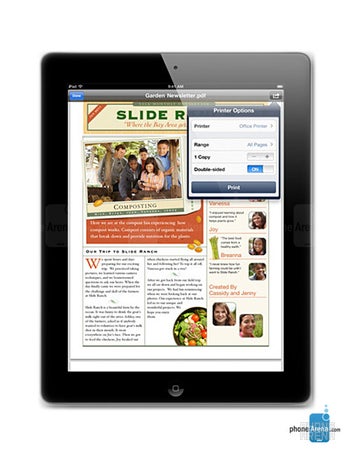
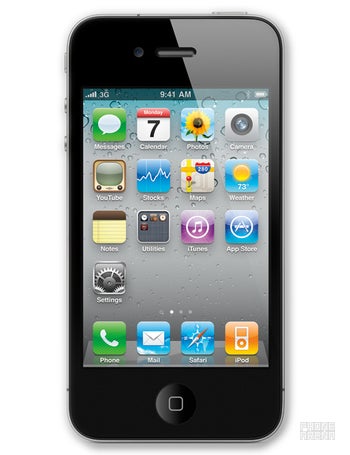
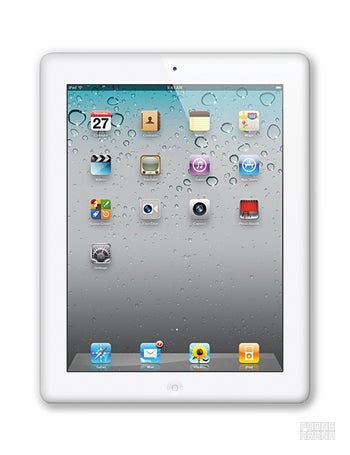
The Wi-Fi-only iPad 2 version is the cheapest of them all, and also the lightest at 1.33 pounds (601 grams). It improves on its predecessor in both desing and hardware, since the iconic tablet is now thinner even than the iPhone 4 at 0.34" (8.8mm). It is powered by a 1 GHz dual-core Apple A5 chipset, which provides 2x the CPU and 9x the GPU performance of its predecessor. All that while keeping the same 10 hours of battery life. Dressed entirely in black or white this time, the iPad 2 sports HDMI output via a separate cable, as well as rear and front-facing cameras.
Rating
Apple iPad 2 Wi-Fi specifications
also known as Apple iPad 2,4
Pros
- Dual core processor
- Thin body, measuring less than 9.5mm/0.37inches (0.34 inches)
- Fast processor (1000 MHz)
Cons
- Low pixel densitiy screen, below 180ppi (132 ppi)
- Lacks global positioning system (GPS)
- Low-resolution camera (0.7 megapixels)
- The camera lacks autofocus
- Lacks microSD slot for storage expansion
- Proprietary USB connector - have to use its cable instead of a standard microUSB
Design
- Device type:
- Tablet
- OS:
- iOS (5.1, 5, 4.x)
- Form factor:
Form factor - Refers to the form factor of a phone. The main handset designs are bar, clamshell, slide, swivel
- Candybar
- Dimensions:
- 9.50 x 7.31 x 0.34 (241.2 x 185.7 x 8.8 mm)
- Weight:
- 21.20 oz (601 g)
the average is 17.3 oz (494 g)
- 21.20 oz (601 g)
Display
- Physical size:
- 9.70 inches
- Resolution:
- 1024 x 768 pixels
- Pixel density:
Pixel density - The pixel density of a display represents the number of pixels over an area of one inch. It’s measured in “pixels per inch”, or ppi. The higher the number, the more detailed and good-looking the display is.
- 132 ppi
- Technology:
Technology - There are two main screen technologies currently used in phones and tablets: LCD and AMOLED. The former usually features a light source and liquid crystals, while the latter is based on organic light-emitting diodes. Newer LCD variations like IPS-LCD and Super-LCD allow for very accurate color reproduction and very wide viewing angles, where no significant image quality loss is observed. Current AMOLED screens differ in such a way that they can exhibit much more saturated colors (sometimes too much) and incredibly high contrast levels, which is due to black color being completely black in AMOLED displays.
- IPS LCD
- Touchscreen:
- Capacitive, Multi-touch
- Features:
- Light sensor
Battery
- Capacity:
- 6944 mAh
Hardware
- System chip:
System chip - Most modern handsets use an advanced chip that includes many of the device’s hardware modules like the processor, Wi-Fi, Bluetooth and sometimes even the wireless radio. This field shows what particular system chip (or System-on-a-Chip) is used in the phone.
- Apple A5
- Processor:
Processor - The processor is the main computing component of a phone and is a major factor when it comes to the overall speed of the device. Some more powerful smartphones use dual-core and quad-core processors designed to deliver greater performance.
- Dual core, 1000 MHz
- Graphics processor:
- Yes
- System memory:
System memory - System memory, or RAM memory is the type of memory that the device uses to temporarily store data from the OS or currently-running apps. The more RAM available to the device, the better the performance will be when multiple or heavier programs are running.
- 512 MB RAM
- Built-in storage:
- 64000 MB
Camera
- Camera:
- 0.7 megapixels
- Camcorder:
- 1280x720 (720p HD) (30 fps)
- Features:
- Video calling
- Front-facing camera:
- 0.3 megapixels VGA
Multimedia
- Music player:
- Filter by:
- Album, Artist, Genre, Playlists
- Features:
- Album art cover, Background playback
- Filter by:
- YouTube player:
- Yes
Internet browsing
- Browser:
- Yes
- Supports:
- HTML, HTML5
- Built-in online services support:
- YouTube (upload)
Phone features
- Organizer:
- Calendar, Document viewer (Office 2007, Office 2003, PDF)
- Messaging:
- Predictive text input
- E-mail:
- Yes
Connectivity
- Bluetooth:
- 2.1, EDR
- Wi-Fi:
Wi-Fi - Wireless Local Area Network (WLAN) - used radio waves (RF) or infrared signals to send and receive data over the air. Most popular WLAN solutions today is Wi-Fi (802.11b and 802.11g) standards. 801.11b provides data speeds of around 11mbps while 802.11g can go up to 54 mbps.
- 802.11 b, g, n, a
- USB:
- Yes
- Connector:
- Proprietary
- HDMI:
- Yes
- TV-Out, Computer sync, OTA sync
Other features
- Notifications:
- Silent mode, Speakerphone
- Sensors:
- Accelerometer, Gyroscope, Compass
- Voice recording
Availability
- Officially announced:
- 02 Mar 2011
Alternative variants
We list only the specs that are different than the main variant
Apple iPad 2 Wi-Fi 32GB
Hardware
- Built-in storage:
- 32000 MB
Apple iPad 2 Wi-Fi 16GB
Hardware
- Built-in storage:
- 16000 MB
Apple iPad 2,4
Hardware
- System chip:
System chip - Most modern handsets use an advanced chip that includes many of the device’s hardware modules like the processor, Wi-Fi, Bluetooth and sometimes even the wireless radio. This field shows what particular system chip (or System-on-a-Chip) is used in the phone.
- Apple A5 32nm LP
- Processor:
Processor - The processor is the main computing component of a phone and is a major factor when it comes to the overall speed of the device. Some more powerful smartphones use dual-core and quad-core processors designed to deliver greater performance.
- Dual core, 1000 MHz, ARMv7
To see the full specifications with in-depth details click here.
Despite our efforts to provide full and correct Apple iPad 2 Wi-Fi specifications, there is always a possibility of admitting a mistake. If you see any wrong or incomplete data, please LET US KNOW.
If you are interested in using our specs commercially, check out our Phone specs database licensing page.