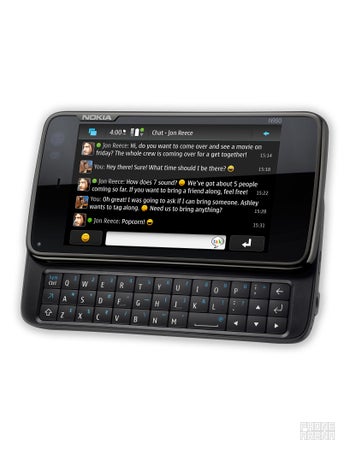
Nokia N900
Pros
- High pixel densitiy screen, over 250ppi (267 ppi)
Cons
- Slow processor (600 MHz)
- It is so thick it needs a personal fitness trainer (0.77 inches inches)
- Resistive touchscreen technology means its display is less sensitive than you would like it to be
- Too little RAM memory (256 MB RAM)
- Low-resolution video capture
Description
Design
- Device type:
- Smart phone
- OS:
- Linux (Maemo 5)
- Dimensions:
- 4.37 x 2.35 x 0.77 inches (110.9 x 59.8 x 19.5 mm)
- Weight:
- 6.38 oz (181 g)
the average is 4.4 oz (125 g)
- 6.38 oz (181 g)
Display
- Physical size:
- 3.5 inches
- Resolution:
- 800 x 480 pixels
- Pixel density:
Pixel density - The pixel density of a display represents the number of pixels over an area of one inch. It’s measured in “pixels per inch”, or ppi. The higher the number, the more detailed and good-looking the display is.
- 267 ppi
- Technology:
Technology - There are two main screen technologies currently used in phones and tablets: LCD and AMOLED. The former usually features a light source and liquid crystals, while the latter is based on organic light-emitting diodes. Newer LCD variations like IPS-LCD and Super-LCD allow for very accurate color reproduction and very wide viewing angles, where no significant image quality loss is observed. Current AMOLED screens differ in such a way that they can exhibit much more saturated colors (sometimes too much) and incredibly high contrast levels, which is due to black color being completely black in AMOLED displays.
- TFT
- Colors:
- 65 536
- Touchscreen:
- Resistive
- Features:
- Light sensor, Proximity sensor
Battery
- Talk time:
- 6.30 hours
the average is 10 h (615 min)
- 6.30 hours
- Stand-by time:
- 12.0 days (288 hours)
the average is 18 days (433 h)
- 12.0 days (288 hours)
- Talk time (3G):
- 4.30 hours
the average is 9 h (532 min)
- 4.30 hours
- Stand-by time (3G):
- 10.0 days (240 hours)
the average is 24 days (565 h)
- 10.0 days (240 hours)
- Capacity:
- 1320 mAh
Hardware
- System chip:
System chip - Most modern handsets use an advanced chip that includes many of the device’s hardware modules like the processor, Wi-Fi, Bluetooth and sometimes even the wireless radio. This field shows what particular system chip (or System-on-a-Chip) is used in the phone.
- TI OMAP3430
- Processor:
Processor - The processor is the main computing component of a phone and is a major factor when it comes to the overall speed of the device. Some more powerful smartphones use dual-core and quad-core processors designed to deliver greater performance.
- Single core, 600 MHz, ARM Cortex-A8
- Graphics processor:
- PowerVR SGX530
- System memory:
System memory - System memory, or RAM memory is the type of memory that the device uses to temporarily store data from the OS or currently-running apps. The more RAM available to the device, the better the performance will be when multiple or heavier programs are running.
- 256 MB RAM / 768 MB ROM
- Built-in storage:
- 32 GB
- Storage expansion:
- microSD, microSDHC up to 16 GB
Camera
- Camera:
- 5 megapixels
- Flash:
- Dual LED
- Aperture size:
Aperture size - The aperture of a camera is the opening through which light travels before it reaches the camera sensor. The smaller the number is, the bigger this opening is, allowing for more light to pass.
- F2.8
- Features:
- Auto focus, Digital zoom, Geo tagging, Self-timer
- Camcorder:
- Other, 848 x 480 pixels 25 fps
- Features:
- Video calling
- Front-facing camera:
- Yes
Multimedia
- Radio:
- FM, FM Transmiter
Internet browsing
- Browser:
- Maemo browser
Technology
- GSM:
- 850, 900, 1800, 1900 MHz
- UMTS:
- 900, 1700/2100, 2100 MHz
- Data:
- HSDPA 10.2 Mbit/s, HSUPA 2 Mbit/s, UMTS, EDGE
- Positioning:
Positioning - This field shows the positioning systems supported by the device. There are three main types: GPS, A-GPS and GLONASS. GPS - This is one of the most widespread global positioning technologies, developed and maintained by the U.S. government. It uses satellites in order to detect your location. Works best in clear weather. A-GPS - A-GPS stands for Assisted GPS and is the industry standard for positioning and navigation. “Assisted” means that it can use local wireless networks, in addition to satellites, for quicker and more precise localization. GLONASS - GLONASS is a global positioning system, developed by the Russian Federation. It’s very similar to GPS, but isn’t so popular in cell phones.
- A-GPS
- Navigation:
- Yes
Phone features
- Phonebook:
- Unlimited entries, Caller groups, Multiple numbers per contact, Search by both first and last name, Picture ID, Ring ID
- Organizer:
- Calendar, Alarm, To-Do, Document viewer, Calculator, World clock, Stopwatch, Notes
- Messaging:
- SMS, Predictive text input
- E-mail:
- IMAP, POP3, SMTP, Microsoft Exchange
Connectivity
- Bluetooth:
- 2.1, EDR
- Wi-Fi:
- 802.11 b, g
- USB:
- USB 2.0
- Connector:
- microUSB
- Features:
- USB charging
- Other:
- TV-Out, DLNA, UPnP, Computer sync, Infrared, SyncML, VoIP
Other features
- Notifications:
- Music ringtones (MP3), Vibration, Phone profiles, Speakerphone
- Sensors:
- Accelerometer
- Voice recording
Availability
- Officially announced:
- 27 Aug 2009
To see the full specifications with in-depth details click here.
Despite our efforts to provide full and correct Nokia N900 specifications, there is always a possibility of making a mistake. If you see any wrong or incomplete data, please LET US KNOW.
If you are interested in using our specs commercially, check out our Phone specs database licensing page.