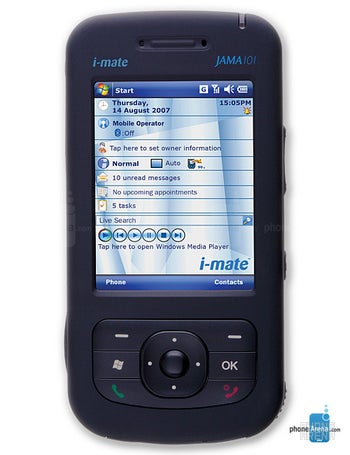
i-mate JAMA 101

The JAMA 101 is a small Windows Mobile 6 Professional phone with 2.4" QVGA touch display. It features microSD slot and 2-megapixel camera but is limited to 2G only usage in Europe, as is only tri-band phone.

Rating

Not rated
Not rated

Share

i-mate JAMA 101 specifications

Pros

No pros

Cons

  • Low pixel densitiy screen, below 180ppi (167 ppi)
  • Slow processor (300 MHz)
  • Slow data means slow Internet browsing (EDGE)
  • Low resolution display (240 x 320 pixels)
  • Resistive touchscreen technology means its display is less sensitive than you would like it to be
  • Lacks global positioning system (GPS)
  • Too little RAM memory (64 MB RAM)
  • Low-resolution camera (2 megapixels)
  • Lacks a standard (3.5mm) headphones jack
  • Lacks an ambient light sensor for automatic screen brightness adjustment
  • Lacks a proximity sensor that turns the display оff during a phone call

Design

  • Device type:
    • Smart phone
  • OS:
    • Windows Mobile Professional (6.0)
  • Form factor:

    Form factor - Refers to the form factor of a phone. The main handset designs are bar, clamshell, slide, swivel

    • Candybar
  • Dimensions:
    • 4.13 x 2.06 x 0.61 (105 x 52.5 x 15.6 mm)
  • Weight:
    • 3.88 oz (110 g)
      the average is 4.2 oz (120 g)

Display

  • Physical size:
    • 2.40 inches
  • Resolution:
    • 240 x 320 pixels
  • Pixel density:

    Pixel density - The pixel density of a display represents the number of pixels over an area of one inch. It’s measured in “pixels per inch”, or ppi. The higher the number, the more detailed and good-looking the display is.

    • 167 ppi
  • Technology:

    Technology - There are two main screen technologies currently used in phones and tablets: LCD and AMOLED. The former usually features a light source and liquid crystals, while the latter is based on organic light-emitting diodes. Newer LCD variations like IPS-LCD and Super-LCD allow for very accurate color reproduction and very wide viewing angles, where no significant image quality loss is observed. Current AMOLED screens differ in such a way that they can exhibit much more saturated colors (sometimes too much) and incredibly high contrast levels, which is due to black color being completely black in AMOLED displays.

    • TFT
  • Colors:

    Colors - Shows the number of colors that the display supports

    • 65 536
  • Touchscreen:
      • Resistive

Battery

  • Talk time:

    Talk time - Maximum talk time in hours

    • 4.00 hours
      the average is 8 h (497 min)
  • Stand-by time:
    • 6.2 days (150 hours)
      the average is 21 days (496 h)
  • Capacity:
    • 1100 mAh

Hardware

  • Processor:

    Processor - The processor is the main computing component of a phone and is a major factor when it comes to the overall speed of the device. Some more powerful smartphones use dual-core and quad-core processors designed to deliver greater performance.

    • Single core, 300 MHz, Samsung
  • System memory:

    System memory - System memory, or RAM memory is the type of memory that the device uses to temporarily store data from the OS or currently-running apps. The more RAM available to the device, the better the performance will be when multiple or heavier programs are running.

    • 64 MB RAM / 128 MB ROM
  • Storage expansion:
    • Slot Type:
      • microSD

Camera

  • Camera:
      • 2 megapixels
    • Flash:
      • Yes
    • Features:
      • Auto focus, Digital zoom
  • Camcorder:
      • Yes

Internet browsing

  • Browser:
      • Internet Explorer Mobile

Technology

  • GSM:

    GSM - Global System for Mobile communications. A world standard for digital cellular communications using narrowband TDMA (Time Division Multiple Access), which allows up to eight calls at a time on 800 MHz and 1800 MHz frequencies. Introduced in 1991. Is the standard most commonly used in Europe and Asia, but not in the United States. GSM phones use a Subscriber Identity Module (SIM) smart card that contains user account information. Any GSM phone becomes immediately programmed after plugging in the SIM card, thus allowing GSM phones to be easily rented or borrowed.

    • 900, 1800, 1900 MHz
  • Data:

    Data - Shows the particular phone's type of data. the major mobile phone data types are GPRS, CDMA2000 1xRTT, EDGE, CDMA2000 1xEV-DO, UMTS, etc.

    • EDGE

Phone features

  • Phonebook:
    • Unlimited entries, Multiple numbers per contact, Picture ID, Ring ID
  • Organizer:
    • Calendar, Alarm, To-Do, Calculator, Notes
  • Messaging:
    • SMS, MMS, Predictive text input
  • E-mail:
      • IMAP, POP3, SMTP

Connectivity

  • Bluetooth:
      • Yes
  • USB:
      • USB 1.1
    • Computer sync

Other features

  • Notifications:
    • Service lights, Music ringtones (MP3), Vibration, Phone profiles, Speakerphone
    • Voice dialing, Voice commands, Voice recording

To see the full specifications with in-depth details click here.

Despite our efforts to provide full and correct i-mate JAMA 101 specifications, there is always a possibility of admitting a mistake. If you see any wrong or incomplete data, please LET US KNOW.

If you are interested in using our specs commercially, check out our Phone specs database licensing page.

Share this page:

Discuss0

New i-mate Phones

i-mate 810-F

i-mate 810-F

i-mate Ultimate 9502

i-mate Ultimate 9502

i-mate Ultimate 8502

i-mate Ultimate 8502

i-mate JAMA 101

i-mate JAMA 101

i-mate JAMA 201

i-mate JAMA 201

i-mate JAMA

i-mate JAMA


iPad 2 Cases

All content (phone reviews, news, specs, info), design and layouts are Copyright 2001-2012 phoneArena.com. All rights reserved.
Reproduction in whole or in part or in any form or medium without written permission is prohibited!
Privacy | Terms of use