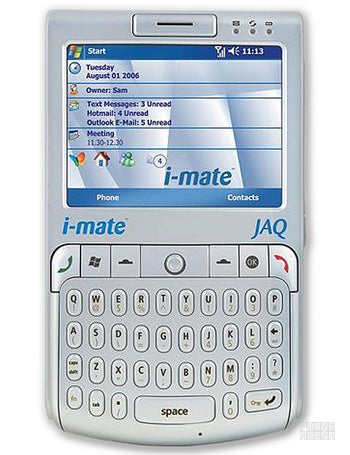
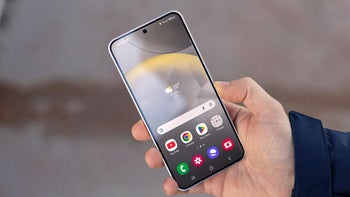
i-mate JAQ
Pros
No prosCons
- Lacks Wi-Fi
- Slow data means slow Internet browsing (EDGE)
- No rear camera
- Slow processor (200 MHz)
- It is so thick it needs a personal fitness trainer (0.86 inches inches)
- Resistive touchscreen technology means its display is less sensitive than you would like it to be
- Low pixel densitiy screen, below 180ppi (143 ppi)
- Too little RAM memory (64 MB RAM)
- Lacks microSD slot for storage expansion
- Lacks a standard (3.5mm) headphones jack
- Lacks an ambient light sensor for automatic screen brightness adjustment
- Lacks a proximity sensor that turns the display оff during a phone call
- No front-facing camera
- Lacks global positioning system (GPS)
Description
Links
i-mate JAQ Official pageDesign
- Device type:
- Smart phone
- OS:
- Windows Mobile Professional (5.0)
- Dimensions:
- 4.80 x 2.79 x 0.86 inches (122 x 71 x 22 mm)
- Weight:
- 5.64 oz (160 g)
the average is 4.4 oz (125 g)
- 5.64 oz (160 g)
Display
- Physical size:
- 2.8 inches
- Resolution:
- 320 x 240 pixels
- Pixel density:
Pixel density - The pixel density of a display represents the number of pixels over an area of one inch. It’s measured in “pixels per inch”, or ppi. The higher the number, the more detailed and good-looking the display is.
- 143 ppi
- Technology:
Technology - There are two main screen technologies currently used in phones and tablets: LCD and AMOLED. The former usually features a light source and liquid crystals, while the latter is based on organic light-emitting diodes. Newer LCD variations like IPS-LCD and Super-LCD allow for very accurate color reproduction and very wide viewing angles, where no significant image quality loss is observed. Current AMOLED screens differ in such a way that they can exhibit much more saturated colors (sometimes too much) and incredibly high contrast levels, which is due to black color being completely black in AMOLED displays.
- TFT
- Colors:
- 65 536
- Touchscreen:
- Resistive
Battery
- Talk time:
- 4.00 hours
the average is 10 h (615 min)
- 4.00 hours
- Stand-by time:
- 6.2 days (150 hours)
the average is 18 days (433 h)
- 6.2 days (150 hours)
- Capacity:
- 1440 mAh
Hardware
- System chip:
System chip - Most modern handsets use an advanced chip that includes many of the device’s hardware modules like the processor, Wi-Fi, Bluetooth and sometimes even the wireless radio. This field shows what particular system chip (or System-on-a-Chip) is used in the phone.
- TI OMAP850
- Processor:
Processor - The processor is the main computing component of a phone and is a major factor when it comes to the overall speed of the device. Some more powerful smartphones use dual-core and quad-core processors designed to deliver greater performance.
- Single core, 200 MHz
- System memory:
System memory - System memory, or RAM memory is the type of memory that the device uses to temporarily store data from the OS or currently-running apps. The more RAM available to the device, the better the performance will be when multiple or heavier programs are running.
- 64 MB RAM / 128 MB ROM
- Storage expansion:
- miniSD
Internet browsing
- Browser:
- Internet Explorer Mobile
Technology
- GSM:
- 850, 900, 1800, 1900 MHz
- Data:
- EDGE
Phone features
- Phonebook:
- Unlimited entries, Multiple numbers per contact, Picture ID, Ring ID
- Organizer:
- Calendar, Alarm, To-Do, Calculator, Notes
- Messaging:
- SMS, MMS (T9), Predictive text input
- E-mail:
- IMAP, POP3, SMTP
Connectivity
- Bluetooth:
- 1.2
- USB:
- Yes
- Other:
- Computer sync, Infrared
Other features
- Notifications:
- Service lights, Vibration, Phone profiles, Speakerphone
- Voice recording
To see the full specifications with in-depth details click here.
Despite our efforts to provide full and correct i-mate JAQ specifications, there is always a possibility of making a mistake. If you see any wrong or incomplete data, please LET US KNOW.
If you are interested in using our specs commercially, check out our Phone specs database licensing page.